


Imagine you’re at a casino and take $8 from your wallet and make a bet that results in winnings of $300. You then decide not to risk any of your original capital (the cash from your wallet) and only bet your $300 in winnings going forward. At that point, you are playing with house money or “free money.” Thus, you are not risking any of your original $8 that you speculated at the start in a random game of chance where the casino odds are against you.
In a recent letter responding to Chris Ram’s questions about whether the oil company’s annual reports comply with accounting standards, ExxonMobil Guyana CFO John A. Colling stated that “the Contractor Group needs to recover its up-front investment in developing Guyana’s oil resources, an investment that now exceeds US$40 billion.” The use of the word “up-front” seems to imply that Exxon and its partners invested US$40 billion of their own money upfront.
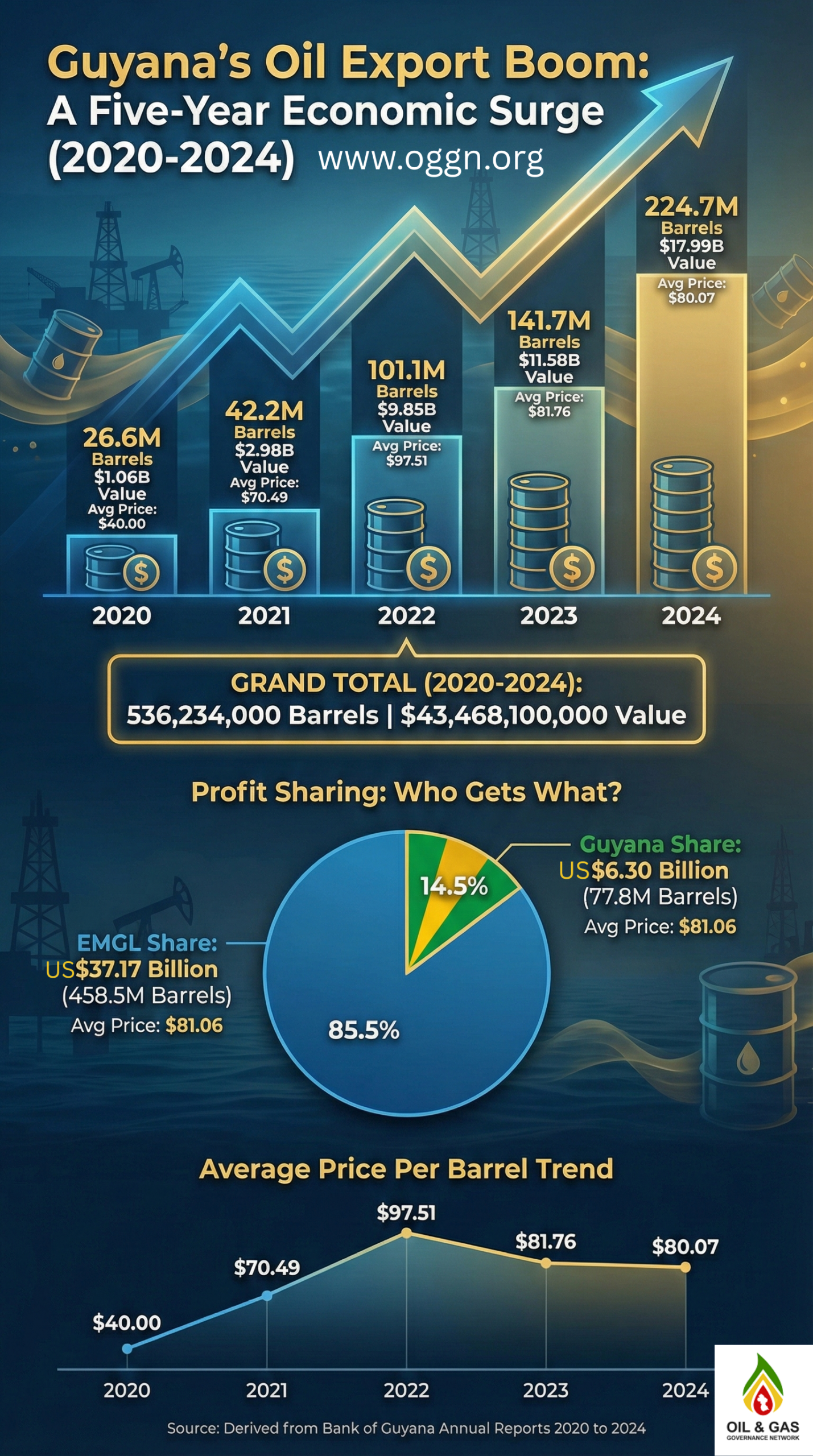
However, an examination of the oil companies’ financials since oil production began reveals that the money actually invested by the companies themselves into ExxonMobil Guyana and Hess Guyana totaled approximately US$8.1 billion. Additionally, examining the liabilities section of their balance sheets shows they do not come close to accounting for the more than US$32 billion (US$40B – US$8.1B) investment gap. Therefore, it is likely that the majority of this more than US$32 billion difference is being made up with the US$29 billion in pre-tax profits that the oil companies have earned since oil extraction began in December 2019.
Furthermore, in the ExxonMobil Guyana financials, there is a line item called “Distributions to head office”—in other words, ExxonMobil Guyana making payments to its parent company. In 2024, ExxonMobil Guyana made a distribution of US$3.2 billion to its parent, which reduced its remaining original investment to US$2 billion at the end of 2024. Hess Guyana has distributed almost all of its US$2.9 billion investment back to its parent company, leaving only US$304 million. If the same distribution pattern continues into 2025, then it is likely that by now the original US$8.1 billion that was invested has been fully recovered by the parent oil companies.
In other words, the oil companies are now playing with “free money”—just like the casino example.
But unlike gambling at a casino where the odds are against you, there is very little risk of the oil companies losing any of this “free money” as they keep re-investing these profits to the tune of billions of US dollars in new projects toward their goal of extracting 1.3 million barrels of oil per day.
At the end of his letter, the ExxonMobil Guyana CFO stated that he is committed to transparency and fact-based discussions. Editor, through your newspaper, we ask Mr Colling to answer the following questions:
1. At the time of his July 2, 2025 letter, how much of the US$40 billion in investment mentioned were funds injected into ExxonMobil Guyana by its parent company, Exxon?
2. For the three projects that are online—Liza 1 (US$3.5B capital cost), Liza 2 (US$6B capital cost), and Payara (US$9 billion capital cost)—how much of the capital costs for each of these projects have been paid off from cost oil?
3. For the 6 approved projects, how much has been paid for, and how much is still owing?
4. For the 6 approved projects, please disclose the schedule of payments – which of the capital costs have been paid off, and how much is still outstanding?
Yours faithfully,
Alfred Bhulai
Andre Brandli
Janette Bulkan
Kenrick Hunte
Darsh Khusial
Mike Persaud
On behalf of www.oggn.org/about a 501(c)(3)