ExxonMobil has concentrated on its ‘golden lane’ of wells drilled in the southeastern part of the huge Stabroek Tract (Block) concession, now of 2.68 million hectares. Exxon has also had a brief look at deeper concessions (Kaieteur Tract) and shallower areas (Canje Tract, formerly part of the original Stabroek Tract of 600 graticular blocks in 1999, totalling about 5.13 million ha).
Petroleum companies have bought into, and sold out of, other offshore oil concessions in Guyana’s EEZ since the 1980s. In most countries, anyone who buys and sells shares in a publicly-owned company will pay a capital gains tax if a sale in profitable, and will be able to carry forward a tax loss if the sale is not profitable. It is not clear if the petroleum companies (or holders of the petroleum offshore tracts) paid any capital gains tax to Guyana on these transactions. We will summarise the signature bonuses, annual rents, royalty rates and profit share, and then look at the history of the ‘farming-into’ and ‘farming-out’ from some of the concessions. There is very little public information on the costs of ‘farming-in’ or on taxation by Guyana of the income from ‘farming-out’ transactions.
We will summarise the changes in ownership of the offshore oil concessions so far as we can find out. The summaries in total are too much for any one newspaper column so we will take them in alphabetical order of the names of the concessions, from Canje to Roraima. We start with Canje, a relatively simple story, covered in part by the series ‘The Fleecing of Guyana’ in Kaieteur News in October-November 2021.
The Canje Tract (block) was created from part of the areas relinquished by Esso Exploration & Production Guyana Ltd. (EEPGL) from the original area of over 5 million hectares (600 graticular blocks of about 8,550 hectares) during or before 2013. The oil exploration company Mid-Atlantic Gas & Oil approached the PPP/C government under then-President Donald Ramotar, but discussion stalled for two years because of the threat by Venezuela to Guyana’s sovereignty over its EEZ. The Guyanese-registered Mid-Atlantic was launched by Hewley Nelson and Nicholas Chuck-A-Sang. A petroleum prospection licence was issued administratively (that is, without open bidding) to Mid-Atlantic (by then with sole shareholder Edris Kamal Dookie, having prior experience of shallow-midwater oil exploration with CGX). The license was issued on 04 March 2015 when Robert Persaud was Minister for Natural Resources and the licence was signed by the President as Minister for Petroleum. The licence covered 0.61 million ha in deep water (1700-3000 metres, well beyond the experience of CGX). The Canje Tract lies against the north eastern part of the Stabroek Tract operated by Exxon Mobil Guyana Ltd. (EMGL).


Two months later, on 04 May 2015, the Canadian exploration company JHI Associates Inc. (founded in Toronto in 2011) was registered as JHI in Guyana and ‘farmed into’ the Canje licence with a 17.5% share on 15 May. However, JHI had ‘pre-farmed into’ Mid-Atlantic a year earlier, before the Canje licence had been issued. JHI Associates were incorporated in the British Virgin Islands on 10 June 2015.
Neither Mid-Atlantic or JHI Associates had the knowledge, experience or working capital to make use of the licence. In February 2016, EEPGL also ‘farmed into’ the Canje Tract, taking a 35% share and becoming the operator. The whole 0.61 Mha were covered by a 3-D seismic survey commissioned by Exxon while Exxon was developing the nearby Liza-1 field in the Stabroek Tract. Exxon already had 2-D seismic data collected before the earlier relinquishment.
The French company Total SA (now TotalEnergies E&P Guyana B.V.), already involved in other areas in Guyana‘s EEZ, ‘farmed-into’ the Canje Tract in February 2018, also taking a 35% share. In August 2018, Dr Jan Mangal asked: “A question: Is/was Sir Shridath Ramphal an adviser to JHI or Mid-Atlantic (who are now Joint Venture partners with Exxon and Total in the Canje Block offshore Guyana)? Is/was he associated with any oil company in Guyana? If so, did he disclose this to Cabinet or the Ministry of Foreign Affairs, and when?” No answer was forthcoming, then or since.
In March 2022, Eco-Atlantic Oil & Gas (listed in London and Toronto) purchased all of JHI Associates (BVI) Inc. for USD 52 million, as 127 million new shares in Eco-Atlantic for JHI stockholders, resulting in them holding 34% of Eco-Atlantic’s stock. A year earlier, in January 2021, Eco-Atlantic had purchased 10% of JHI Associates Inc.
Three wells have been perforated for Exxon by Stena drillships in the Canje Tract. Bulletwood-1 was drilled through most of 2021, finding some oil at well depth 6690 metres under 2846 metres of water. The possible 0.5 billion barrels of oil were assessed as non-commercial. Jabillo-1 was drilled in mid-2021 to well depth 6475 metres in 2904 metres of water but the well was dry, no oil. Sapote-1 was drilled in late 2021 to well depth 7658 metres in 2549 metres of water, some oil but non-commercial. The wells did confirm that the geology is somewhat similar to the Golden Lane in the nearby Stabroek Tract: Turonian (late Cretaceous) lower slope and bottom fans and turbidites but deeper than in the Golden Lane. Further drilling, of 12 wells, was proposed by EEPGL in late 2021 but none have happened by early 2026.
Under the terms of the licence, area was relinquished in 2019, leaving the Canje Tract now with an area of 0.48 Mha.
The non-competitive pre-election award in 2015 of the potentially very valuable Canje Tract was investigated for corruption by the State Asset Recovery Agency (SARA) from May 2019. The investigation was stopped and SARA was closed in October 2020 after the PPP/C government resumed office in August 2020 [CBC News by journalist Chris Arsenault 21Dec2021 and 09Jan2022).
The petroleum concession licence for the Canje Tract expired on 04 March 2026. This seems to indicate that Exxon has determined from intensive seismic surveys and exploratory drilling that the Golden Lane of petroleum discoveries does not extend into deeper water and deeper rocks to the northeast of the Stabroek Tract.
As at the beginning of 2026, the ownership of the Canje licence was –
EMGL 35% and oil field operator, Total Energies E&P Guyana B.V. 35%, Eco-Atlantic Oil & Gas 17.5%, and Mid-Atlantic Gas & Oil Ltd. 12.5%. No details have been published about who paid what for the ‘farm-ins’ to the Canje licence. As noted in the table above, no signing bonus was paid, no area rent has been paid. With no commercial oil yet produced, the 1% royalty has not been collected nor the 50/50 profit split. This potentially valuable oil field was essentially privatized in 2015 and Guyana does not seem to have earned any income by way of taxes or other cash income in the subsequent 11 years from the farm-ins. It is clear that taxation is complex for such transactions, especially when the deals are done not in cash but by way of share issues. However, what seems to have been a lack of attention to these transactions on the parts of the Guyana Revenue Authority and the Ministry of Natural Resources parallels the failures to conclude the four audits of the consortium led by EMGL for the Stabroek Tract. We are not talking about a few missing bags of rice, these matters involve tens and hundreds of millions of US dollars.
Guyana, having neither a State-owned oil company to take shares in these ventures nor a Petroleum Commission to manage the national petroleum resource technically on behalf of the nation, has been little more than a bystander or onlooker to these inter-company transactions.
Why are these summaries important, on the buying and selling of Guyana’s petroleum resources? Because they are another illustration of the ways by which the monetary value of Guyana’s natural resources is escaping from our country because either the system (tax laws on capital gains) is too feeble or the tax laws are not being properly applied. And we can see from the small number of exploratory wells which have been drilled, and in some cases the legal minimum number of wells has not been drilled even after repeated extensions in time, that there is evidence of inexperienced and under-capitalised entrepreneurs becoming the holders of the petroleum concessions. We can see this even in the concessions issued through the 2022 licensing round.
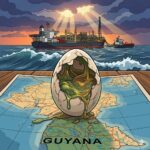
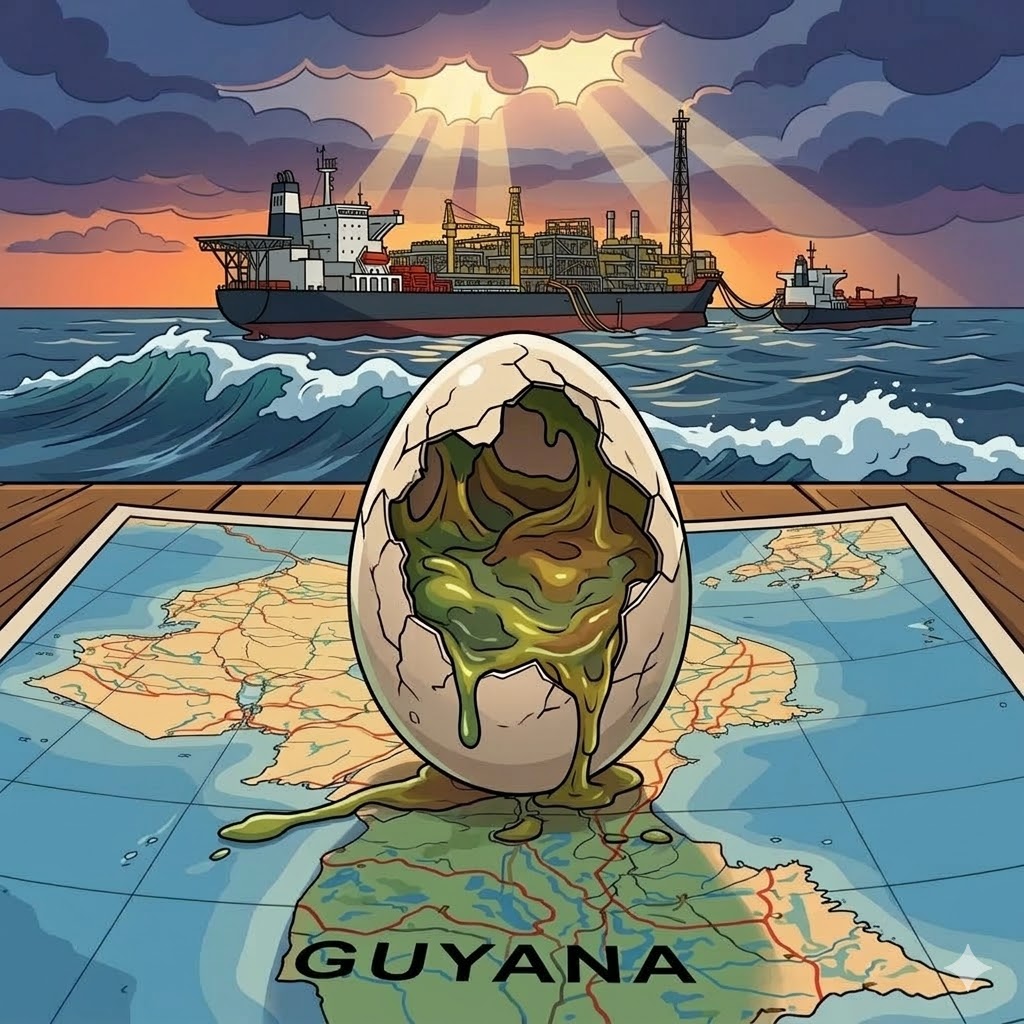
What does Guyana gain from the buying and selling of petroleum concessions? A big fat gander egg