


By Anthony Paul, Senior Energy and Strategy Advisor and former Director of Geology and Geophysics at the Trinidad and Tobago Ministry of Energy.
Throughout this series, my intention has been to support the continued strengthening of policy thinking around gas production and development. Sound policy, however, cannot be designed in abstraction. It must be rooted in the technical and commercial realities of the resource itself.
Regulators and policymakers do not need to become reservoir engineers or portfolio managers, but they must understand enough of the underlying mechanics to ask the right questions, recognise where value may be created or lost, and design frameworks that can actually be implemented.
No policy is worth its salt if it cannot withstand the discipline of execution – and implementation, in the gas industry especially, reinforces the need for solid technical grounding. This instalment therefore moves deliberately away from the institutional discussion and into the technical terrain, to illustrate why a working understanding of gas reservoir behaviour and commercial sequencing is so critically important in shaping outcomes for emerging producers.
Gas is frequently described in public discourse as a “bridge fuel,” a transition resource, or a by-product of oil development. In subsurface reality, it is none of those simplifications. It is a compressible fluid governed by pressure decline, reservoir energy, permeability architecture and fluid contacts that behave very differently from oil-dominated systems. The way it is produced – the rate, the sequencing, the pressure management strategy – materially influences ultimate recovery, project economics, and national value capture.
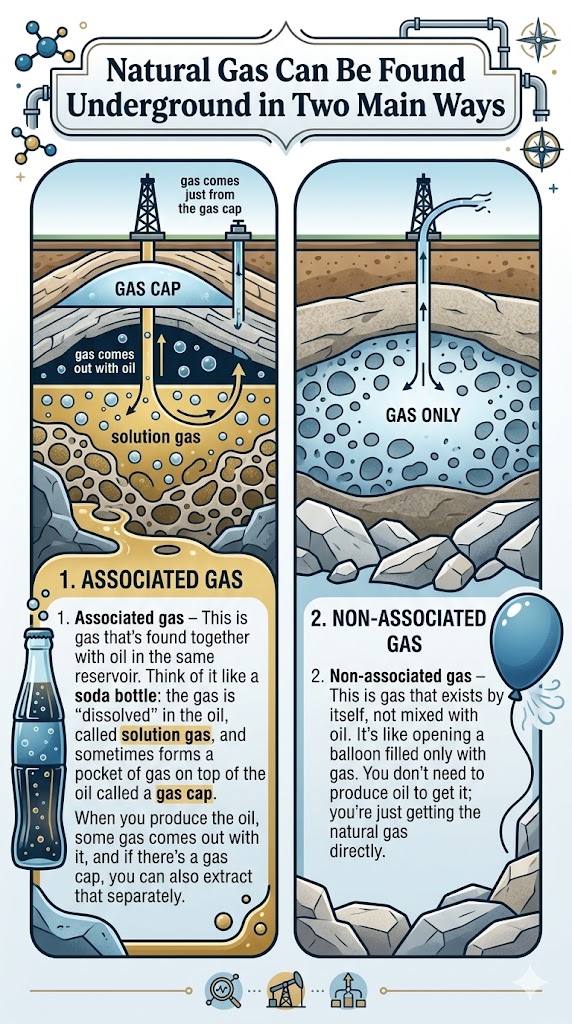
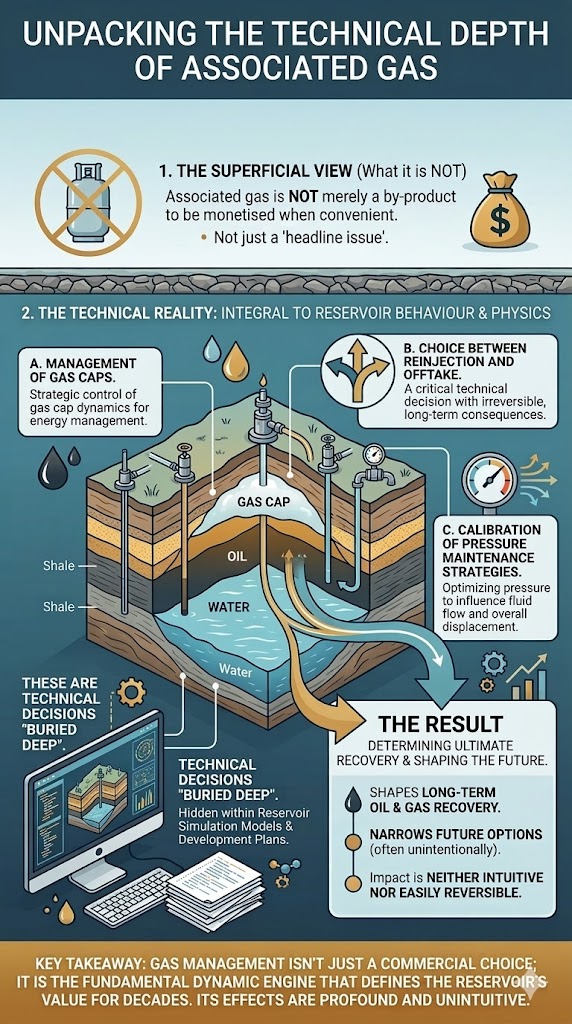
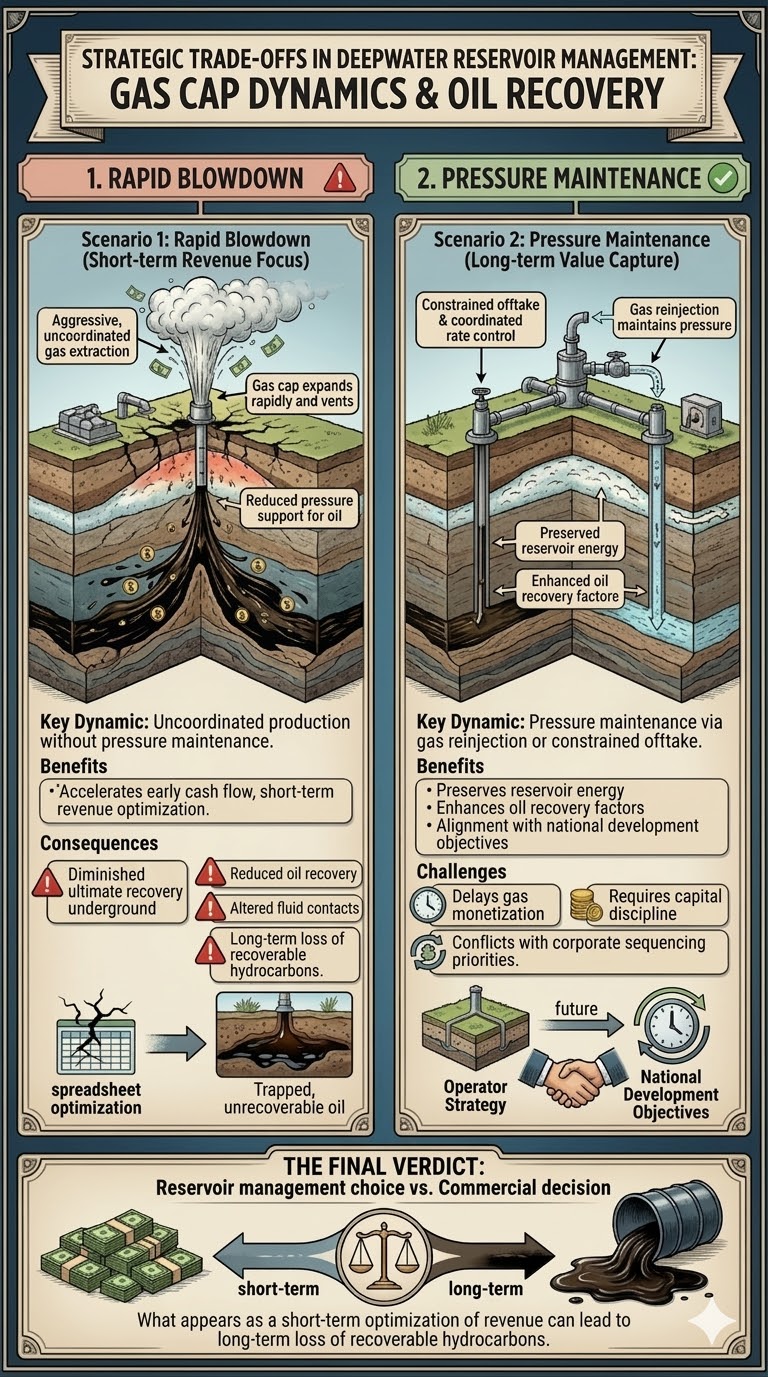
Consider first the dynamics of a gas cap in an oil reservoir. In many deepwater systems, particularly those where associated gas is present above an oil column within the same reservoir body, production strategy is not merely a commercial decision but a reservoir management choice. Rapid blowdown of the gas cap can accelerate early cash flow, but it alters pressure support within the reservoir. If gas is produced aggressively without coordinated pressure maintenance – whether through reinjection or disciplined rate control – the consequences can include reduced oil recovery, altered fluid contacts, and long-term loss of recoverable hydrocarbons. What appears, on a spreadsheet, as an optimisation of short-term revenue can translate underground into diminished ultimate recovery.
The alternative, pressure maintenance through gas reinjection or constrained offtake, may preserve reservoir energy and enhance oil recovery factors. But this approach requires capital discipline, infrastructure planning, and alignment between operator portfolio strategy and national development objectives. Reinjection delays gas monetisation. It may conflict with corporate sequencing priorities if the operator holds multiple gas assets globally and allocates capital based on comparative returns across its portfolio.
It is important to recognise that reservoir management choices are rarely linear in their effects. Measures designed to preserve long-term recovery – such as gas reinjection to maintain pressure – can themselves introduce operational trade-offs. Reinjection may increase gas–oil ratios over time, raise compression and separation costs, and require additional injector wells. In complex reservoirs, early gas breakthrough or channeling can affect near-wellbore performance and alter production profiles.
Similarly, in condensate-rich non-associated gas reservoirs, pressure maintenance is often essential to prevent retrograde condensation that can impair liquid recovery. In such cases, commercial gas production may be deferred for many years while condensate extraction is prioritised.
What appears externally as a delay in monetisation may, in fact, reflect reservoir physics rather than commercial reluctance. Associated gas co-development may reduce reinjection costs and flaring exposure, yet it can also introduce trade-offs between enhanced oil recovery strategies and early gas revenue. Each pathway carries cost, recovery, and timing implications that must be evaluated holistically rather than in isolation.
This is where technical geology intersects commercial strategy. Multinational operators manage global portfolios. A gas field in one country competes internally with LNG expansions elsewhere, brownfield optimisations in mature basins, or new deepwater developments in other provinces. The decision to accelerate production, defer infrastructure, prioritise reinjection, or sequence developments in a particular order is rarely driven solely by reservoir considerations. It is influenced by balance sheet constraints, shareholder expectations, geopolitical exposure, and internal capital allocation frameworks.
For policymakers, this is not a criticism of operators; it is a structural reality. But it has implications. If portfolio sequencing decisions influence production profiles, and production profiles influence reservoir performance, then national revenue trajectories are indirectly shaped by corporate capital allocation strategies. Without technical literacy at the regulatory level, these interactions can pass unnoticed.
Gas reservoir behaviour compounds this complexity. Unlike oil, gas expansion is highly sensitive to pressure decline. In dry gas reservoirs, early high-rate production can lead to rapid pressure depletion, affecting deliverability over time. Recovery factors in gas systems are often high relative to oil, but they are not immune to suboptimal rate management. Over-aggressive drawdown can compromise long-term plateau stability, alter condensate dropout behaviour in retrograde systems, and increase surface handling challenges.
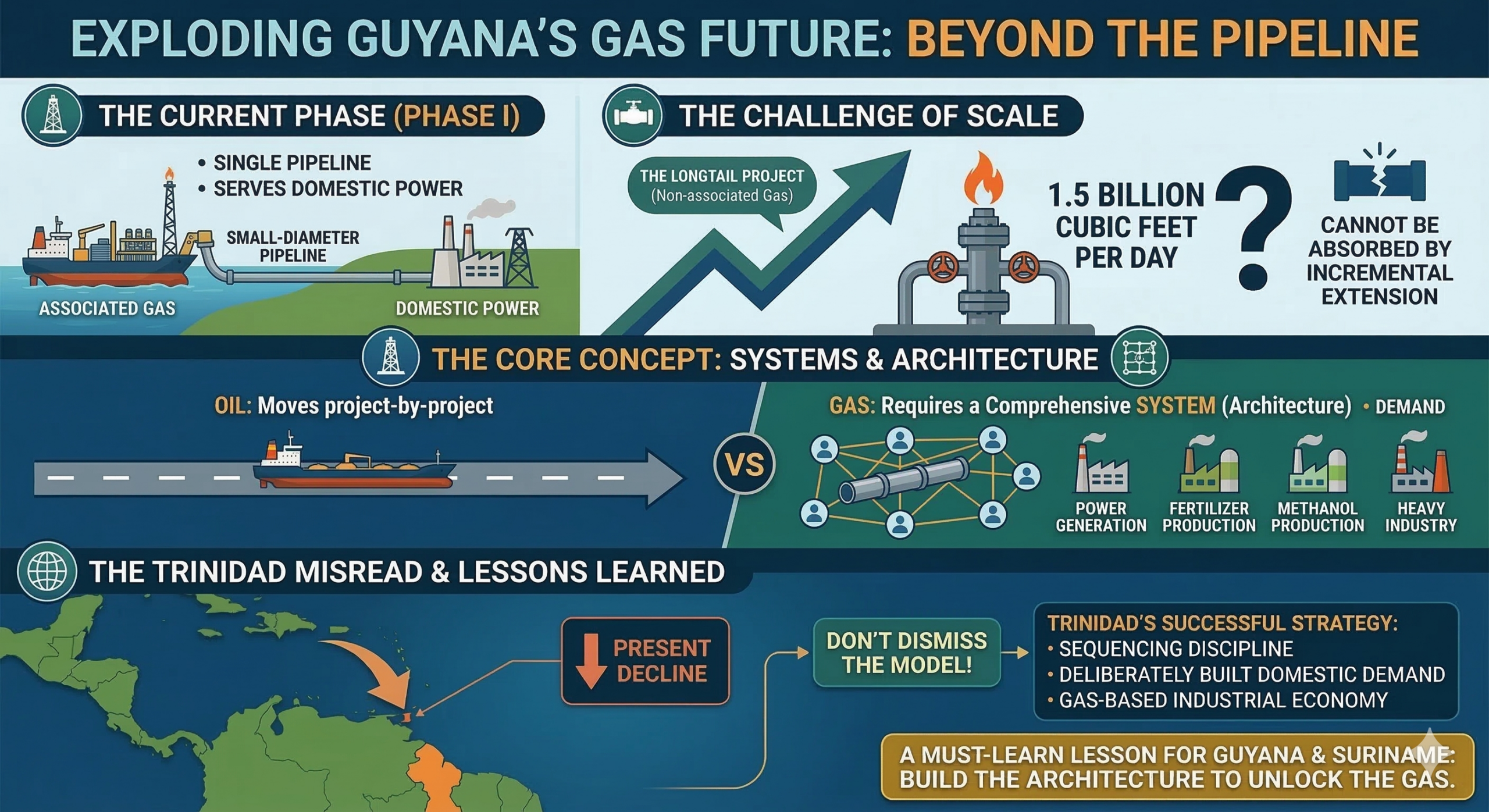
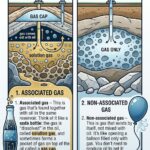
In associated gas systems, the trade-off is even more delicate. Oil optimisation and gas monetisation do not always align temporally. Accelerating gas sales to meet domestic power demand or to justify pipeline infrastructure may conflict with an oil-focused pressure management strategy. Conversely, deferring gas development to protect oil recovery may delay domestic industrial ambitions.
These are not abstract engineering debates. They shape electricity pricing, industrial policy, fiscal stability and sovereign revenue. If gas is committed under long-term contracts at a moment of global oversupply, the pricing consequences may persist for decades. If infrastructure is oversized relative to sustainable reservoir deliverability, fixed costs can burden the domestic economy long after initial optimism fades.
The lesson, drawn from past gas provinces, is not that development should be slowed or that caution should paralyse action. It is that technical discipline must underpin policy ambition. Infrastructure expansion without reservoir alignment creates systemic risk. Fiscal models built on optimistic plateau assumptions can unravel if reservoir performance diverges from early forecasts. Domestic market obligations, if misaligned with field productivity, can distort upstream incentives.
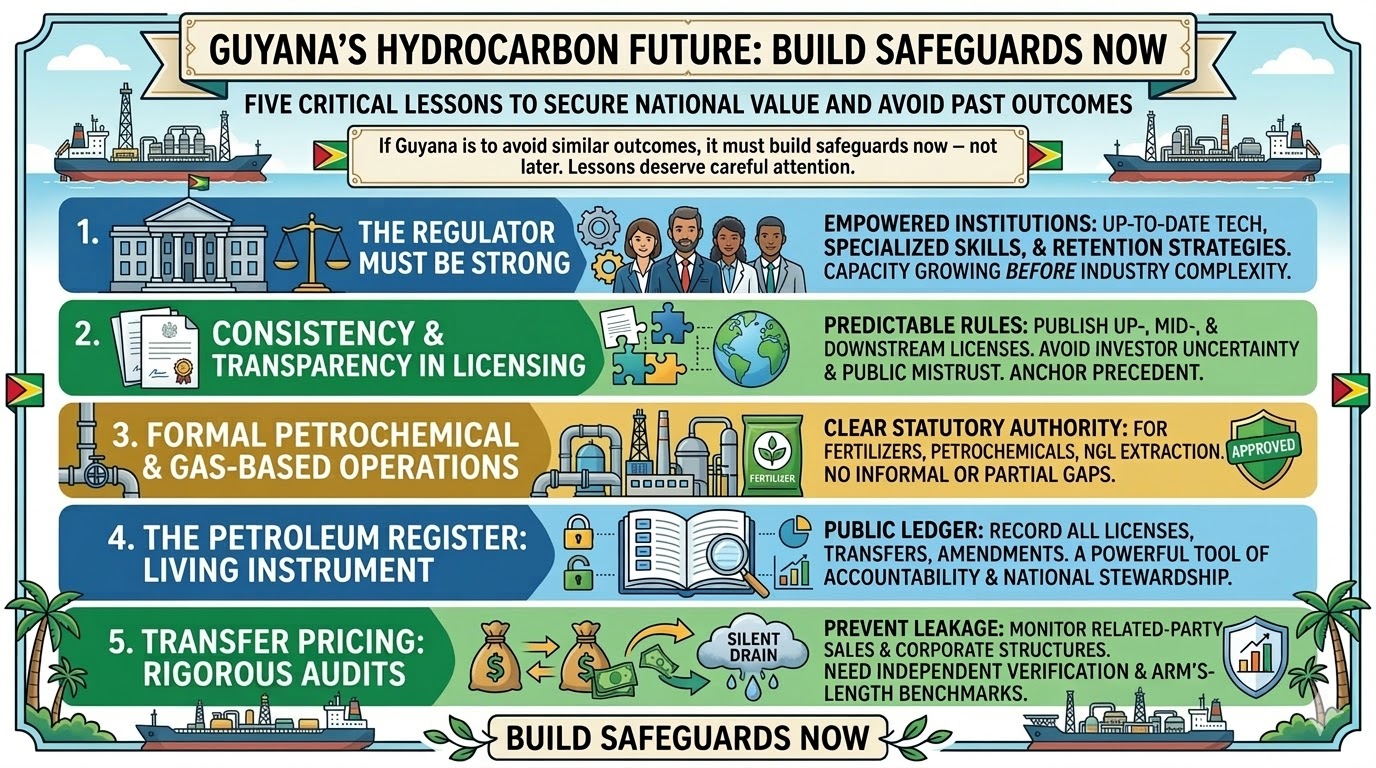
Transparency remains essential, but transparency alone does not guarantee optimal outcomes. Public disclosure of contracts is valuable; understanding how production strategy interacts with those contracts is equally so. The governance challenge for emerging gas producers lies in bridging this gap — ensuring that policy frameworks are informed by a sufficiently deep grasp of reservoir physics and commercial sequencing to anticipate where value might be gained or quietly lost.
Gas does not destroy value dramatically. It erodes gradually – through marginal recovery losses, suboptimal sequencing, pricing rigidity, or infrastructure mismatches. Each decision may appear rational in isolation. The aggregate effect may only become visible years later, when decline sets in and policy space narrows.
It is worth acknowledging that several of the deeper technical considerations referenced here have been articulated in detail in LinkedIn analyses by Les Anthony (e.g. https://lnkd.in/e4bEZweU) . Drawing on publicly available production data made possible through transparency initiatives, he has demonstrated how reinjection strategy, gas–oil ratio trends, condensate dynamics and sequencing considerations in associated versus non-associated systems can be identified, examined and in some cases quantified. That capacity to interrogate technical performance through disclosed data reinforces the importance of transparency not merely as a governance principle, but as a practical tool for safeguarding national value.
This is why the conversation must move beyond institutional design into technical comprehension. Policymakers need not calculate permeability coefficients or simulate reservoir models. But they must understand the consequences of blowdown versus pressure maintenance, of accelerated offtake versus reinjection, of portfolio-driven sequencing versus resource-driven optimisation. Only then can policy frameworks be calibrated to align corporate incentives with national objectives.
The central point is straightforward: gas development is not merely a commercial opportunity; it is a systems engineering challenge embedded within national governance. Where technical literacy informs policy, countries retain strategic control over timing, recovery and value capture. Where it does not, outcomes are shaped elsewhere — not by malice, but by momentum.
The future of emerging gas provinces will depend less on the size of their discoveries and more on the discipline with which they are managed. And discipline, in this context, begins with understanding.