

Thanks are extended to Mr. Phillip Rietema, Vice President and Business Services Manager of ExxonMobil Guyana Limited (EMGL), who made two important statements about the performance of the Oil company in Guyana. In the first statement published in Kaieteur News (https://www.kaieteurnewsonline.com/2024/07/02/exxons-guyana-operations-secure-with-us40-per-barrel-breakeven-point-phillip-rietema-vice-president-of-emgl/), it is reported that Mr. Rietema said that oil prices, ‘…went (down) from US$100 to US$80.
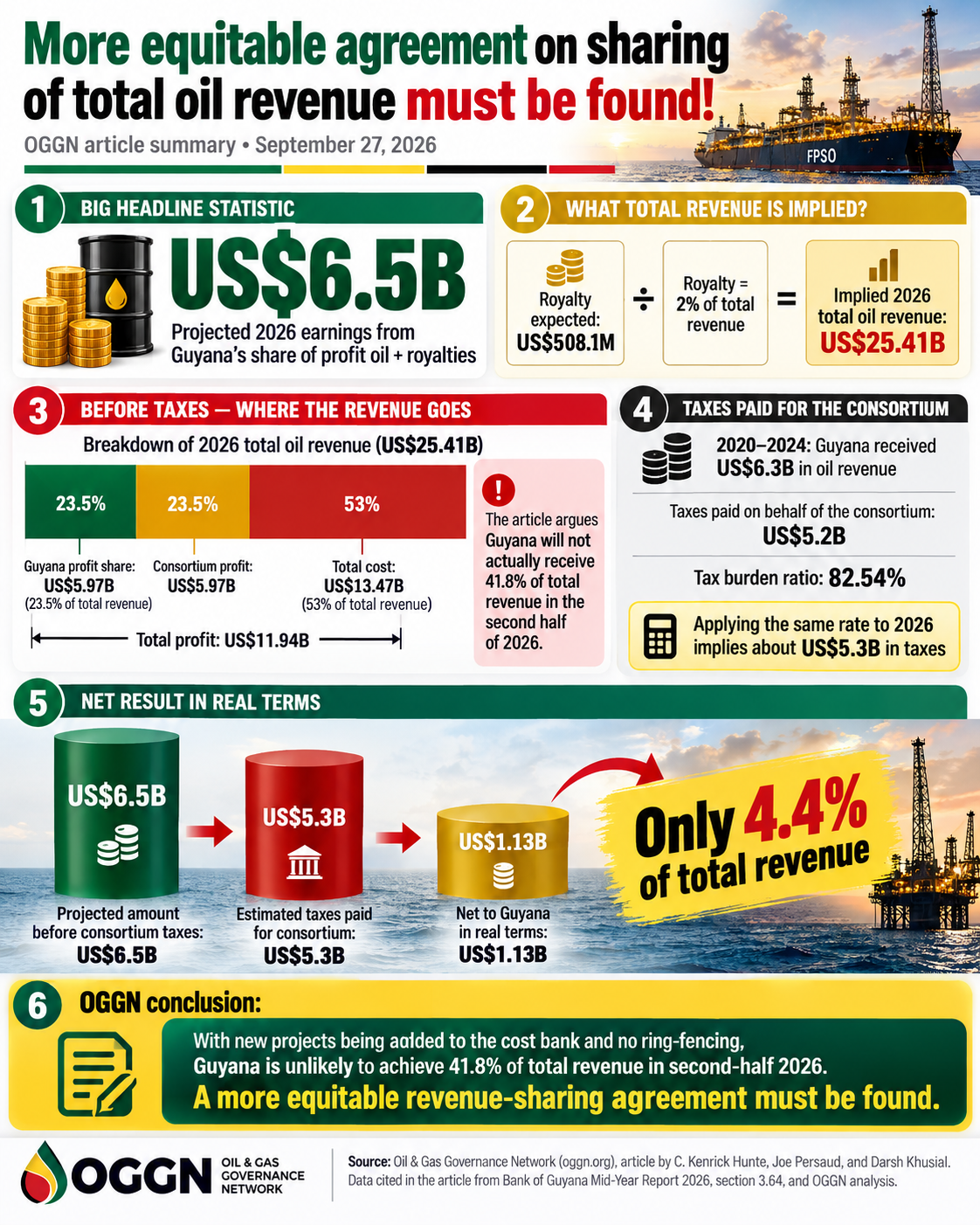
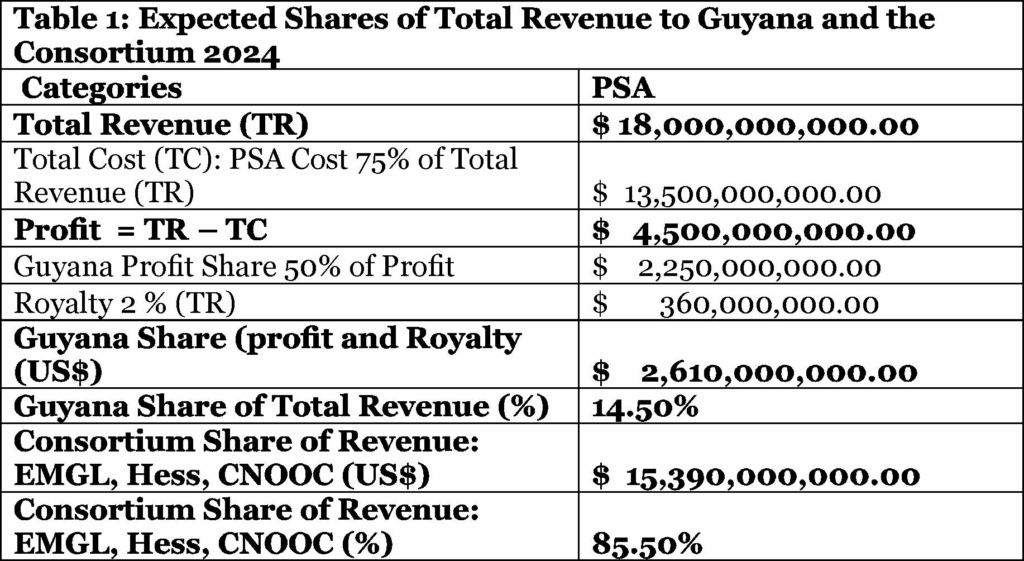
In 2020, it was down to US$40. So these projects, they all have costs of supply under $40 a barrel…’. This information by Mr. Rietema supports the idea that Guyana is a low cost producer; and confirms that this low production cost is observed in the published consolidated 2023 financial statements for the consortium of the three companies (EMGL, Hess and CNOOC), where the average cost of a barrel of oil was estimated at US$34.97 (KN:https://www.kaieteurnewsonline.com/2024/07/01/is-there-a-shortfall-in-royalty-and-profits-in-2023/). In the second statement, it is reported that Mr. Rietema noted that “At current prices, … the revenue generated is over 1.5 billion US dollars a month currently,” (KN.https://www.kaieteurnewsonline.com/2024/07/03/guyanas-oil-generating-us1-5b-a-month-from-three-projects-exxons-vice-president/),forecastinga total of US$18.0 billion in revenue for 2024. Consequently, Guyana’s share in keeping with the Production Sharing Agreement (PSA) at 14.5 percent of total revenue (TR) is US$2.61 billion, distributed as royalty equal to US$360.0 million(2% of TR); and profit equal to US$2.25 billion(12.5% of TR). The share of total revenue projected to be earned by the consortium is US$15.39 billion or 85.5 percent of total revenue (Table1).
However, this PSA calculation is not the methodology that should be employed to measure Guyana’s share of total revenue; instead, Guyana’s share of revenue must be constructed on the cost of a barrel of oil at US$40.00, as announced by Mr. Rietema, who has access to accurate information. Now, assuming that an average price of a barrel of oil is US$80.00 as it was in 2023 (https://www.eia.gov/todayinenergy/detail.php?id=61142)and the projected total revenue is US$18.0 billion, this implies that 225 million barrels of oil (US$18.0 billion/ US$80.00 per barrel) will be sold in 2024. Given that the cost of producing a barrel of oil is US$40.00 or lower, it can therefore be derived that profits will be higher than the PSA 75 percent cost method. For example, the total cost (TC) of producing 225 million barrels of oil is US$9.0 billion, assuming an average cost of US$40.00 per barrel, as indicated by Mr. Rietema. Since total revenue is US$18.0 billion and total cost is US$9.0 billion, this implies that profits will be US$9.0 billion (Profit = TR – TC = US$18.0 billion-US$9.0 billion = US$9.0 billion). Therefore, Guyana profit share at 50 percent of US$9.0 billion is US$4.5 billion; and this amount is larger than the profit share under the PSA model by US$2.25billion (Table 2).Additionally, applying the cost of a barrel of oil at US$40.00, Guyana’s share of total revenue increases from US$ 2.61 billion to US$4.86 billion, signaling an increase in the share of total revenue to 27 percent, compared with the 14.5 percent under the PSA. Consequently, this is a much better deal for Guyana; and policymakers need to use Mr. Rietema’s cost of production methodology that generated the US$40.00 per barrel; instead of the PSA method in which the average cost of a barrel of oil (ACBO) is specified as ACBO = 0.75 (Price) = 0.75 (US$80.00) = US$60.00.This shows that ACBO in the PSA is US$20.00 higher than it should be (US$60-US$40.00 = US$20.00); and it is being used to fund other activities, due to no ring-fencing; and as such, it reduces Guyana profit share by at least US$10.00 for every barrel of oil sold.
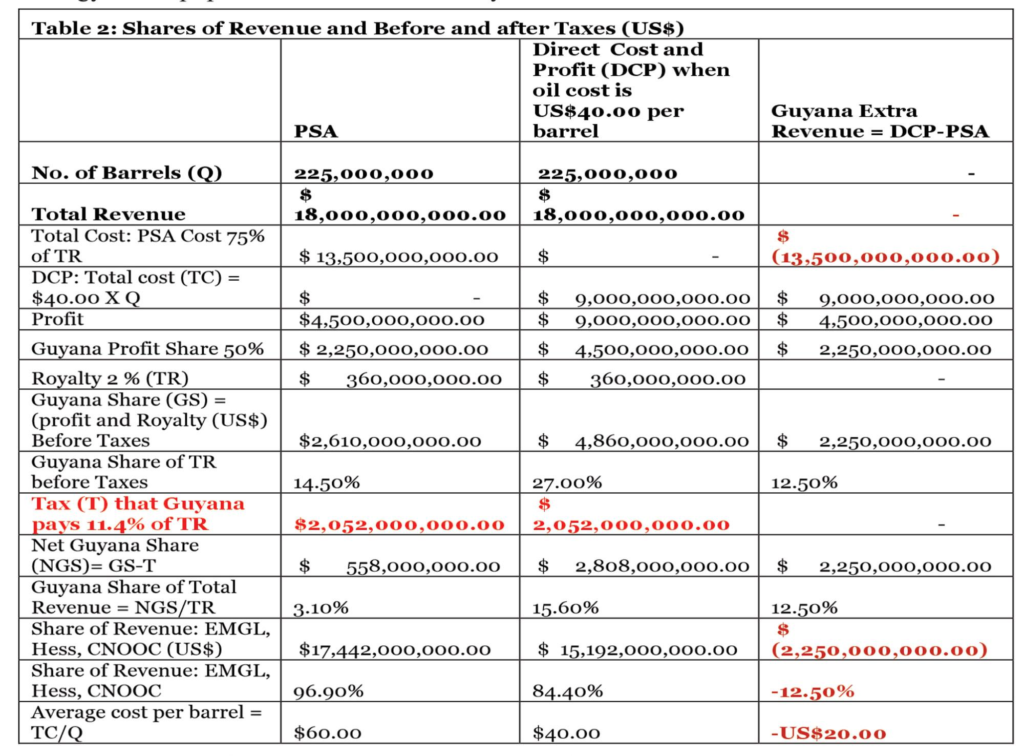
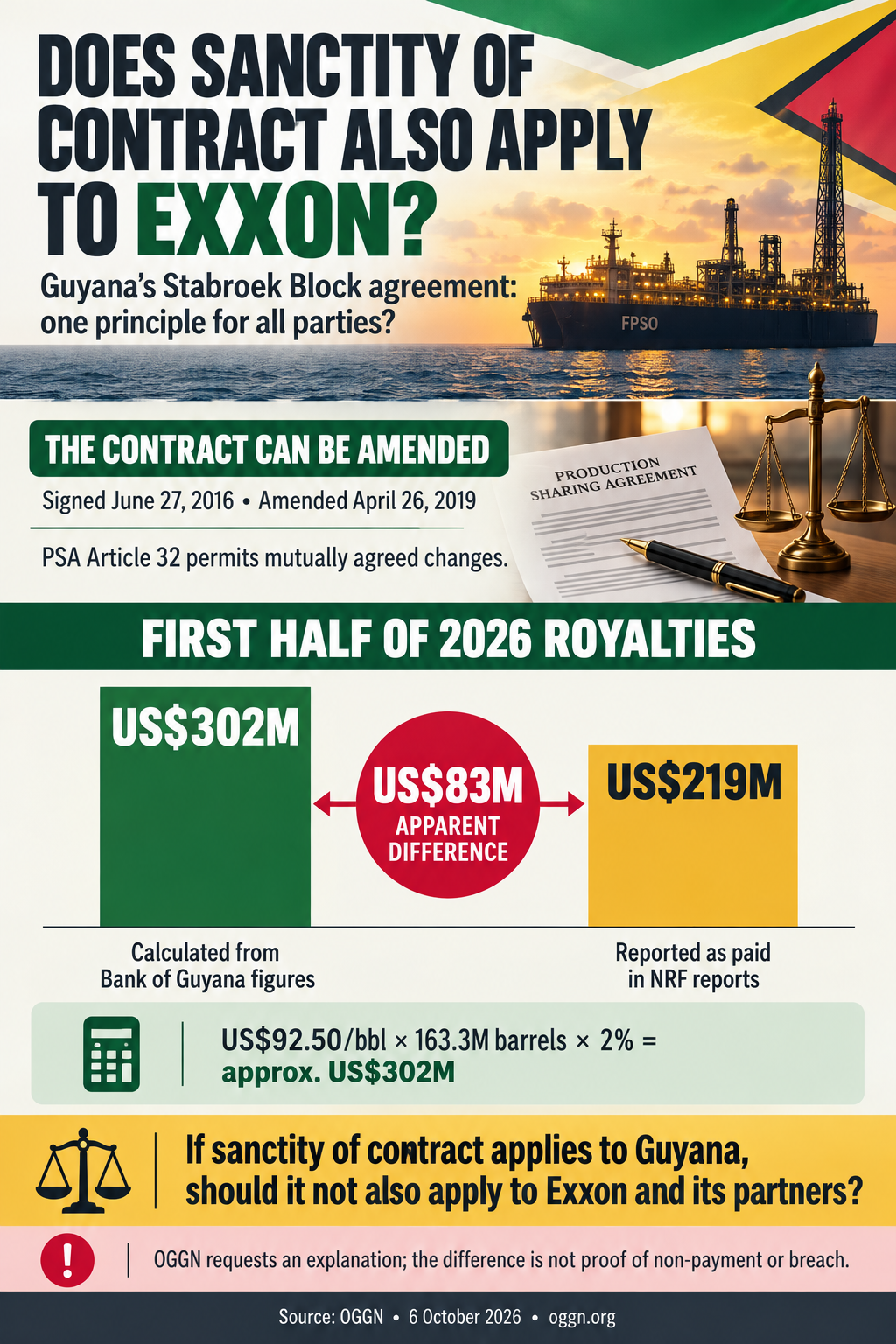
Equally troubling is the notion that Guyana pays the taxes for the consortium from its share of its oil revenue (PSA, Article 15.4). And not surprisingly, this expected fake tax payment of US$2.052 billion will be more than five times the expected royalty (US$360.0 million) to be collected in 2024, given the 2023 tax rate of 11.4 percent of total revenue. Undoubtedly, this outcome of the taxes (US$2.052 billion) paid by the government being large than the royalty (US$360.0 million)is a clear signal of a lopsided contract, for as more projects come stream to exhaust the known 11 billion barrels of oil, along with no ring-fencing, and Guyana paying the taxes of the consortium, with the average cost of a barrel of oil being tied to the price of barrel of oil, Guyana’s share of revenue will not substantially increase, if at all. Consequently, collecting a fair share of total revenue must occur when production is expanding; and that time is now. In contrast, to do so when output is falling in the declining years of production is irrational behavior. Incidentally, it reported that oil production will be around for at least twenty years. While this may be so, may I remind Guyanese that the oil in some wells will be exhausted long before that time and no extra revenue will be obtained from those early projects, given no ring-fencing. For example, it is reported that Liza 1 has a profitable supply of 450 million barrels of oil and its official extraction rate is 120,000 per day, yielding an annual production of 43.8 million barrels per year. Therefore, the profitable life of Liza 1 is 10.27 years (450 million/43.8 million) And since the consortium has ramped up production beyond the safety limit of 120,000 barrels per day, the life of the project will be less than 10 years; and this can be done with the other projects as well. Hence, getting our fair share of revenue today is in our best interest, for a dollar today is worth more than a dollar tomorrow, especially when there are tremendous uncertainties in the oil sector. So, wake up Guyana before our oil, one of our non-renewable resources, is exhausted; for the time to obtain a fair share is now!
Dr. C. Kenrick Hunte
Professor and Former Ambassador