

Guyanese citizens pay taxes and expect everyone to pay their fair share. Tax revenue funds essential services, including the salaries of customs officers who verify foreign oil workers’ identities, and pensions for seniors. Given this context, it is troubling that oil companies pay no taxes on their profits.
According to the Bank of Guyana, personal income taxes collected in 2024 totaled US$370 million (GY$77.149 billion). Meanwhile, examining the 2024 financials reveals that oil companies avoided paying US$2.4 billion in taxes. To put this in perspective, before oil production began, the country’s entire annual budget was less than US$2 billion. How can it be reasonable for wealthy foreign companies to avoid billions in taxes while Guyanese employees, who barely earn decent wages, fund the government?
The disparity is stark: for every dollar in taxes paid by Guyanese employees in 2024, oil companies avoided paying $6.49 in taxes.
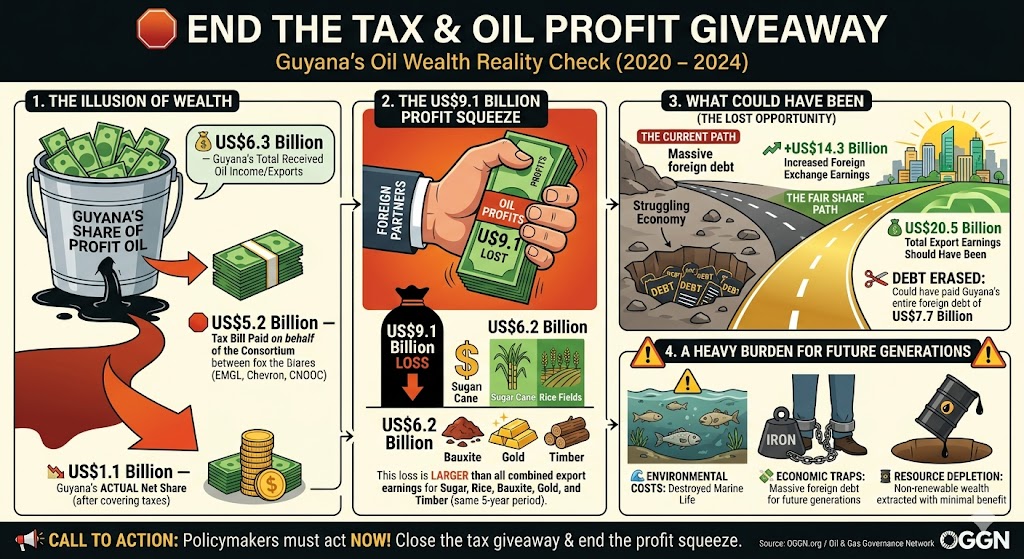
In 2024, the Bank of Guyana reported collecting US$2.0 billion in total tax revenue. However, oil companies avoided paying US$2.4 billion in taxes that same year (see chart below). Even more concerning, the total unpaid taxes by oil companies from 2020 to 2024 amounts to US$5.2 billion, while Guyana’s oil income over this period was approximately US$6.3 billion.
The tax arrangement between the Government of Guyana and the oil companies as specified in the 2016 Petroleum Agreement stipulates that Guyana pays the taxes owed by the oil companies out of its share of the oil revenues. Article 15.4(b) and 15.5 of the agreement describes the procedure that should be followed by the Minister of Natural Resources to pay for the taxes owed by the oil companies. A detailed flow diagram is available here: https://www.oggn.org/2024/01/09/payment-of-tax-under-article-15-4-b-and-15-5-of-the-petroleum-agreement/.
The chart shows that these tax exemptions the Government of Guyana grants to oil companies each year nearly equal the country’s annual oil income. The data reveals what appears to be a 10-fold increase in oil company taxes covered by Guyana over the last 4 years, suggesting that the 1 to 6.49 disparity between employee tax payments and oil company tax avoidance will likely grow even larger in 2025.
The OECD/G20 Inclusive Framework on Base Erosion and Profit Shifting (BEPS) is implementing a landmark reform to the international tax system, which will ensure multinational enterprises will be subject to a 15% effective minimum tax rate (see https://www.oggn.org/2023/04/29/guyana-needs-to-join-the-oecd-g20-inclusive-framework-on-base-erosion-and-profit-shifting/). Guyana urgently needs to join over 140 countries that have committed to implementing the Global Minimum Tax of 15%, which would pressure Exxon and its partners to pay taxes. In 2024, Exxon Guyana avoided paying US$1.25 billion in taxes on pre-tax income of US$6 billion (assessed at about 21% rate).
Notably, the Bahamas may collect at least US$749 million in taxes from Exxon Guyana this year—calculated as (US$1.25 billion ÷ 0.25) × 0.15—taxes that Guyana has chosen to forgo. Chris Ram discussed why this will occur in his revealing article here: https://www.oggn.org/2025/02/22/the-bahamas-gets-15-tax-on-guyana-oil-revenue-and-guyana-like-piggy-gets-none/.
This means that in 2025, the total income taxes paid by Guyanese employees could likely be covered entirely by the 15% taxes that the Bahamas will collect from Exxon Guyana—taxes that rightfully belong to Guyana.
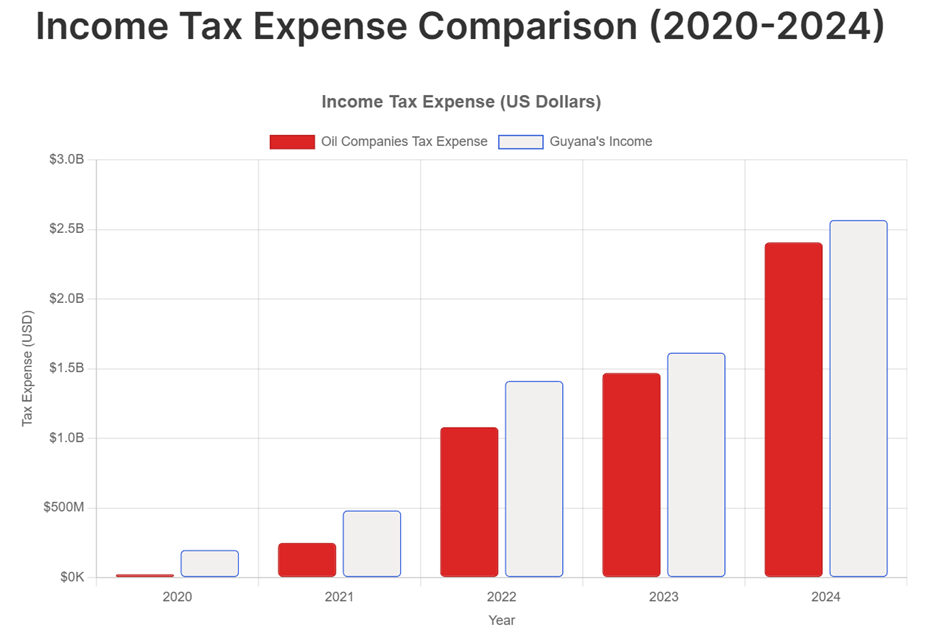
Interactive version of chart can be found here: https://www.oggn.org/2025/06/22/oil-companies-income-tax-expense-comparison-2020-2024/
Alfred Bhulai
Andre Brandli
Janette Bulkan
Kenrick Hunte
Darsh Khusial
Joe Persaud
on behalf of OGGN (www.oggn.org)