
In a recent presentation by President Ali, he stated that “…We have seen around us countries that made the mistake of treating oil of treating natural resources revenue as wealth you’ve seen … Trinidad and Tobago Venezuela natural resources revenue is not wealth is revenue to be invested to create wealth… and that is what we’re doing that is what we’re doing.”. (Source: (https://youtu.be/hLLbhv6msSM?t=2915); Minute 48:38). The President’s statement is also mentioned in this article: https://www.kaieteurnewsonline.com/2025/07/22/guyanas-exciting-future-requires-risk-taking-president-ali/. There are several issues with what President Ali said in the above statement which should be clarified, since it presents the wrong interpretation on what wealth and natural resources are in any country.
First, the implicit value of the eleven billion barrels of commercial quantities of oil now being extracted by a foreign owned consortium (Exxon Mobil, Hess/Chevron, CNOOC) is already being incorporated in the Financial Statements of these companies, increasing thereby the share price on the stock market, as well as the market value of the company. Consequently, it is incorrect for the President to state that the natural resource revenue or the value of the unextracted oil is not wealth, for the increasing stock price conveys a different message of increasing profitability. And in this regard, Chevron recently bought Hess for US$60.0 Billion (https://tinyurl.com/4p68wt5u); and assuming that the value of the Hess investment in the Guyana business is worth 80 percent of the Hess-Chevron deal, this implies that Hess contribution in the Guyana oil business is US$48.0 Billion (80% x US$60.0 Billion).
Furthermore, since Hess owns 30 percent of the oil business in Guyana, it can be deduced that the implied book value of the Guyana Stabroek Block is US$160.0 Billion (US$48.0 Billion ÷ 0.30), with the ownership distributed as follows: ExxonMobil stake at 45 percent equal to US$72.0 Billion; Hess/ Chevron at 30 percent equal to US$48.0 Billion; and CNOOC at 25 percent equal to US$40.0 Billion.
It is also apposite to note that since these companies invested a much smaller amount of money than the US$160.0 Billion, we know that their owner’s equity, or wealth, have amplified significantly by the increasing value of the stock price. For example, the Hess stock price was less than US$70.00 when oil production began in December 2019; today, the stock price has more than doubled, climbing to US$149.00. What is most disturbing, however, about this increasing value of the company is that since Guyana is not an equity owner in the Business, and is only identified in the lopsided PSA contract as a Non-Owner Associate, Guyana has nothing extra to get, even though Guyana owns the natural resource.
Second, many countries have a large bundle of natural resources that are valued in the trillion of dollars; and these natural resources are included in their national patrimony of collective national assets (https://tinyurl.com/e6fps467). Table 1 below contains the value of the natural resources of several countries (https://tinyurl.com/33apwzkb). For example, the natural resources (coal, gas, oil, and rare earth metals) in Russia are valued at US$75.0 Trillion, while the natural resources in the United States of America (coal, timber, natural gas, gold, and copper) are valued at US$45.0 Trillion. In Brazil and Venezuela, their natural resources are valued at US$22.0 Trillion and US$ 14.0 Trillion, respectively.
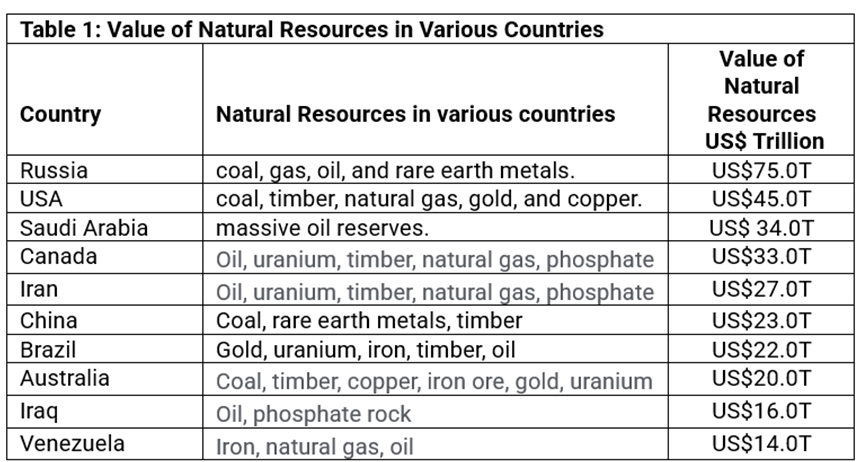
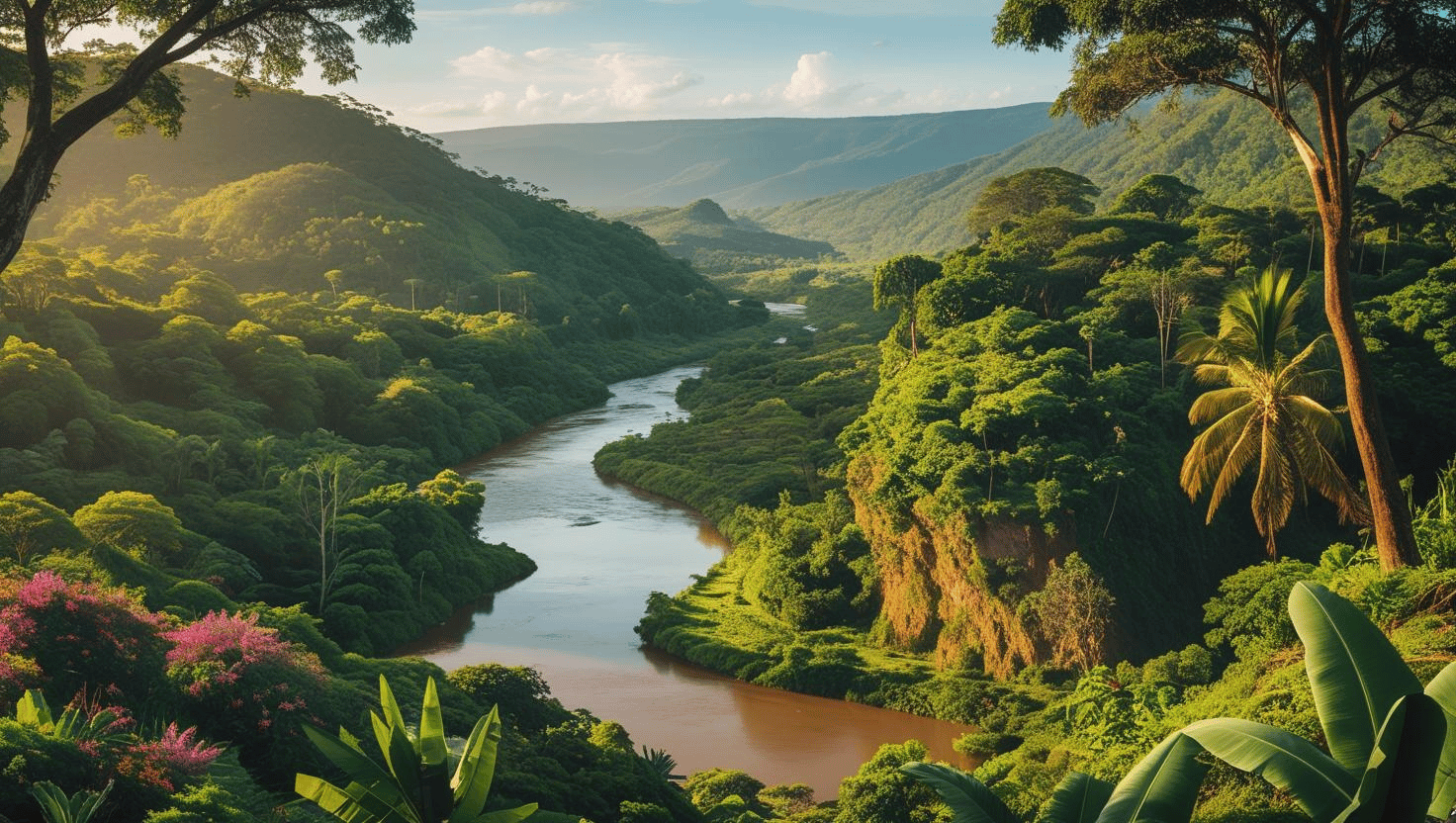
Similarly, Guyana has a bundle of renewable and non-renewable natural resources (See the Figure below) which are included in our national patrimony of collective national assets. And interestingly, Guyana’s natural resources (oil, natural gas, gold, bauxite, timber, see Table 1) are no different than what obtains in many of the countries.
b
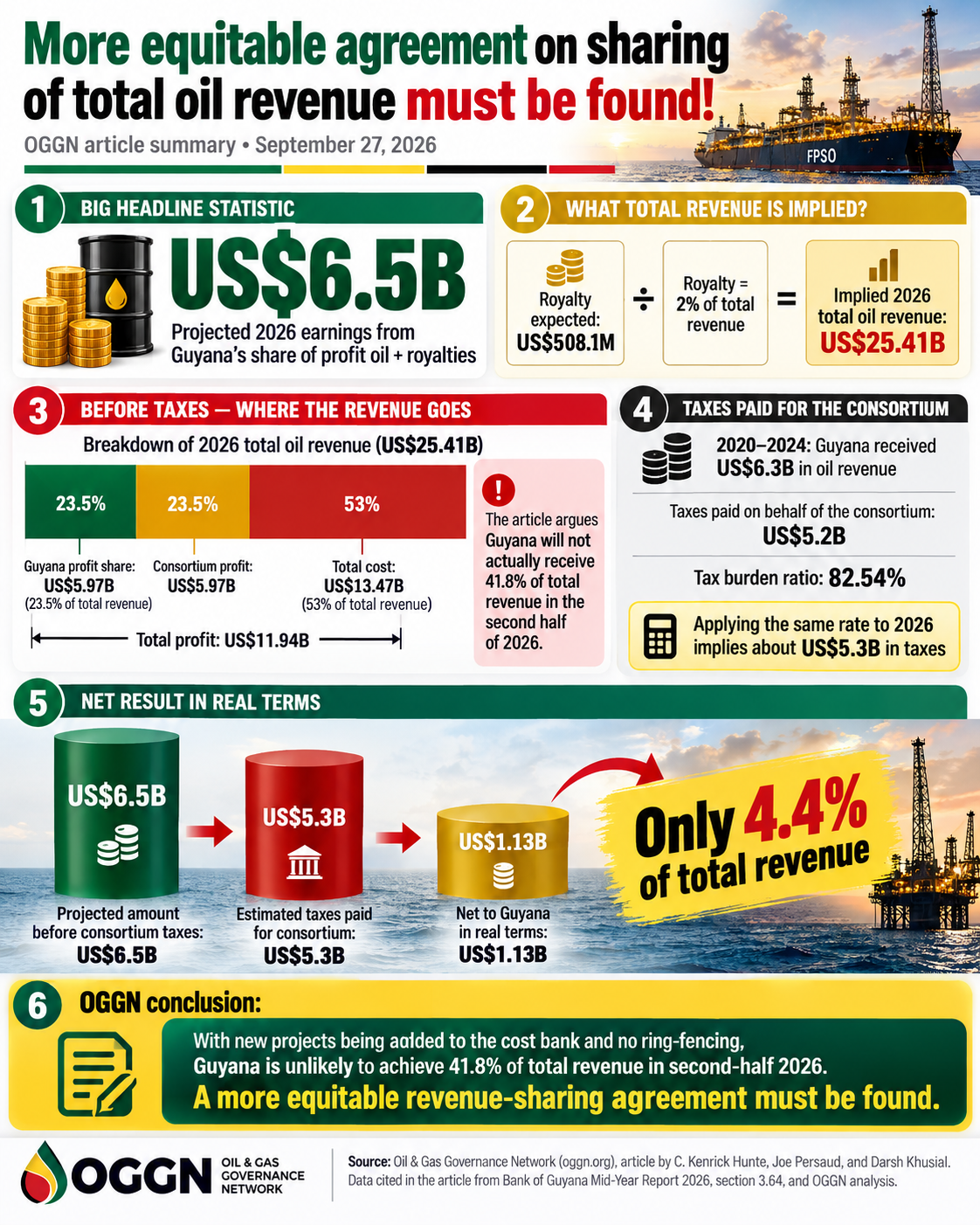
Given the wide collection of natural resources identified in Guyana, it is likely that Guyana on a per capita basis is one of the richest countries in the world. But if a foreign owned company develops the resource, using lopsided contract indicators (https://tinyurl.com/2s3ttk3m), then it is highly likely that Guyana’s net worth from our natural resources would be small, and our wealth will be small. For instance, recall that last year the export value of oil was US$17.9 Billion; and of this amount Guyana only received in real terms US$ 202.7 Million (or 1.13 percent of the total exports), after paying the taxes of the company (https://tinyurl.com/2s3ttk3m). Consequently, correcting this problem would require a different policy and management approaches, along with appropriate incentives. Moreover, since Guyana does not have all the required skills, we have to develop an enhanced mineral research and documentation system by upgrading the Natural Resource Ministry, and introducing a Geology Department and Program at the University of Guyana. This will provide valuable technical and investment information, while funding for such a program should be disbursed from the Natural Resource Fund.
Third, investing oil revenue to create wealth, the President said it “… is what we’re doing that is what we’re doing.” This statement would be correct, if the oil revenue is being disbursed for projects that are technically feasible, and optimally resourced with the required inputs.
In this regard, and to the extent that Mr. Marco Rubio, Secretary of State, USA, is correct when he said he almost had a concussion on a poorly build road in Guyana, the facts would not support the kind of transformation President Ali is claiming of investing oil revenue to create wealth. For another example, if the report from the newly commissioned Diamond Hospital where the lack of oxygen that was required to treat a patient resulted in the death of the patient, this outcome would also fail to support the President’s claim. Consequently, enhanced management, optimal transparency, and timely accountability will make a significant difference; otherwise, failure will be guaranteed, money will be wasted, and perhaps precious lives might be lost due to pervasive incompetence across the entire governance system.
Finally, wealth (or net worth) in accounting is typically measured as the difference between the total value of assets (TVA) and liabilities (what you owe): Wealth = TVA – Liabilities. Since natural resources are included in total assets, it therefore follows that when the value of natural resources increases (decreases), wealth will increase (decrease), holding liabilities constant. And when liabilities are zero (fully repaid debt), wealth is equal to total assets. This outcome is therefore different from what was stated by President Ali, for wealth includes the value of natural resources. The oil consortium in Guyana have included this in their financial statements; Guyana need to step-up!
Sincerely.
Kenrick Hunte
Andre Brandli
Alfred Bhulai
Darshanand Khusial
Joe Persaud
Mike Persaud On behalf of www.oggn.org/about a 501(c)(3) organization