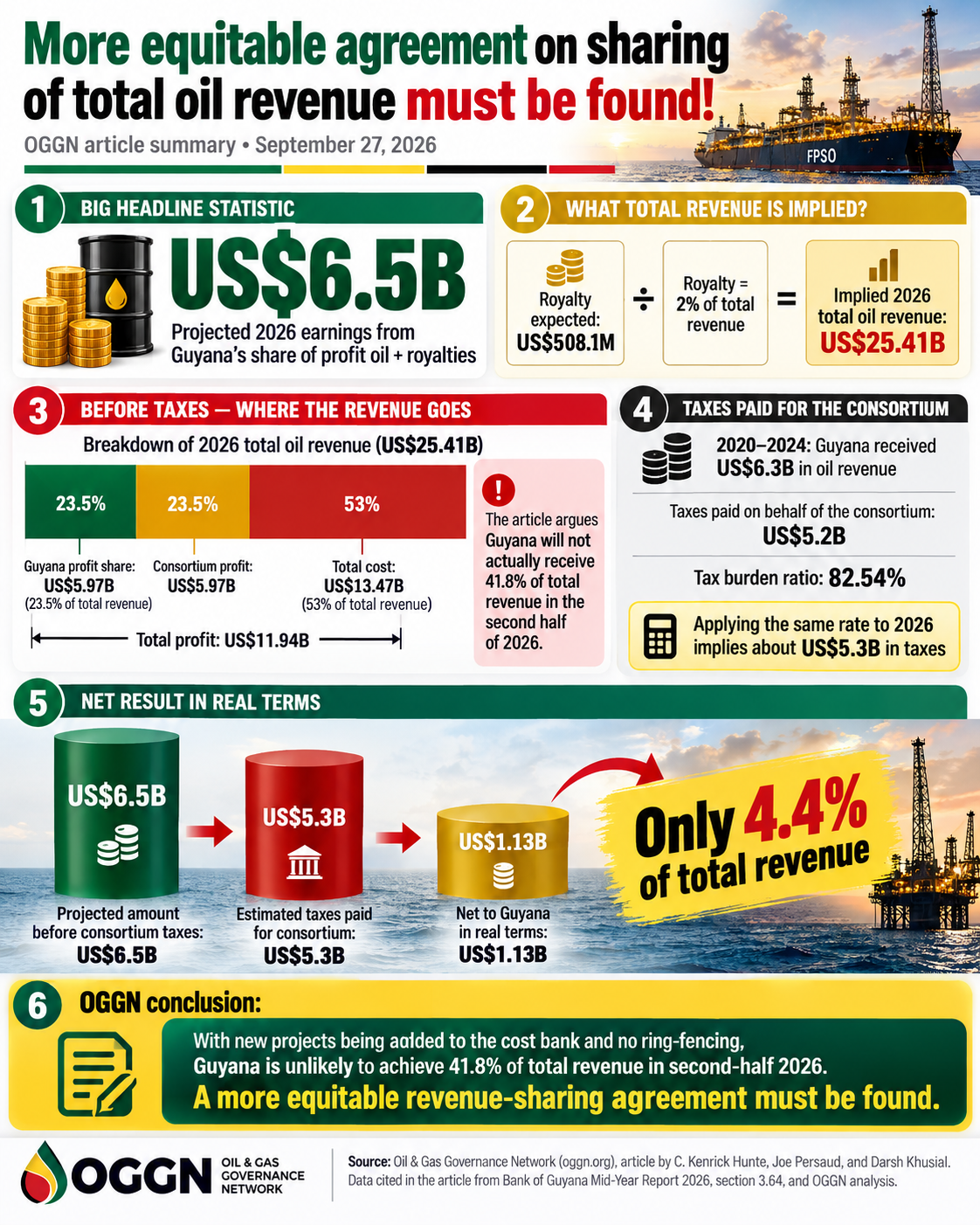
In keeping with Article 15.6, page 42 of the Production Sharing Agreement (PSA), the Government of Guyana is assigned the burdensome task of paying the taxes of the oil consortium (EMGL, Hess, and CNOOC) from its share of oil profits and royalties.
This contractual arrangement is unheard-of; as it discriminates against other local companies which are expected to pay taxes from their business income in Guyana. Alternatively, a more nuanced approach is for the Government of Guyana to approve a tax-holiday for a certain period of time whenever the Government is interested in providing an incentive to stimulate investment and production. At the end of such a grace period, a company is expected to pay taxes as other tax-paying companies in Guyana. Consequently, this costly burden on the Guyanese people must be resolved before the commercial quantity of oil is exhausted; for a level playing field offered by Government is a necessary condition for all investors.
Meanwhile, what compounds this Guyana oil tax problem even further is the fact that the Government of Guyana is obligated to issue a tax certificate for money it never received from the consortium; and this tax certificate can thereafter be presented to other governments as proof of the consortium paying taxes in Guyana. Furthermore, there is no termination clause in the PSA for this arrangement; but it is projected that the commercial quantities of extracted oil will be exhausted in 2057 (Ram: https://tinyurl.com/4edmw7jk). It is therefore contended that the burden created by this tax certificate must be corrected by a parliamentary decision.
With the financial terms defined in the PSA, Guyana is expected to receive 14.5 percent of total revenue, until the capital cost is repaid, which implies that Guyana should get a higher share of the revenue. However, there is no information indicating how much of the capital cost has so far been repaid or when the capital cost will be repaid. Meanwhile, the total amount of revenue earned by the consortium from total oil exports amounted to US$43.49 Billion for the period 2020 to 2024 (Bank of Guyana Annual Reports https://tinurl.com/37s9v93b; https://tiyurl.com/285t3ruz). Therefore, Guyana’s gross share of total revenue at 14.5 percent will yield US$6.31 Billion (Table 1).

Here is the Lopsided Contract Indicator (https://tinyurl.com/4eu59xjt): The Government paid the consortium taxes, (the ‘Lopsided Contract Indicator’ is valued at US$5.23 Billion), for the period 2020-2024 to the Guyana Revenue Authority from its share of oil revenue. This yielded a net amount in real terms for Guyana of US$1.07 Billion, which is only 2.47 percent of total revenue (US$43.49 Billion) for the entire period 2020 to 2024.
Undoubtedly, this meager amount of US$1.07 Billion (2.47percent) represents a significant inequity, as the consortium captures US$42.41Billion, which is 97.53 percent of total revenue (US$43.49 Billion). If the Government were to remove this Lopsided Contract Indicator and have the consortium pay its taxes, royalty and profit, Guyana would receive a more equitable share of total revenue of US$11.54 Billion (US$6.31Billion + US$5.23 Billion), which is 26.53 percent of total revenue (US$43.49 Billion), while the consortium would receive US$31.95 Billion. This must be the goal that the Government of Guyana should be working towards on behalf of the Guyanese people.
Another interesting analysis is the comparison between the net oil income and the total amount of remittances Guyanese send home. During the period 2020-2024, the real net income from oil after the Government absorbed the Lopsided Contract Indicator was US$1.08 Billion (Table 2).
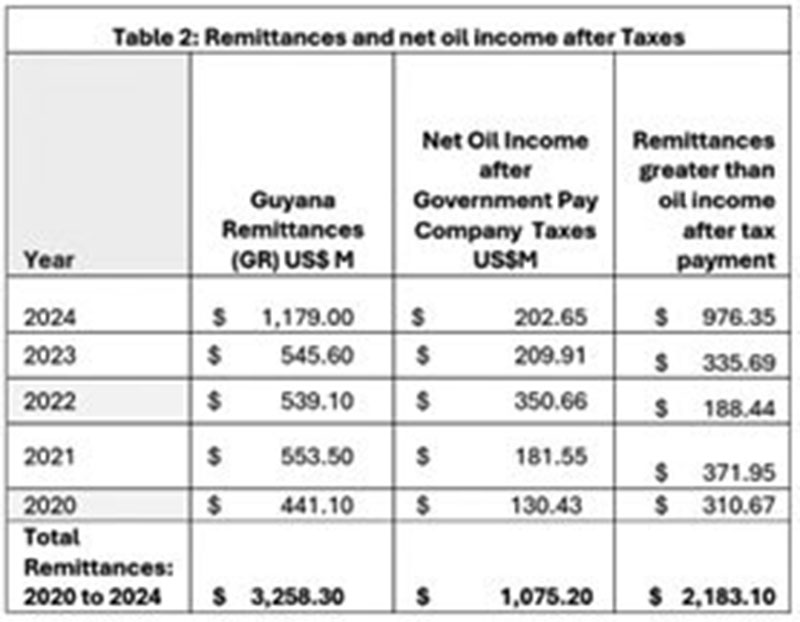
The total remittances that Guyanese sent home during the same period (2020-2024) was US$3.26 Billion, with the Inter-American Development Bank (IDB) reporting that remittances sent to Guyana in 2024 amounted to US$1.18 Billion ( https://tinyurl.com/4hdv62k6; https://tinyurl.com/598dwpbh). These remittances sent by the Diaspora in 2024 of US$1.18 Billion were larger than the net oil income of only US$ 202.7 Million, after the taxes were paid by the Government for the consortium. Every effort must therefore be made to get rid of the Lopsided Contract Indicator. And thanks to the diaspora for being a major source of foreign exchange earnings, thereby enhancing the wellbeing of the Guyanese people at home.
Not surprisingly, there are other elements of the Lopsided Contract Indicator that are integrated in the PSA; and some of these elements can be identified as follows:
1. Guyana is recognized in the PSA as the Non-Owner Associate, even though Guyana owns the resource. This implies that the owners of the consortium, who are not Guyanese and pays no taxes, own all the oil resources that is Guyana’s patrimony;
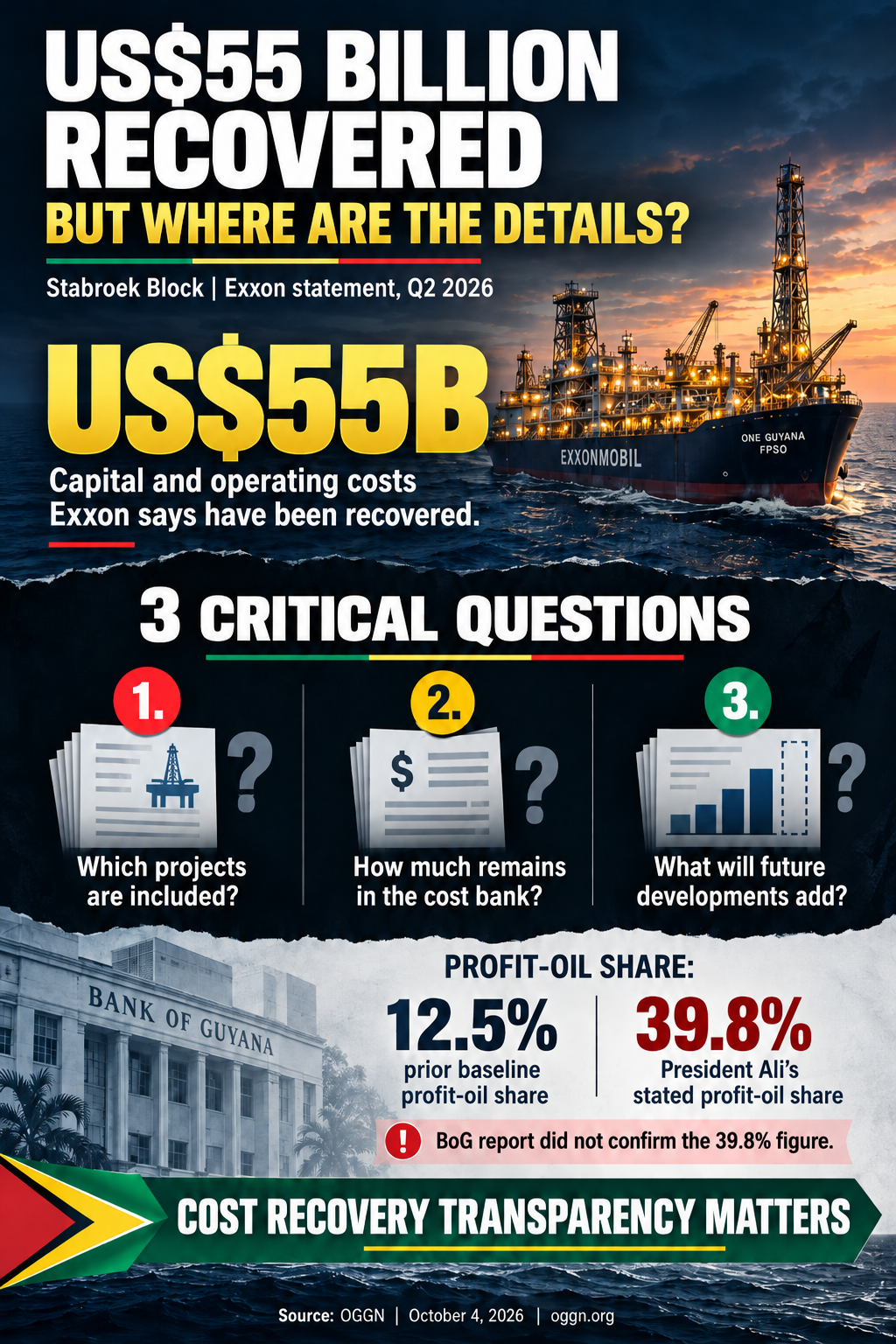
2. There is a cost recovery mechanism in the PSA which guarantees that 75 percent of total revenue for the life of the PSA is unequivocally captured upfront by the consortium, while the Non-Owner Associate has no authority to change this clause in the PSA; and
3. No ring-fencing and no real-time auditing provide an incentive for the consortium to invest in new oil projects and non-oil activities both on and offshore. These disbursements are achieved by using some of the money in the 75 percent cost recovery bucket; and the Non-owner Associate has no input in this process. For example, money earned in one project can be used to conduct drilling operations in an unapproved project. Another example could be spending some of the cost recovery money on community-based projects or sports events (Cricket); and this can buy the silence of the Guyanese politicians and citizens.
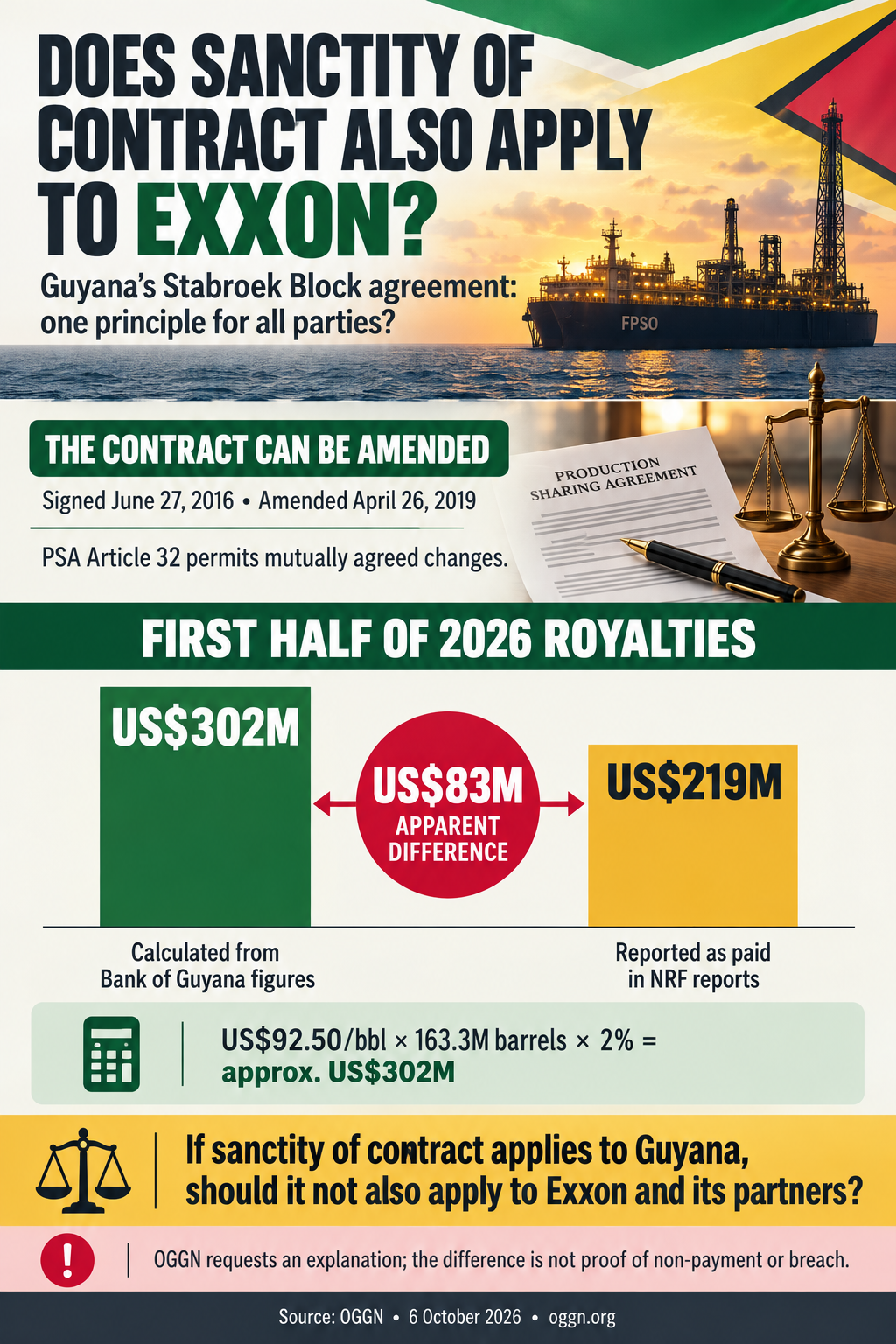
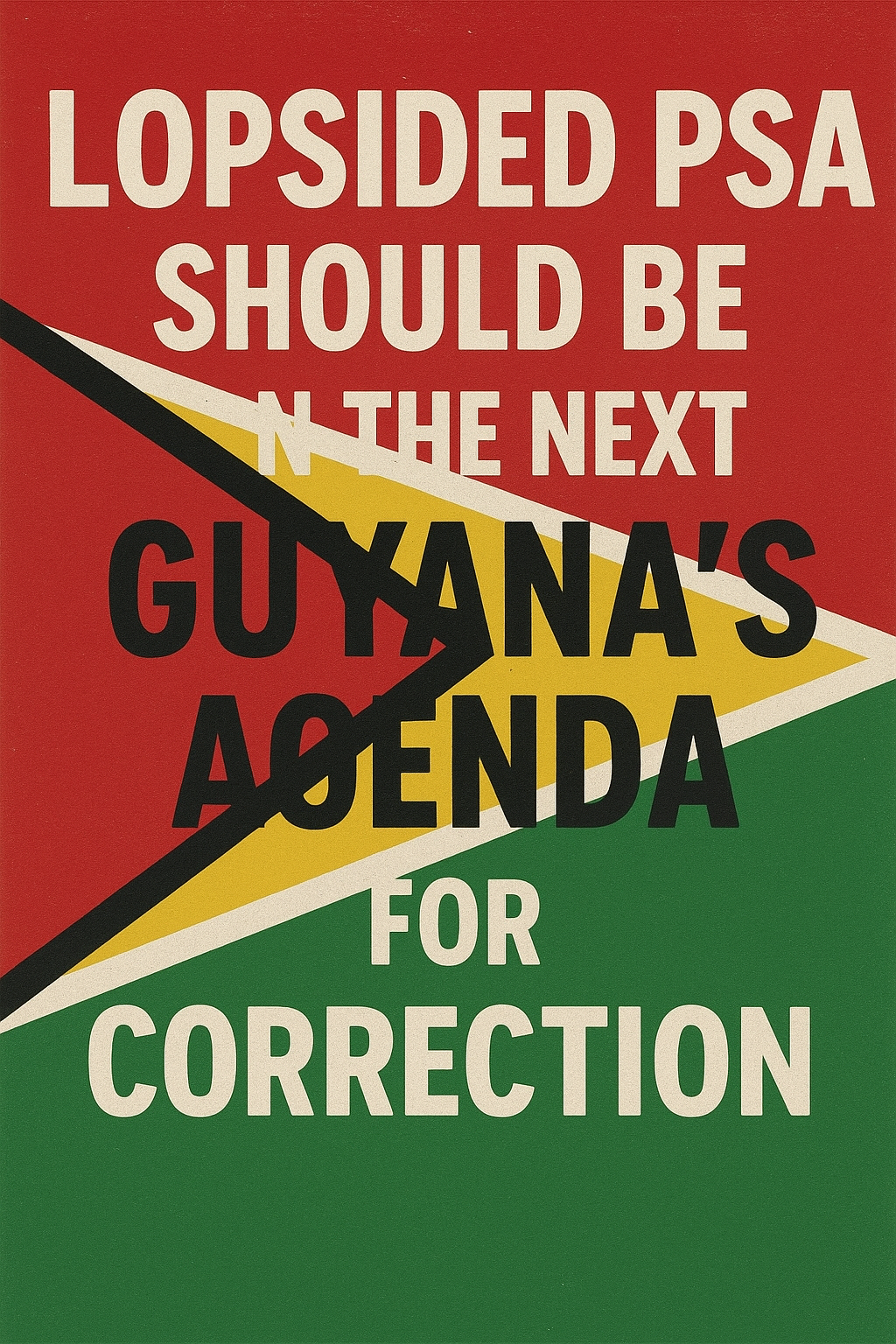
In conclusion, the ‘Lopsided Contract Indicator’, typically formalized as ‘sanctity of the PSA contract’, must be deactivated; and every effort must be made by Parliament to introduce a just and equitable outcome for Guyana as well as the investors. In other words, if this lopsided PSA deal is not corrected, future generations will not think kindly of policymakers whenever this matter is raised. End the blame game, get the job done; our elected leaders must step up!
Sincerely,
Kenrick Hunte
Janette Bulkan
Darsh Khusial
Mike Persaud
Joe Persaud
On behalf of www.oggn.org/about a 501(c)(3) organization