
Recently, the Government of Guyana approved the US$6.8 Billion Hammer-head oil extraction project which is expected to produce 150,000 barrels of oil per day, with first oil projected for 2029 (SN Article: Ram https://www.stabroeknews.com/2025/09/26/ features/the-road-to-first-oil/while-guyana-celebrates-hammerhead-america-investigates/ ). It was reported also that the total commercial quantity of oil to be extracted from Hammerhead is set at 445 million barrels (KN: https://kaieteurnewsonline.com/ 2025/09/23/govt-approves-exxons-hammerhead-project/).
Having read these two articles, I recall reading another KN News Article (KN: https://kaieteurnewsonline.com/2025/09/24/exxon-unable-to-say-when-guyana-will-receive-full-50-profit-share/ ) in which it was reported that Mr. John Colling, ExxonMobil Guyana Limited (EMGL) Business Services Manager, was asked when will Guyana receive 50 percent profit share ? His response was the classical diversion in which he stated how much money the Company had invested (over US$40.0 Billion; that amount should be questioned), but he was unable to say when Guyana’s share of profit would increase to 50 percent from the current 12.5 percent under the lopsided 2016 PSA Arrangement. I therefore contend that given the long history of ExxonMobil being a profitable oil company, with more than one hundred years in the business, such an answer by Mr. Colling is the classical diversion typically employed to redirect the discussion. Moreover, the fact that EMGL is continuing to invest in new extraction projects in Guyana, which are generally described as low-cost operations that are loaded with light crude; and recognizing that EMGL has published all the production and investment data for Hammerhead, but still does not know when maximum profits would be earned, I can only conclude that the answer provided by Mr. Colling is unacceptable. As a result, I decided to produce some profitability estimates for the Hammerhead project; and with real time monitoring, especially the capex account, this information can be updated. Incidentally, similar estimates can be made not only for all the oil projects, but for all the non-renewable resources, including gold, diamond, bauxite, manganese, among others. This natural resource monitoring is a fundamental job of the Ministry of Natural Resources; and if this is not in current work assignments, it should be started forthwith.
With reference to Hammerhead, it was published that the daily oil extraction rate is set at 150,000 barrels per day; and to extract the total commercial quantity of 445 million barrels of oil will require 2,967 days of extraction operations to fully extract all the commercial oil; that is, 2967 extraction days divided by 150,000 barrels of oil per day. And if 350 days per year are allocated for the extraction operation, then the full quantity of oil in Hammerhead will be extracted in approximately 8.5 years (2,967 divided by 350 days). Of course, when EMGL most likely will undertake the debottlenecking project, which will increase production above the rated extraction capacity of the equipment, this will increase the daily extraction rate and reduce the number of years for full extraction, assuming that there is no extraction trouble, or any environmental damage due to an oil spill. This is an important task that Guyana must undertake to monitor in real time the proposed oil extraction operation. (Incidentally, I use the term extraction and not production as no in-house technology and inputs are used to make any natural resource; for natural resources are nature-given).
The second task is to construct two profit models: the first being a profit model using ring-fencing, which means that only revenue and costs associated with Hammerhead or each project must be accounted separately and not commingled with another project. And the second task is to construct a profit model that employs the 2016 Profit Agreement, which exemplifies a ‘cost maximizing and profit squeezing approach’ that minimizes Guyana’s profit share. Both of these financial approaches will be presented below.
Ring fencing Profit Model: It was stated that the investment cost of Hammerhead is US$6.8 Billion; and with 445 million barrels of extracted oil, this will yield an average investment cost of US$15.28 per barrel of oil (US$15.28 = US$6.8 Billion divided by 445 Million). To cover operating cost (labour, admin, other expenses) an additional amount of US$ 9.00 per barrel of oil is included. Therefore, the estimated average cost of a barrel of oil is US$24.28 per barrel (US$15.28 + US$9.00). It assumed that the price of a barrel of oil is US$70.00; and since 445 million barrels of oil will be sold at an average price per barrel of US$ 70.00, the total revenue earned from Hammerhead is US$31.150 Billion ($70.00 x 445 million barrels); total cost is US$10.805 Billion (US$24.28 X 445 million barrels); total profit is US$20.345 Billion (US$31.150 Billion – US $10.805 Billion); and Guyana profit share at 50 percent is US$10.173 Billion (Table 1).

2016 PSA Profit Model: The second profit approach is generated from the 2016 PSA (Table 2) in which the total revenue will be the same amount at US$ 31.150 Billion; but the total cost of the project will be more expensive; and this will negatively impact profits, squeezing Guyana profit share. In particular, the total cost (TC) of the 450 Million barrels of oil under the PSA is US$23.363 Billion ( TC = 75% x US$31.150 Billion); and the total profit is US$ 7.79 Billion of which Guyana profit share is US$ 3.894 Billion (Table 2).

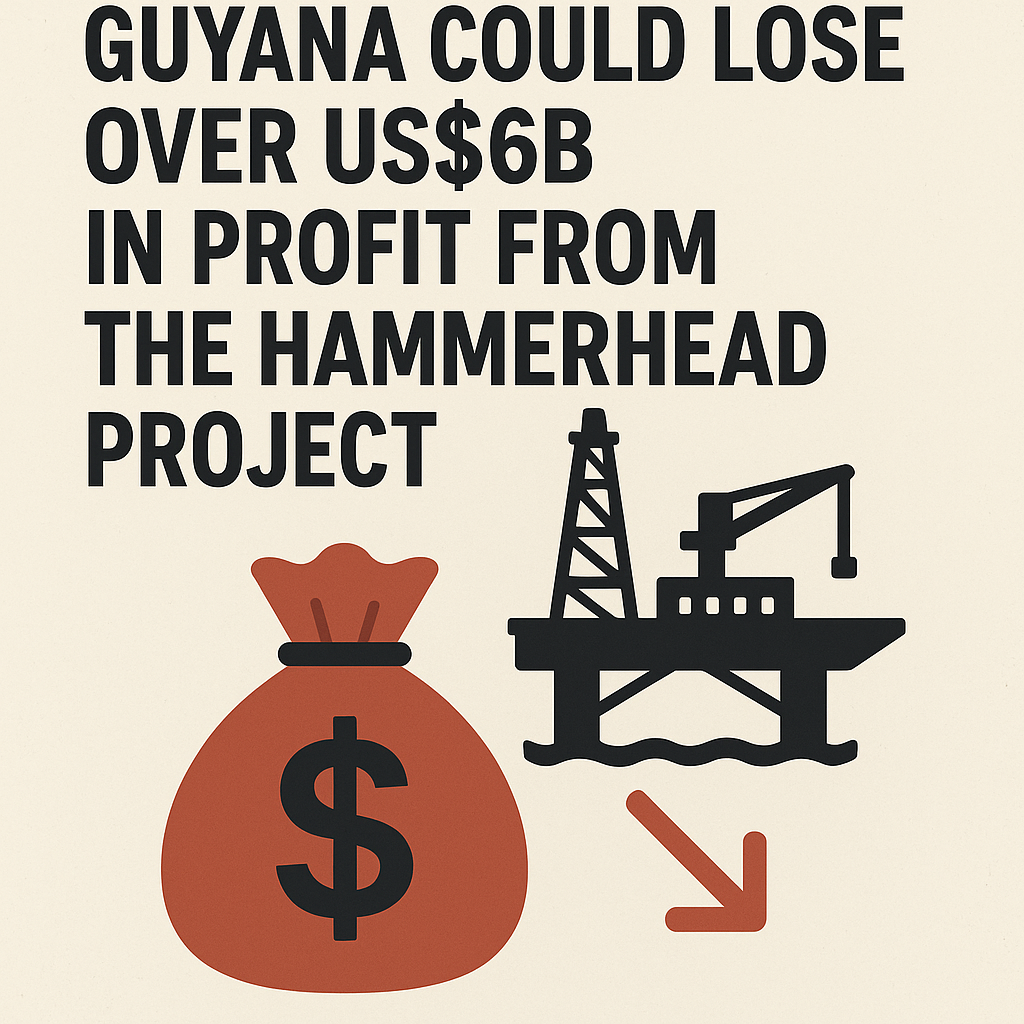
The comparison between the two profit models show that under the ring-fencing model, Guyana’s profit is US$10.173 Billion. In contrast, under the PSA Model, Guyana profit is only US$3.893 Billion; and this represents a loss, a profit squeeze imposed on Guyana of US$6.279 Billion (Table 3).

Undoubtedly, this loss of over US$ 6.0 Billion from Hammerhead cannot be a fair and equitable arrangement between EMGL and the people of Guyana. Can you imagine how much profit has been lost from the previous projects? Consequently, the Parliament of Guyana must ensure that the 2016 PSA is renegotiated to correct this this lopsided contract; for you cannot blame those in the past, but at the same time use the money earned from the lopsided contract and claim success. Please get the job done!
Sincerely,
Dr. C. Kenrick Hunte
Professor and Former Ambassador