



The Transparency Institute of Guyana Inc. (TIGI) hereby seeks to add a degree of clarity to the public revelations concerning the Extractive Industries Transparency Initiative in Guyana (GYEITI), and to expose the latest efforts of the GOG which appear to be geared to ensure the frustration of the aims and objectives of the GYEITI and the bona fide role of Civil Society therein.
It is now 8 years since The Cooperative Republic of Guyana obligated itself to implementing the EITI Standard, when in October 2017, Guyana officially became an EITI Implementing country. In 2016, the EITI International Secretariat and World Bank Consultants provided guidance and necessary assistance to Guyana after the APNU+AFC Government re-launched the Guyana EITI Membership application process, which, having commenced in 2010 were not followed up under the PPP/C government.
To move the process forward in the early stages, World Bank Consul-tants, approved by EITI international, were hired and instrumental in building capacities in collaboration with Policy Forum Guyana (PFG), as the designated Convenor of Civil Society in an open and transparent process as per Requirement 1.3 of the EITI International Standard.
It is the opinion of TIGI, which has kept abreast of the GYEITI, that Policy Forum Guyana (PFG) has served honourably as the GYEITI-MSG Civic Convenor, with a robust procedure for nominations and selection of the MSG Civic representatives, who, in turn, have well served the GYEITI MSG up to December 2024. As evidence of this, it is noted that in the first Validation process of the GYEITI which received a low score – the then Civil Society (Civic) component of the MSG consistently scored comparatively higher that the government and Industry sectors.
A list of excellent, bona fide, independent Civil Society representatives was approved/recommended through the PFG process and submitted to the relevant Minister for Letters of Appointment in March/April 2025. This met the requirement in the 2023 EITI Standard which states (1.4 a(ii): “Each stakeholder group must have the right to appoint its own representatives, taking into account pluralistic and diverse representation”. There was no response until the International Secretariat informed PFG in late September 2025 that the Minister had launched a parallel process for the selection/appointment of civil society members to the MSG. To date, this parallel List has been shrouded in secrecy. Neither PFG nor any of the MSG-Civic appointees have been provided with any rationale as to why the Minister rejected this List.
Additionally, the Minister’s recent appointment of a Civil Society Convenor – Private Sector Chairman, Mr Komal Singh – was publicly queried in terms of his eligibility under the rules of EITI Standard (Section 1.3) which debars private sector persons to represent Civil Society.
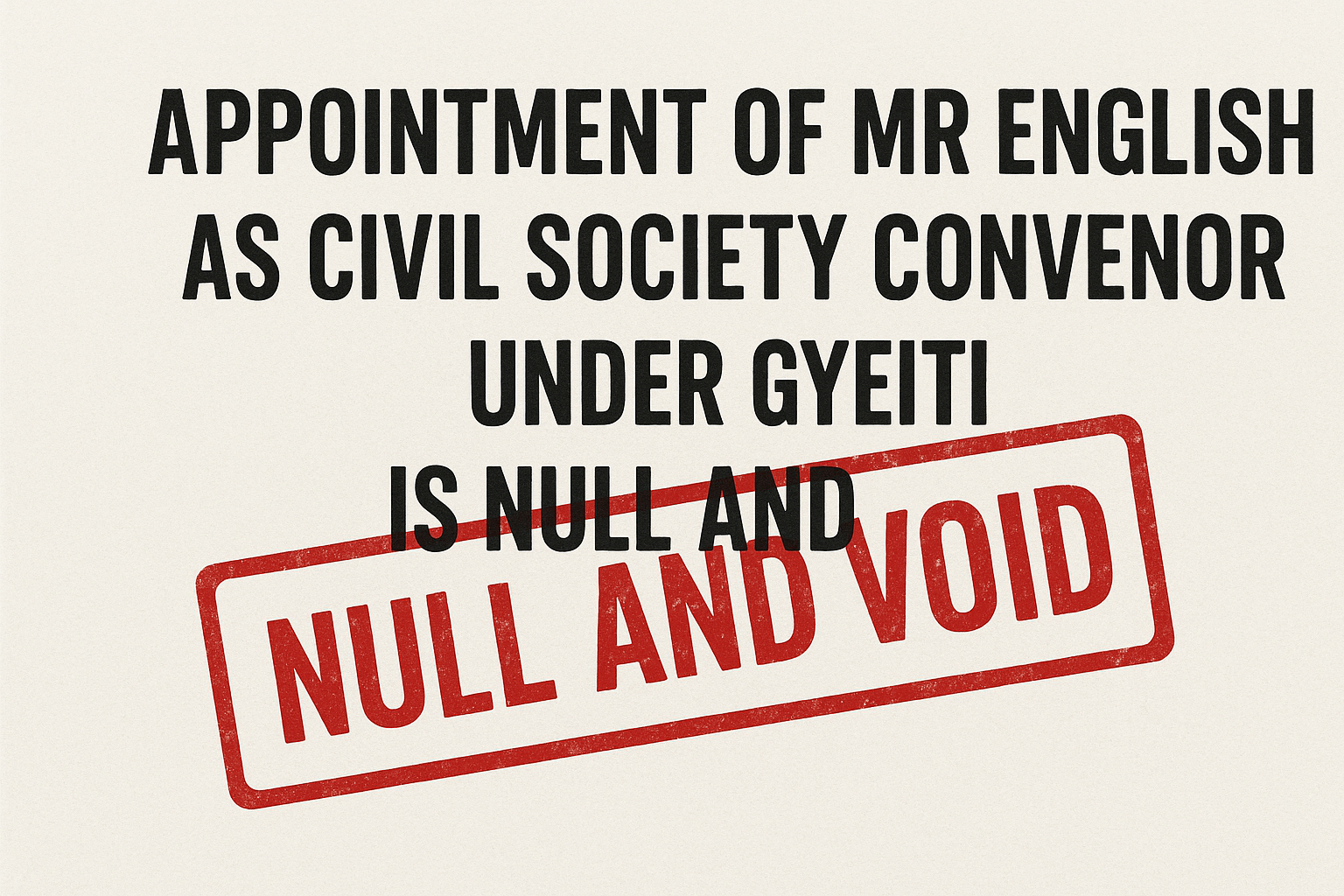
The Minister of Natural Resources replaced Komal Singh with Ivor B. English who has major gold and diamond interests – 17 licenses for 19,586 acres of land for gold and diamond mining in the Cuyuni Mining District. These licenses were officially reported by GYEITI since 2017. Further, Ivor B. English publicly disclosed to the Press on 9 November this year that he may reactivate these mining licenses. The EITI Standard prohibits persons involved in the extractive industries from representing Civil Society – and, therefore, this appointment of Mr English is null and void.
The EITI global Standard is very clear on how the representatives of a country’s EITI MSG Sectors are to be nominated and appointed. TIGI hereby takes the opportunity to point out to the general public some of the relevant clauses of the Standard which is available on the EITI.ORG website.
EITI Protocol for Civil Society:
a) Civil Society must be fully, actively and effectively engaged in the EITI process.
c) The government is required to ensure that there are no obstacles to civil society participation in the EITI process.
d) The government must refrain from actions, which result in narrowing or restricting public debate in relation to implementation of the EITI.
e) Stakeholders, including but not limited to members of the multi-stakeholder group, must:
Be able to speak freely on transparency and natural resource governance issues.
Be substantially engaged in the design, implementation, monitoring and evaluation of the EITI process, and ensure that it contributes to public debate.
iv. Be able to operate freely and express opinions about the EITI without restraint, coercion or reprisal.
1.4 Multi-stakeholder group (MSG)
The objective… is to ensure that there is an independent multi stakeholder group that can exercise active and meaningful oversight of all aspects of EITI implementation … the multi stakeholder group must include adequate representation of key stakeholders appointed in open, fair and transparent constituency procedures; make decisions in an inclusive manner; and report to wider constituencies.
Each stakeholder group must have the right to appoint its own representatives, taking into account pluralistic and diverse representation.
The nomination process must be independent and free from any suggestion of coercion.
Civil society groups involved in the EITI as members of the multi-stakeholder group must be independent of government and/or companies, both operationally and in policy terms.
Where relevant, the multi-stakeholder group is encouraged to provide a narrative of whether it has considered publicly known corruption cases in the sector that are of national relevance for the year in review, and to document its discussion, response and recommendations.
Yours faithfully,
Fred Collins,
Board of Directors,
Transparency Institute of Guyana Inc. (TIGI)