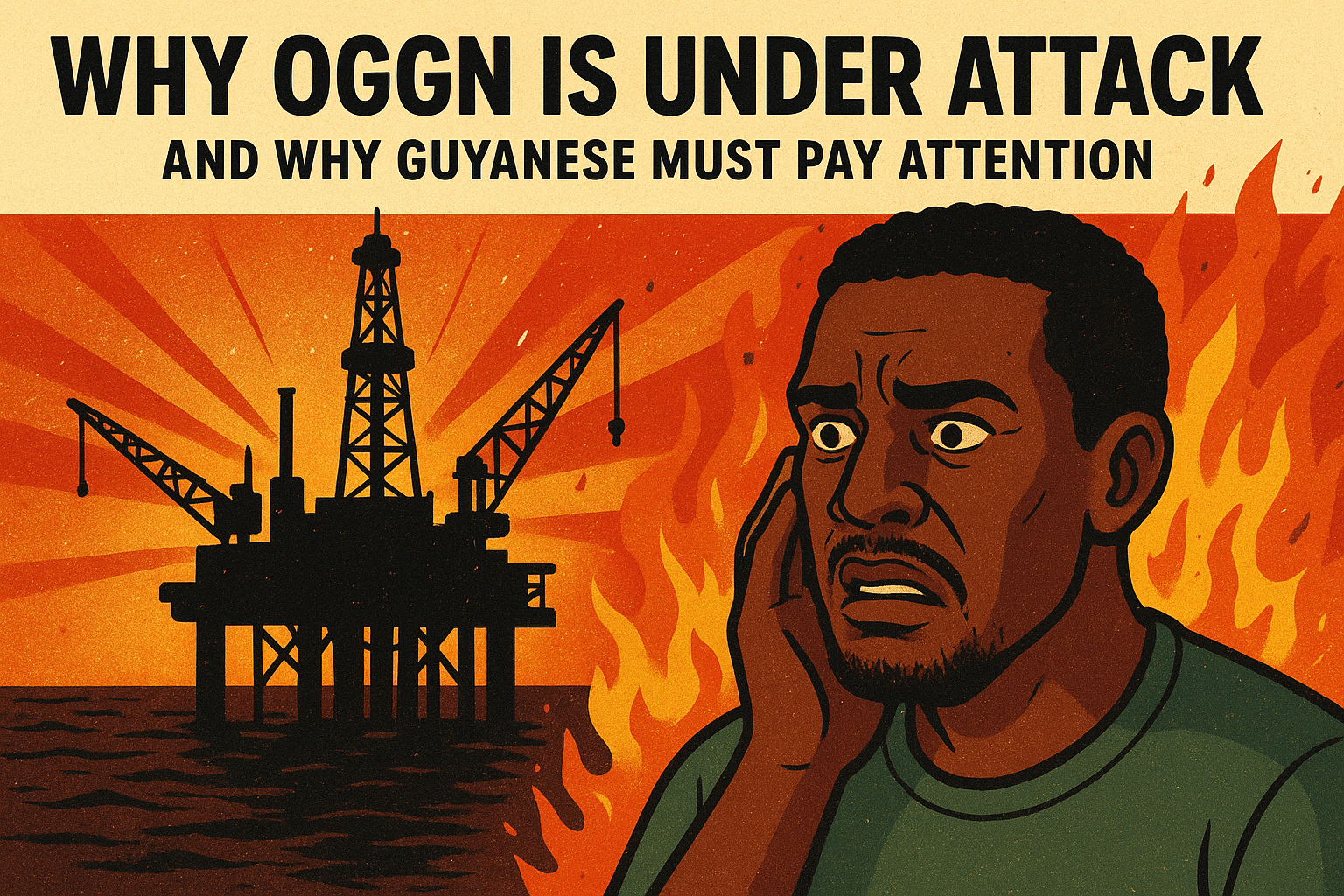
For weeks, OGGN’s home page (www.oggn.org) has faced sustained attacks, WITH hundreds of intrusion attempts weekly from Amsterdam to São Paulo, Sydney to Izmir. These are not random. The hackers demonstrate familiarity with the site’s systems, user behaviour, and even aspects of administration. The volume and sophistication of these attempts to sabotage the site strongly suggest well-funded actors.
Unlike commercial platforms, OGGN sells no products, collects no fees, and earns no revenue. We publish research so that Guyanese and the wider world can understand how wealth is managed and who truly benefits.
Yet the hacking campaign treats us like guardians of El Dorado.
The sustained attacks on the portal are part of an increasing trend of intimidation and violence directed against independent voices in Guyana. Two other prominent victims are Kaieteur Radio and Policy Forum Guyana.
Why visit oggn.org?
The Government of Guyana has not acted in a rational manner with regard to the 2016 Production Sharing Agreement, shamefully signed under the previous administration. Only one change has been made to that Agreement: a 2019 clarification that the 2% royalty is not a recoverable cost and must be paid to Guyana out of the consortium’s profit oil. Otherwise, ExxonMobil has been allowed to argue for changes to the environmental authorisations (operating permits) for individual oil fields. Three examples:
Effectively unlimited flaring of associated gas in exchange for a nominal financial penalty, instead of a prohibition on gas flaring except in an emergency.
ExxonMobil Guyana can save itself time by dumping toxic substances into the Caribbean Sea instead of pumping them back into the reservoir beneath the ocean floor. Exxon can mitigate liabilities by refusing to honour a parent company guarantee.
The government of Guyana was elected to serve the people of Guyana. Exxon’s main goal is to serve its shareholders. The interests of the Guyanese people and Guyana’s marine ecosystem are directly at odds with those of rich foreign shareholders. Hence, it is no surprise that there are entities that want to silence the information published on the portal.
The website is a portal that hosts media engagements on oil extraction with many of Guyana’s intellectuals, on issues ranging from finance to environment. OGGN is an US-registered non-profit organization. Unlike some other Guyanese oil sites, OGGN explicitly lists its board of directors. Our website is not dependent on US Big Tech platforms. The website is a fully independent site where authors have full freedom of expression, outside the grasp of advertisers or the Government of Guyana. The material hosted there is clearly worth more than black gold; otherwise, it wouldn’t have attracted this much attention from hackers who have nothing financially to gain from the site. OGGN welcomes you to visit to find up to date information on the Guyana’s oil and gas sector. Learn for yourselves. The website is running as fast as it ever has been. You can use the search feature at the top right to find the topics that interest you.
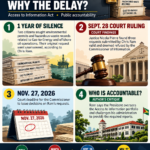
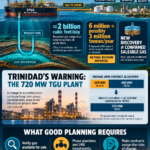
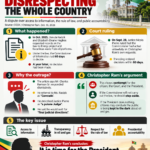
A loose guide to OGGN homepage and its offerings ((links to the full articles can be found at www.oggn.org/more/)):
If one wants to learn about our members, mostly Guyanese teachers, a brief biography can be found on our site (go to the ‘about’ section), along with a YouTube video in which Dr. Andre Brandli eloquently outlines our mission statement.
One can find some of the most prominent Guyanese writings on oil & gas topics organized by authors. For example, Dr. Vincent Adams, former head of Guyana’s EPA, addresses critical topics related to oil insurance. Dr. Bulkan covers how our ocean and fish are being affected by oil production. If one is more financially inclined, there are articles by economics professor Dr. Kenrick Hunte, on why Guyana’s share of oil revenues is significantly less than 14.5.
You can also find all the public oil contracts signed by Guyana – from the original 1999 Stabroek contract to the current 2016 Stabroek PSA. Although a little dated, one can see a visual representation of which oil contracts covers which areas in Guyana’s territory here: https://www.oggn.org/infographics/guyana-oil-blocks.html.
We have a link to some recommended books under our resources section. One of particular note is Steve Coll’s Private Empire: ExxonMobil and American Power, which offers insights into the Exxon playbook. One example discussed by Coll is from Chad: “Exxon’s negotiators addressed this conundrum not just by negotiating for favorable royalties; they also inserted into the 1988 contract what was known in the oil industry as a stability clause. Article 34, entitled ‘Applicable Law and Stability of Conditions,’ placed the terms of the convention beyond the reach of any Chadian law that might be enacted by any government of the future. The clause protected Exxon against political risk. That Exxon had the power to carve out rights trumping any future law passed by any future Chadian regime was perhaps not surprising in this instance…”
Exxon has used stability clauses to shield long‑term profits since at least 1988 — the same mechanism embedded in Guyana’s 2016 PSA. Chad, widely seen as having one of the weakest contracts, still secured 12.5% royalty (six times Guyana’s). Chad’s profit share could rise to 60%; Guyana is permanently capped at 50% with only 2% royalty applied to oil sold. Worse still, this deal was signed at a time when global reserves of light sweet crude were declining —a moment when Guyana should have been negotiating from a position of strength.
A selection of notable articles penned by OGGN members includes the following (again, links to the full articles can be found at www.oggn.org/more/):
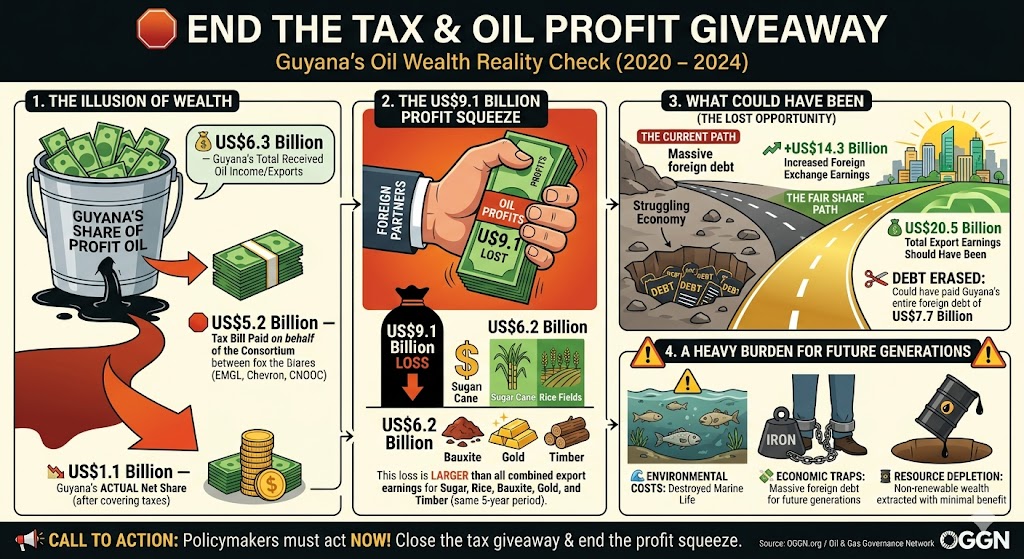
OGGN advocates a simpler, fairer fiscal regime — one where Guyana captures at least 55 out of every 100 barrels produced. Our letters, published February–April 2025 in Kaieteur News and Stabroek News, highlighted the PSA’s structure: up to 75% of oil revenue is allocated for cost recovery, leaving 25% as profit oil split 50/50, with only 2% royalty. Even more troubling are the tax provisions that require corporate taxes to be paid from Guyana’s own share. Repeated requests for clarity from the Government have gone unanswered.
OGGN is committed to safeguarding Guyana’s resources, strengthening democratic institutions, and ensuring that the nation’s oil wealth truly serve the people of Guyana. OGGN penned a series of letters published in Sunday Stabroek and Kaieteur News between February 16 and April 6, 2025. These letters highlighted the lopsided nature of the 2016 Production Sharing Agreement (PSA) between the Government of Guyana and ExxonMobil Guyana Ltd, along with its affiliates Hess Corporation and CNOOC. Under the agreement, up to 75% of the oil produced and sold is allocated for recovery of specified categories of allowable oilfield-related costs. The remaining 25%, referred to as profit oil, is shared equally between the Government and the oil companies, with the latter paying just 2% royalties on overall oil sales. A central focus of our recent advocacy is the PSA’s questionable tax provisions, which require that corporate and income taxes owed by the oil companies be paid out of Guyana’s share of profit oil. OGGN’s attempts to obtain public clarifications on these issues – especially the flow of money from the Natural Resource Fund to the Guyana Revenue Authority (GRA) and the Consolidated Fund – have been ignored by President Irfaan Ali and his administration. A synopsis of the 2025 letter campaign was published August 31, 2025, on the eve of the 2025 General Elections:
Dr. Adams has laid out why a Parent Company Guarantee is a must have. That equation is: Full Liability Coverage = Insurance + Parent Company Guarantee. Full Coverage as outlined in all Environmental Protection Agency (EPA) Permits, comprises of insurance plus a Parent Company Guarantee to cover “any amount” of costs that are above the insurance cap.
Although the government in power in 2016 signed one of the worst oil contracts, the political party that gained power in 2020, and is still in power today, stated in 2019 that it would renegotiate the 2016 PSA. It has been 5 years since 2020, and nothing has been done. While the previous government had 2 projects (Liza Phase 1 and Liza Phase 2) it could use as leverage for a better deal for Guyanese, the current government has had 6 opportunities – the two Liza fields, Payara, Yellowtail, Uaru and Whiptail.
In each instance, it failed to initiate negotiations for better PSA terms. Even simple things like ring fencing can be put in place without any renegotiation to extract better terms for the Guyanese people, but the Government turns a blind eye to these options. There are documented promises by the President and Vice President in the government to renegotiate the oil contract, all of which can be found on our website.
OGGN has frequently made the public aware when Exxon makes statements or behaves in ways that are questionable. OGGN challenged claims by ExxonMobil Guyana’s country president that the company was not making profits in Guyana before 2023, pointing to financial filings showing income of US$681 million in 2021 and US$2.98 billion in 2022. OGGN has made the outrageous tax arrangement under the 2016 Production Sharing Agreement known to US Senators, where the Guyana Revenue Authority issues tax receipts to ExxonMobil for payments that are never actually made by the company, depriving the Guyanese treasury of taxes that are urgently needed for improving the lives of Guyanese. OGGN has advocated for ExxonMobil to provide legally binding parent company guarantees for environmental liability in the event of an oil spill, as required by the Environmental Protection Agency (EPA) permits. OGGN has relentlessly reminded the public via our website and letters to the press, when the Government of Guyana lacks transparency and accountability, such as its failure to publish oil lift data, or the refusal to make public tax certificates, which would show the billions in US$ dollars of taxes foregone, but that are fraudulent receipts which are issued to ExxonMobil Guyana.
This is about Guyanese resources and patrimony. And the Guyanese public has a right to know and a right to ask questions and a right to demand accountability. As the title of this week’s column underlines, Guyanese must pay attention to these attacks that are clearly aimed at disrupting the OGGN site. We will not be silenced.
Originally posted here: https://www.stabroeknews.com/2025/12/01/features/in-the-diaspora/why-oggn-is-under-attack-and-why-guyanese-must-pay-attention/print/