On Monday, September 1, 2025, the people of Guyana will head to the polls in what may be the most consequential General and Regional Elections since independence in 1966. The Oil and Gas Governance Network (OGGN) is committed to safeguarding Guyana’s resources, strengthening democratic institutions, and ensuring that the blessings of our oil wealth truly serve the people of Guyana. In this context, OGGN draws the public’s attention to a series of letters published in the Sunday Stabroek between February 16 and April 6, 2025. These letters highlighted the lopsided nature of the 2016 Production Sharing Agreement (PSA) between the Government of Guyana and ExxonMobil Guyana Ltd, along with its affiliates Hess Corporation and CNOOC. As OGGN and others have documented, the 2016 PSA heavily favours the oil companies at the expense of the Government and the people of Guyana – a fact acknowledged repeatedly by the current administration, including President Irfaan Ali (e.g., https://www.oggn.org/2021/09/29/irfaan-ali-said-that-all-oil-contracts-are-on-the-table-for-review-and-renegotiation/).
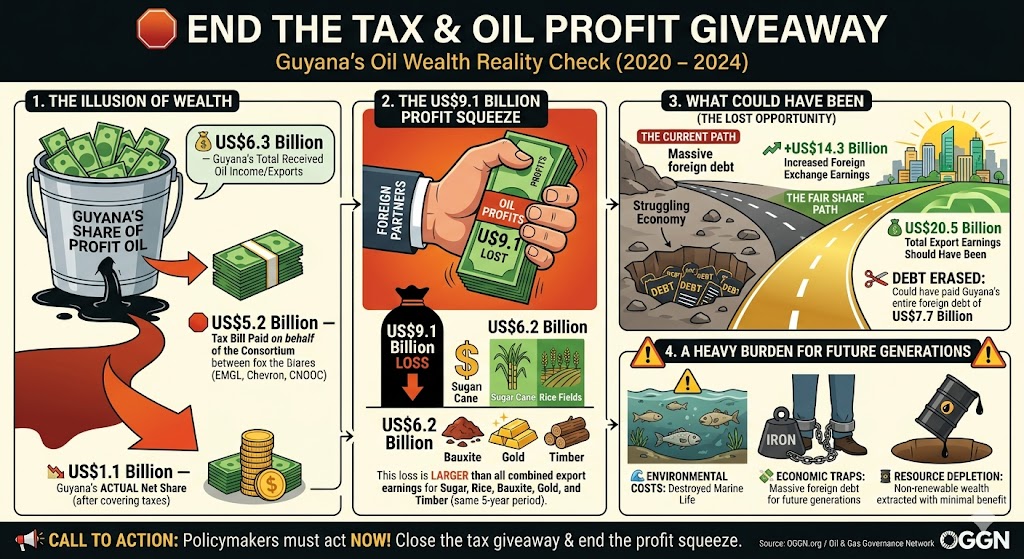
Under the agreement, up to 75% of the oil produced and sold is allocated for recovery of specified categories of allowable oilfield-related costs. The remaining 25%, referred to as profit oil, is shared equally between the Government and the oil companies, with the latter paying just 2% royalties on overall oil sales. A central focus of our recent advocacy is the PSA’s questionable tax provisions, which require that corporate and income taxes owed by the oil companies be paid out of Guyana’s share of profit oil. We also noted a conflict between the 2016 PSA and the 2021 Natural Resource Fund Act regarding tax payments on behalf of the oil companies.
Our attempts to obtain public clarifications on these issues – especially the flow of money from the Natural Resource Fund to the Guyana Revenue Authority (GRA) and the Consolidated Fund – have been largely ignored. Specific questions were addressed to:
· Mr. Godfrey Statia, Commissioner-General of the GRA (February 23, 2025)
· The Hon. Vickram Bharrat, Minister of Natural Resources (March 2, 2025)
· Dr. Ashni Singh, Senior Minister in the Office of the President for Finance and Public Service (March 9, 2025)
· The Hon. Gail Teixeira, Minister of Parliamentary Affairs and Governance (March 16, 2025)
· The Hon. Anil Nandlall, Attorney General and Minister of Legal Affairs (March 23, 2025)
· The Hon. Bharrat Jagdeo, Vice President overseeing Finance, Natural Resources and the Environment (March 30, 2025)
· His Excellency, Dr. Irfaan Ali, President of the Cooperative Republic of Guyana (April 6, 2025)
Herewith, OGGN takes the opportunity to reiterate these questions once again as a reminder and to the attention of the public.
Given Commissioner-General Godfrey Statia’s leadership of the GRA and the agency’s responsibility in overseeing tax administration in Guyana, OGGN calls on him to publicly clarify the following:
1. Has the Minister of Natural Resources made the required tax payments on behalf of ExxonMobil and its partners for the years 2020, 2021, 2022, and 2023? If this is indeed the case, which fund was extracted or which government budget code was charged to pay the Contractor’s taxes as required by article 15.4 of the 2016 Petroleum Agreement?
2. Has the GRA issued corresponding tax certificates for these payments? To whom (name and position of company official), and when (dates) did the GRA issue the corresponding tax certificates for these payments, and what exactly was certified?
3. What is the total sum of tax payments made from Guyana’s share of oil revenues to cover ExxonMobil and its partners’ obligations?
4. Has there been any independent audit or verification of these payments, and where is the public documentation confirming this?
Given the Minister of Natural Resources responsibility for remitting the tax payments on behalf of the oil companies to GRA, OGGN formally requests that the Hon. Vickram Bharrat publicly confirm and provide verifiable evidence of the following:
1. That the Minister of Natural Resources has paid the required corporate income taxes on behalf of ExxonMobil and its partners for the years 2020, 2021, 2022, and 2023, as stipulated in Article 15.4 of the 2016 Production Sharing Agreement;
2. That these taxes have been paid, and from which fund or government budget allocation were these taxes drawn; and
3. That the Guyana Revenue Agency issued tax certificates for these payments, and to whom were the tax certificates issued, and on what dates. Furthermore,
4. What is the total sum of tax payments made from Guyana’s share of oil revenues to cover ExxonMobil and its partners’ obligations?
5. When did these payments undergo independent audit and verification, and where is the public documentation confirming audit?
To uphold transparency and accountability in Guyana’s oil and gas sector, Dr. Ashni Singh, Senior Minister in the Office of the President with Responsibility for Finance and the Public Service must confirm whether the Ministry of Finance has provided relevant data on all material financial flows for the Extractive Industries Transparency Initiative (EITI) Annual Reports. Given this, the public deserves detailed answers to the following:
1. What specific details has the Ministry of Finance disclosed regarding tax payments made by the Government of Guyana on behalf of ExxonMobil and its partners for inclusion in EITI reports?
2. For the EITI reports of 2020, 2021, and 2022, what specific information has the Ministry of Finance provided regarding these tax payments, and how has this been reflected in the reports?
3. What measures have the Ministry implemented to enhance transparency regarding these payments, and how do they align with international best practices in extractive sector governance?
Given the UN Human Rights Committee (UN-HRC) concerns and recommendations regarding the Access to Information Act 2011, OGGN formally requests that Minister of Parliamentary Affairs and Governance, the Hon. Gail Teixeira, who represented the State party at the public hearings of the UN-HRC in Geneva (March 18 to 20, 2024), provide a public statement addressing the following points:
1. What measures have been taken to ensure the effective implementation of the Access to Information Act 2011?
2. What steps have been taken to improve the accountability and transparency of the Commissioner of Information?
3. For which years did the Commissioner submit annual reports to the National Assembly, as required by the Act?
4. How has the Act been revised to facilitate citizen access to public information, excluding matters of personal privacy or national security?
Given the apparent contradiction between the 2016 PSA and the NRF Act (2021) with regard to tax payments on behalf of oil companies, OGGN respectfully requests the Attorney General, the Hon. Anil Nandlall, to clarify the following key points for the public:
1. How can the Government of Guyana fulfil its contractual obligations regarding tax payments to ExxonMobil and its partners under the 2016 PSA without violating the spending restrictions imposed by the NRF Act (2021)?
2. Why did the Attorney General, acting as the Government’s Chief Legal Advisor, not recommend the inclusion of tax payments as a third lawful category of spending under the revised NRF Act?
3. What is the legal basis that empowers the Commissioner-General of the Guyana Revenue Authority to issue tax certificates on behalf of oil companies when those taxes are not paid by the companies themselves, but rather by the government?
4. Given that Section 103 of the Income Tax Act requires tax compliance certificates to be issued only when a taxpayer satisfies all tax obligations, what kind of documentation—such as validated transfers from the NRF to the Consolidated Fund or budgeted allocations—must the Minister of Natural Resources provide to the GRA to meet this standard?
5. Why is there no independent audit or verification process in place for the Government’s tax payments on behalf of the oil companies, and where can the public access documentation that confirms these payments?
6. What verification process does the Government of Guyana have in place to validate the issuance of tax credit documentation to foreign tax authorities?
Given that Vice President Bharrat Jagdeo is a senior cabinet member and plays a central role in Guyana’s oil and gas governance, which includes specific oversight responsibilities for finance, natural resources, and the environment, OGGN urges him to exercise his responsibility and leadership by:
1. Ending the practice of the Government paying taxes on behalf of ExxonMobil and its affiliates, as stipulated in the 2016 PSA;
2. Guaranteeing full transparency in the flow of oil revenues to the Guyana Revenue Authority and the Consolidated Fund;
3. Ensuring that all tax certificates issued to the oil companies are backed by actual, audited tax payments; and
4. Amending the 2016 PSA, resolving its conflict with the 2021 NRF Act, and invoking Article 32 (Stability Clause) to bring Exxon and its partners to the negotiating table.
Finally, given President Dr. Irfaan Ali’s constitutional responsibilities to promote the well-being and rights of the Guyanese people, OGGN asks the following:
1. Why has the President not appointed an independent Commission of Inquiry to investigate the signing of the 2016 PSA?
2. Why has the President not hired international tax experts to assess the legality of the tax arrangements in the 2016 PSA, including the issuance of foreign tax certificates for taxes paid by the Government on behalf of oil companies?
3. Why has the President not directed cabinet members to respond to the issues raised by OGGN, such as the conflict between the 2016 PSA and the NRF Act?
4. What steps has the President taken to address the shortcomings of the Access to Information Act of 2011, which the UN Human Rights Committee highlighted in its 2024 report?
5. Why does the President reject calls to amend the 2016 PSA? What prevents him from invoking Article 32 of the PSA to bring ExxonMobil and its partners to the negotiation table?
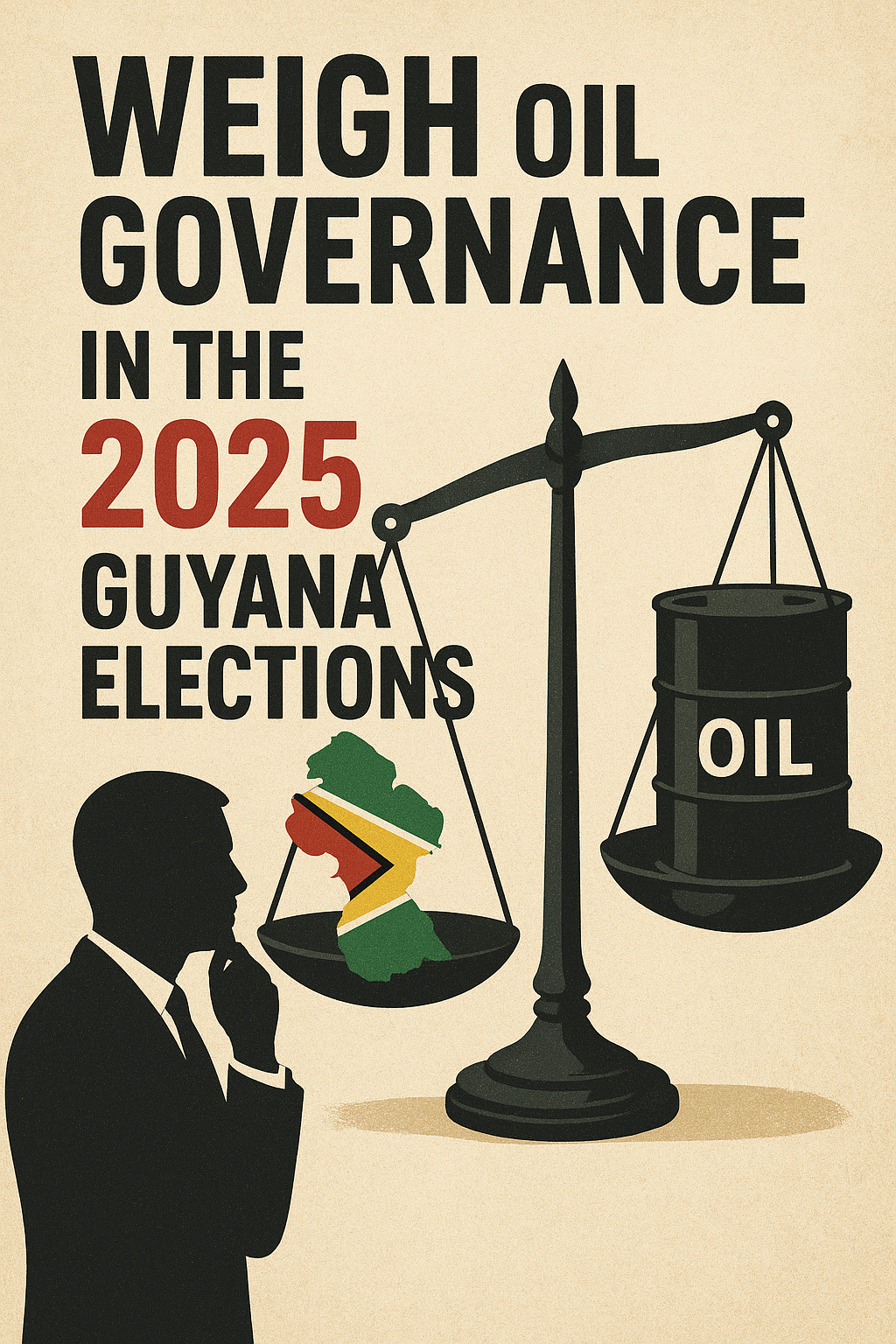
As Guyanese decide who deserves their vote and support, these unresolved questions strike at the very heart of our democracy and our nation’s future. The stewardship of our oil wealth will determine whether prosperity is broadly shared or whether inequities are entrenched for generations. It is therefore vital that every citizen carefully consider the record of transparency, accountability, and fairness in the management of the petroleum sector when casting their vote. This election is not only about choosing political leaders – it is about charting the long-term future of our country and ensuring that Guyana’s oil wealth benefits all citizens well beyond the depletion of our petroleum resources.
Sincerely,
Andre Brandli
Darshanand Khusial
For the Oil and Gas Governance Network (OGGN), www.oggn.org