

By Janette Bulkan, Kenrick Hunte, Darsh Khusial, John Palmer, Mike Persaud and Andre Brandli
On 10 December 2025, the seizure by United States military forces of the Skipper, a Very Large Crude Carrier (VLCC) oil tanker falsely flying the Guyana flag, off the Venezuelan coast, made front page news in Guyana and around the world. Ten days later, on 20 December, US forces seized a second tanker, the Panama-flagged Centuries. On Monday 22 December, US forces were reportedly pursuing a third oil tanker linked to Venezuela. USA seizure of oil tankers transporting Venezuela oil [but excluding Venezuelan oil pumped by Chevron and destined for the USA] is among the suite of US actions, including sanctions, aimed at ousting Nicolas Maduro from power, who was finally illegally kidnapped by the USA on 2 January 2026.
Meanwhile, next door in Guyana’s waters, information on tanker traffic can be gleaned painstakingly by checking the websites of the Maritime Administration Department (MARAD) and the Environmental Protection Agency (EPA).
The mandate of MARAD – created by the Shipping Act (section 4, cap. 49:01, 1998) – includes the determination or investigation of the amount or type of bulk cargoes and dangerous goods, and general maritime safety. So arrivals should be logged and publicised through Nav Warnings. Only the Nav Warnings of the current year [2025] are immediately accessible through this website.
The mandate of the EPA – created by the EP Act (cap. 20:05, 1996) – includes the issue of environmental permits under section 13 of the Act. Crude Oil Transfer (COT) permits cover the offloading from a Floating Production Storage and Offloading vessel (FPSO) to a lifting tanker. Each permit covers only one lift. Permits are listed year-by-year.
OGGN reports here on a brief study of oil shipping data for the half-year January-June 2025. This link will take you to a table with eight columns posted on OGGN’s website. Column A is a list from 1 to 156 of the MARAD Nav Warnings. Column B lists the name of the FPSO stationed in Guyana’s waters into which the oil was extracted. The three FPSOs are the Liza Destiny (Liza-1 oil field), Liza Unity (Liza-2 oil field) and Prosperity (Payara oil field). Column C lists the name of the offloading tanker. Column D lists the MARAD Notice Date, and Column E the MARAD approximate loading date. Column F lists the EPA crude oil transfer (COT) number and Column G lists the EPA Environmental Permit Number. Column H lists the EPA-FPSO lifting schedule dates.
More than 100 tanker loads from Guyana in January-June 2025
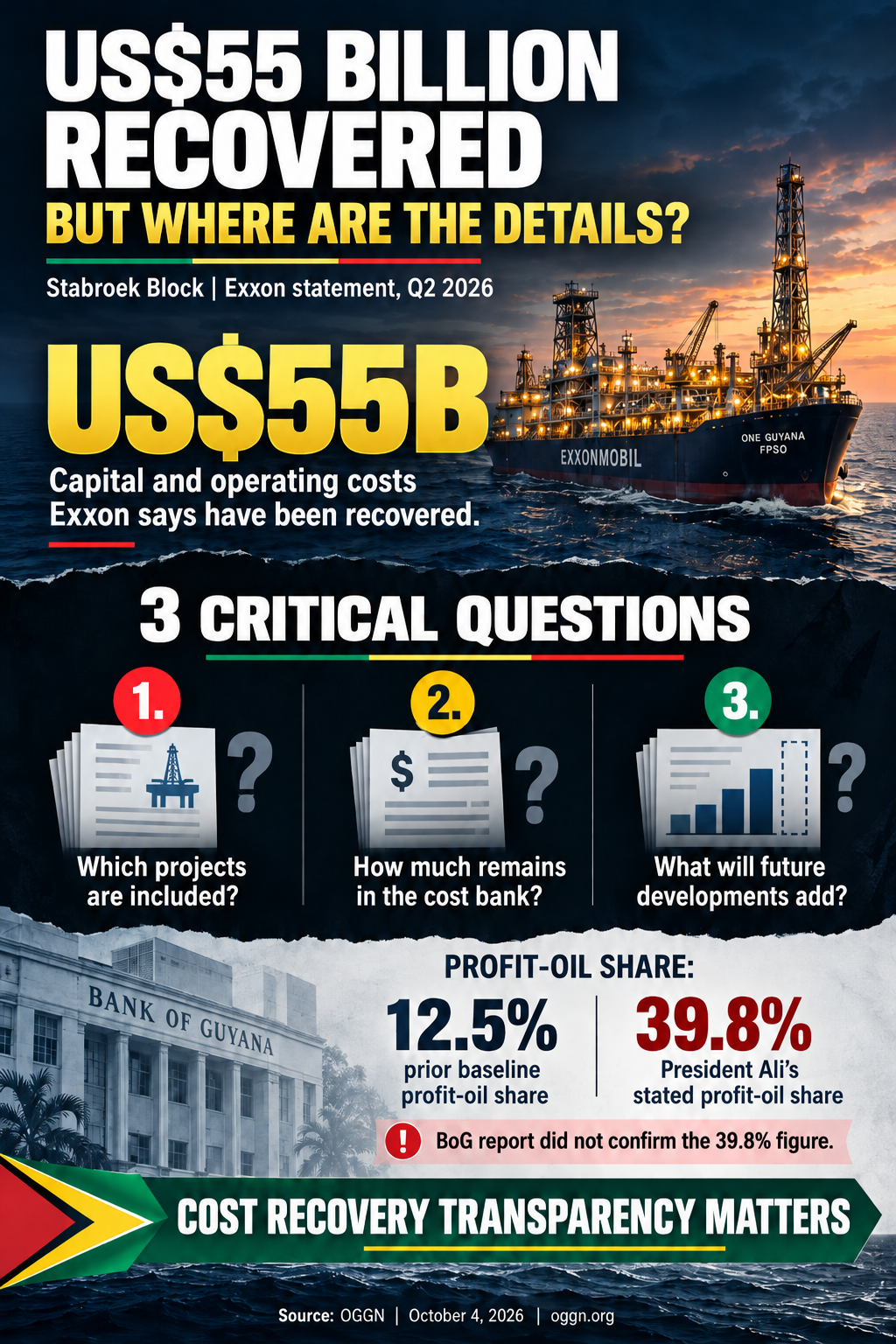
The half-year report 2025 of the Bank of Guyana mentions 13 lifts of oil (page 81) while the July-September 2025 quarterly report on the Natural Resources Fund (table 6, page 20) shows 15 lifts of Guyana’s share of the profit oil. A lift of oil means the physical loading of crude oil from one of the FPSOs through a floating hose into a transporting tanker. Each load is worth USD 75 million or more at market price.
The maritime safety information, Nav Warnings, published by Guyana’s MARAD show about 113 tanker arrivals in this half year. Guyana’s share of the total marketed oil is 12.5 per cent, according to the Production Sharing Agreement (Article 11.4, page 26, 2016) or about 1 in every 8 tanker lifts. 15 lifts for Guyana means a total of about 120 lifts, about the same as MARAD’s Nav Warning numbers and EPA’s 116 COT numbers (25 for FPSO Liza Destiny, 45 for FPSO Liza Unity and 46 for FPSO Prosperity).
Why are oil cargoes secret in volume and value?
Our study summarised here follows on from the letter ‘Shortage in the oil payment, January to June 2025: US$ 152 million’ from the Oil and Gas Governance Network (OGGN) published in Kaieteur News and Stabroek News on November 23. That letter noted the failure of government to release oil lift data, in contrast to a promise made by Vice President Jagdeo at his Press conference on February 09, 2021.
This secrecy should be compared with the detail released by the then Minister of Finance [Winston Jordan] in January 2020 when Exxon was filling the tanks of FPSO Liza Destiny for the first offload in February 2020. The Minister’s Report on Petroleum Production & Revenues included ‘information on production, including all oil produced in that month, barrels used for facility fill, crude remaining in the hose and piping of cargo tanks and the crude offloading point that connects to the offloading vessel, whether changes are made to volume of ballast crude, whether there were operational losses or crude used for transportation. A table accompanies this information, which shows the mathematics to ensure the public knows where all its oil went’.
Minister for Natural Resources [Vickram Bharrat] has argued against independent metering of oil extraction and production, on the grounds that the government has access to an Exxon data cable purportedly showing FPSO activity at 10-minute intervals. The question is: can the Minister check that the dashboard which he is seeing is of real data or simply a masquerade of the kind prepared by some international oil companies for governments of some Middle Eastern countries in the 1960s?
If indeed the Ministry is seeing real data of the kind and quality released in January 2020, then the subsequent failure to publish in Guyana is another hole in the government’s claim to be transparent in its communications to citizens; like the complete refusal to activate the Access to Information Act since that Act was passed in 2011.
The Minister for Natural Resources assured in August 2024 that the Guyana Revenue Authority (GRA) and Guyana National Bureau of Standards (GNBS) were continuously checking all aspects of petroleum extraction and production on the-then three operational FPSOs. Unfortunately, they are silent services in relation to petroleum, publishing no reports or commentaries, nor interpreting the data flows for Guyanese citizens about the efficiencies of the FPSOs, about discharges of the enormous volumes of treated and untreated wastes, and about the emissions of vast clouds of greenhouse gases.
The petroleum management program in the Ministry of Natural Resources (MNR) has moved the daily reports disclosed on the website www.petroleum.gov.gy/data-visualizations?id=207 to a new set of pages under www.petroleum.gov.gy/data-centre/. These pages of graphs include oil production and price for the oil grade; gas injected, flared and used; water produced and injected. We had and have no confirmation by independent auditors that these graphs were and are accurate records of daily flows. It is not possible to know from these graphs or from MARAD or EPA at what price per barrel each oil lift has been sold, or the exact number of barrels lifted by each tanker.
Why can’t we be more certain, given that most lifts are by SuezMax tankers of 1 million barrels oil capacity, each lift worth about USD 75 million in 2015? Some lifts are by VLCCs with up to 2 million barrels of oil.
Do we have a cross-check against the MARAD Nav Warnings?
Yes, the Environmental Protection Agency issues environmental permits for Crude Oil Transfer (COT) to each offloading tanker. More or less. MARAD Nav Warnings used to be uploaded to its website daily but are now uploaded only on the 25th of each calendar month. EPA environmental permits are listed apparently in random order and at random times. There should be a 1-to-1 match: for every unique Nav Warning number there should be a corresponding unique EPA Crude Oil Transfer (COT) number and Environmental permit number.
Discrepancies and uncertainties
But just in this half-year – January-June 2025 – we found the following six kinds of discrepancies and uncertainties. Under each kind of discrepancy, we show the tanker arrivals for January-June 2025. Tanker names are shown in the more complete report on the OGGN website [https://www.oggn.org/oil-tanker-arrivals-in-guyana/ ], together with the table summarising all estimated tanker arrivals during January-June 2025 from the MARAD and EPA web pages referenced above.
- two (consecutive) MARAD Nav Warnings for the same tanker, same arrival date, same FPSO but only one EPA/COT. There may have been accidental duplication of Nav Warning numbers. 2 tankers in this category.
- two MARAD Nav Warning numbers for the same tanker and same FPSO but different arrival dates and only one EPA/COT. The two numbers may indicate uncertainty about arrival date. 5 tankers in this category.
- two EPA Crude Oil Transfer numbers but only one MARAD Nav Warning. 1 tanker in this category.
- two MARAD Nav Warnings and two EPA/COT numbers for the same tanker with arrivals a few days apart, lifting from one or two FPSOs. These numbers also may indicate uncertainty about arrival date. When two FPSOs are indicated, this could indicate uncertainty about which FPSO was actually offloaded, or it could indicate that the tanker lifted part-loads from both FPSOs. The tankers listed in this section are Very Large Crude Carriers (VLCCs) with twice the lifting capacity of the SuezMax tankers mostly used for offloading from Guyana (2 million versus 1 million barrels). In the half-year January-June 2025, there were 56 named SuezMax tankers and 13 VLCC tankers, plus 1 Ultra Large Crude Carrier (ULCC, a tanker for more than 3 million barrels of oil). So lifting from two FPSOs would be not unusual, especially if the buyer wanted two different grades of oil. 8 tankers in this category, two of which loaded twice in Guyana during January-June 2025.
- error in EPA Crude Oil Transfer number. 3 tankers in this category.
- two EPA/COT numbers not matching any MARAD Nav Warning numbers. 2 tankers in this category.
For 8 of the last 10 tanker lifts in June 2025 the EPA/COT numbers can be estimated but not verified because the EPA website folders have not been updated since 20 June 2025. These 10 lifts are not included in the six categories mentioned above.
The EPA environmental permit numbers are a combination of 8 digits and 5 letters. It is not clear why several sets of the same 8 digits are reused just in these 6 months in 2025, or why sets of the 5 letters are also reused? OGGN did not detect improper reuse of any particular combination of digits and letters.
OGGN does not claim that all discrepancies have been detected for January-June 2025. The cross-checking is a tedious process because of EPA’s random postings of environmental permits. OGGN cannot be sure if these discrepancies are just due to poor record keeping in, and lack of coordination between, MARAD and EPA, or if some tankers are departing – each with about USD 75 million worth of oil – but not properly recorded by the government of Guyana.
Can auditors check the volumes and values?
Even if the MARAD and EPA files were error-free and matched, a reader could not see which oil tanker lifts represented Guyana’s 50 per cent share of profit oil, roughly 1 in every 8 tanker offloads (12.5 per cent of the oil extracted and sold). The MARAD and EPA files do not detail the exact volume of oil in each lift, or its market value. It is not possible to associate a payment by Exxon into the Natural Resources Fund with a specific tanker lift, because of the delay between offloading and payment which is allowed by section 11.7 of the Production Sharing Agreement 2016, and because neither Exxon nor the GRA publish the volume and market price per barrel of each lift. It is not clear if the GRA auditors are verifying independently, through on-board monitors, the volumes and sale values of each oil lift as declared by Exxon Mobil Guyana Ltd. (EMGL).
Vice President Bharrat Jagdeo, under his constitutional mandate (September 2025) for ‘specific oversight responsibilities for finance, natural resources and the environment’ should be very concerned if there is occasional large-scale ‘tiefing’ because the government has rejected the idea of independent monitoring of oil extraction and production. Our study notes large discrepancies between MARAD and EPA data, linked to the government’s failure to function as a responsible custodian of the nation’s assets.
Why should Guyanese be concerned about vehicle speeding tickets but not about huge amounts of oil?
Why should Guyanese be concerned about the arrivals and departures of oil tankers far out of sight, 200 km offshore, from Floating Production Storage and Offloading (FPSO) vessels hardly anyone has ever seen, pumping oil that never sees light of day in Guyana? Part of the answer is that the potential loss from just one unreported tanker transporting Guyana’s oil to a buyer is valued around USD 75 million.
Guyana does not have a credible Petroleum Commission (a commitment in the 2020 PPP election manifesto). Instead of pursuing oil tanker traffic, President Ali is pursuing speeding vehicle traffic tickets. The Guyana Police Force issued 42,000 speeding tickets since April, but only ¼ had been paid by 26 November 2025. According to President Ali, “This is about accountability … The system will only work if we have compliance. And Guyana must do better.”
A speeding ticket costs about GYD 7,500 (USD 35), about the same as 14 pounds of chicken in Bourda Market. So 30,000 unpaid tickets are costing the government about USD 1 million. President Ali waxes eloquent about the societal cost of unpaid speeding tickets. But we don’t hear him worrying about the potential loss from just one unreported tanker with USD 75 million of Guyana’s oil, or about the discrepancies in accounting by the three oil companies – EMGL, Hess and CNOOC.
We suggest that, while the President goes about synchronizing the oil monitoring systems, he might ask the USA to share their monitoring data of oil tanker traffic from Guyana’s FPSOs.