In Guyanese Creolese, the word ‘basiddey’ means ‘being in a state of mental disorientation or confusion, dazed, dumbfounded’. The oil giant ExxonMobil certainly seems to have acquired expertise in sowing a state of ‘basiddey’ in successive governments in Guyana.
Relinquishing areas
Last year, in early July 2025, the government announced that ExxonMobil Guyana Limited (EMGL) had finally complied with clause 5 in the 2016 production sharing agreement (PSA), relinquishing some of the huge Stabroek Tract deep-water oil concession first awarded in 1999. The Facebook page of the Ministry of Natural Resources said that 2,534 square kilometres had been returned (https://www.facebook.com/dpiguyana/posts/ the-ministry-of-natural-resources-announced-on-wednesday-that-exxonmobil-guyana-/1051885013787550/), 20% of the Tract area. As the area licensed in 2016 was 26,806 square kilometres (see annex A in the 2016 PSA, https://petroleum.gov.gy/wp-content/uploads/2024/10/Petroleum-Agreement-Oct-7-2016_2.pdf), a schoolchild can see that what has been returned is only just over 9%, not 20%.
Force majeure
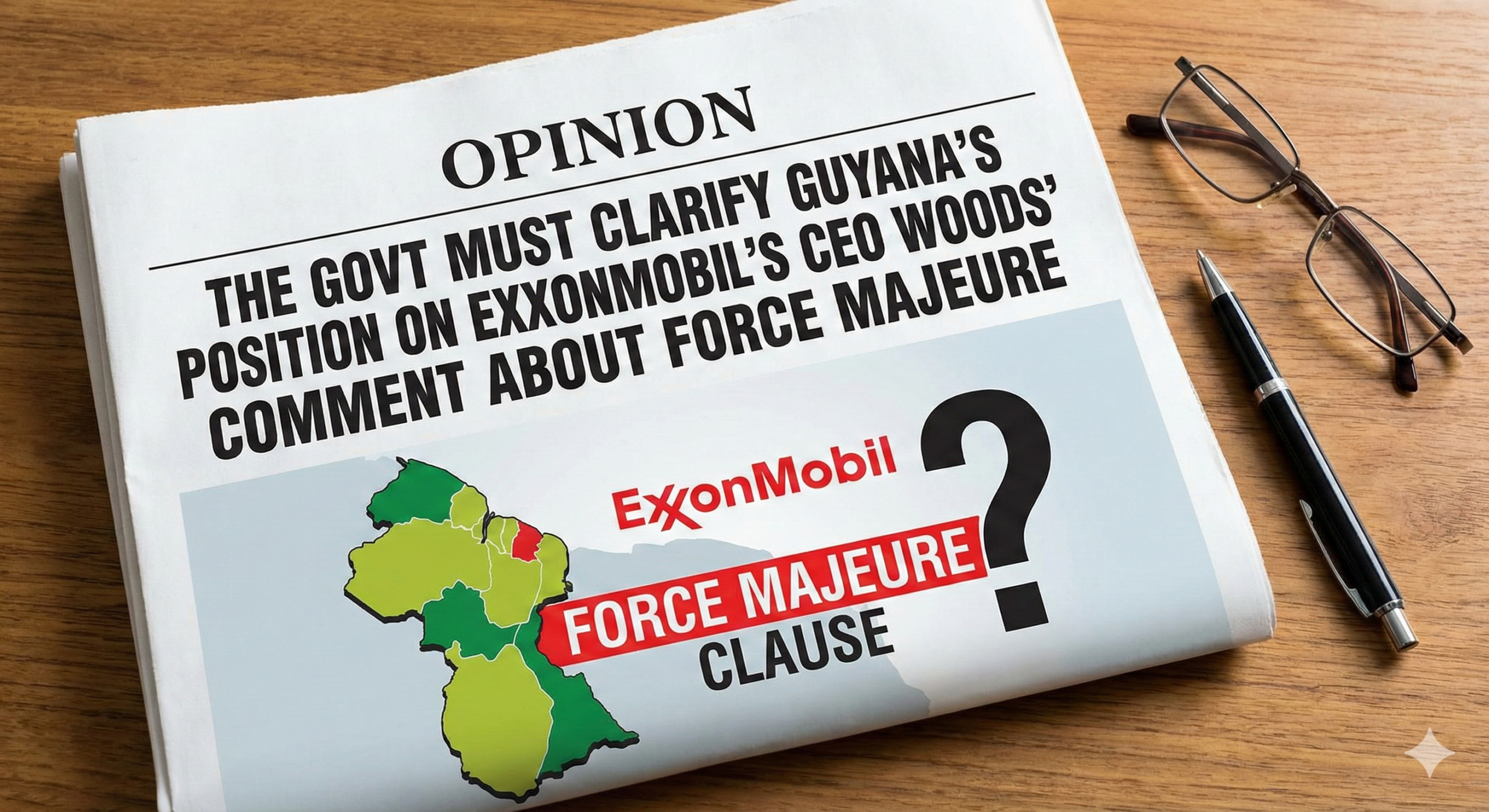
And now it seems that ExxonMobil’s (XOM) CEO, Darren Woods, is regretting even that late compliance; the relinquishment should have been in 2024. CEO Woods is now rumbling about ‘force majeure’, the legal principle that contractual obligations and privileges are frozen because of external circumstances beyond the control of either contracting party. Woods explicitly stated in the XOM Q4 earnings call on January 31, 2026 that force majeure “pauses the clock”; see https://finance.yahoo.com/quote/XOM/earnings/XOM-Q4-2025-earnings_call-395149.html
Exxon’s declaration of force majeure to the 1999 oil concession was made in September 2001, ostensibly because of the military threat against a CGX-contracted drill ship which was allegedly in Surinamese waters. That controversy was laid to rest on 17 September 2007 when the maritime boundary between Guyana and Suriname was settled through a decision of the arbitral tribunal under the UN Convention on the Law of the Sea, https://legal.un.org/riaa/cases/vol_xxx/1-144.pdf.
During the period 2000-2008, Exxon’s obligations – to explore and to pay even the tiny area rental under the 1999 concession – were frozen. Exxon lifted its declaration in 2008, as stated by then President Bharrat Jagdeo, (https://tinyurl.com/fc6rwycn). Jagdeo signed an extension to the 1999 agreement also in 2008, giving Exxon even more time to explore this vast area, 10 times the space usually allowed for oil licenses. We remind readers that the Venezuela border controversy, cynically manufactured in 1962, predates the 2016 agreement by 54 years, and was a known risk. Therefore, it arguably cannot count as force majeure, which typically applies to unforeseen events.
Curiously, when Venezuela also stopped exploratory drilling by Anadarko in the adjacent Roraima tract in Guyana’s Exclusive Economic Zone in October 2013, there was no call by Exxon for force majeure again, https://mail.guyanagraphic.com/uncategorized/guyana-says-venezuelan-navy-has-detained-oil-exploration-ship-operated-us-based/. In December 2018, an Exxon sub-contractor, PGS, informed Stabroek News that a Venezuelan naval ship had stopped its ship, the Ramform Tethys, from continuing seismic surveying in the western portion of the Stabroek Block (https://www.stabroeknews.com/2018/12/22/news/guyana/exxonmobil-pauses-seismic-activities-after-alleged-venezuelan-incursion/). Presumably, that was because Exxon’s exploration had confirmed that there was offshore deep-water oil in the SE part of the EEZ, well away from the NW part where Anadarko had its concession.
Government inaction
But now, with at least 40 actual and potentially commercial oil wells in the Stabroek Tract discovered in the decade 2015-2025, Exxon is looking again at ways of avoiding legal compliance with the relinquishment provisions of the 2016 PSA. Chris Ram pointed out, in number 35 of his Stabroek News columns ‘The Road to First Oil’, that Exxon had inserted in clause 24.1 of the 2016 PSA an interpretation that ‘government inaction’ could be considered as [grounds for] force majeure, (https://tinyurl.com/47e7nkfw).
Unfortunately, there are examples of successive governments of Guyana failing to enforce legislation and the terms of permits against ExxonMobil. Examples are non-payment of a financial penalty for an oil spill, prolonged failure to control flaring of associated gas, failures to report on monitoring as required in EPA environmental authorisation (or government failure to publish such reports), unsafe operation of the machinery on the four Floating Production, Storage and Offloading vessels, and the failure to complete and settle any of four audits of Exxon’s expenses, potentially depriving Guyana of hundreds of millions of US dollars.
Continuation of this ostrich behaviour would reinforce Exxon’s view of force majeure, and so not requiring it to surrender more area from the Stabroek Tract. With this petroleum concession allowing cheap and easy access to commercially invaluable light sweet crude oil, of course it makes sense for Exxon to hang on to the largest possible area. And don’t forget that for this Guyanese-‘owned’ resource, Exxon is paying only USD 1 million rental per year while extracting oil worth billions. We politely ask the government of Guyana to clarify Guyana’s position on Woods’ comment by 12 February 2026, i.e., in a week’s time.
Sincerely
Janette Bulkan
Andre Brandli
Kenrick Hunte
Darsh Khusial
For OGGN (www.oggn.org)