
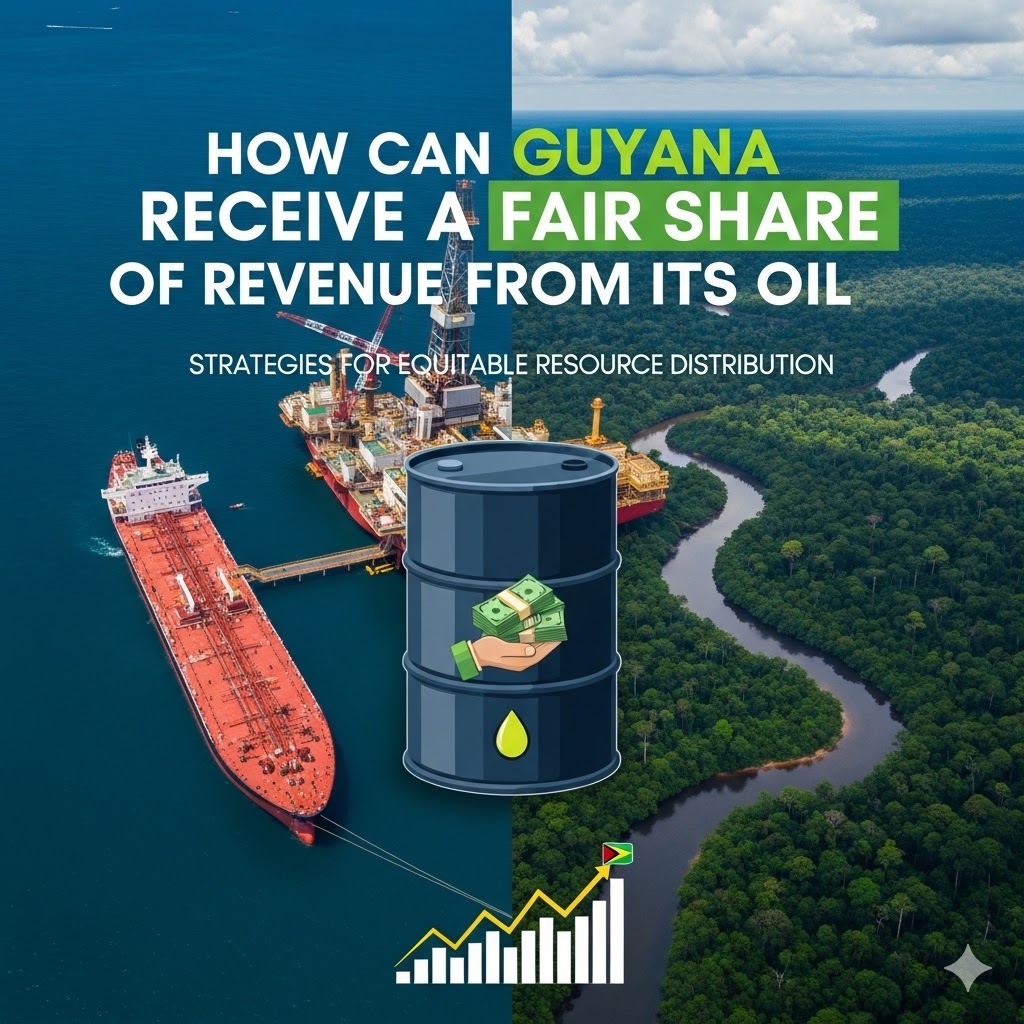
The 2016 Stabroek PSA allows the operator, ExxonMobil Guyana Ltd. (EMGL) to deduct massive expenses against current production—including costs from unsuccessful exploration elsewhere (due to lack of ring-fencing). Because the contract permits up to 75% of oil produced, on a monthly basis, to be used to pay off these Recoverable Contract Costs, we show below that over the life of the Liza 1 project Guyana’s actual take of 14.5 percent of revenue amounts to US $9.7 Billion less. Were ring-fencing employed to limit deductions, and a fair benchmark applied to the operating costs of extracting this premium, low-cost crude, Guyana’s 14.5% of profit oil would be orders of magnitude larger. Outlined below is a derivation of what Guyana’s share of total revenue would be under a ring-fencing model, and a no ring-fencing model, for the Liza 1 Project, which was the first of the 4 projects currently producing oil. Furthermore, the current cost recovery methodology, permitting deductions of up to 75% of revenue, creates a structure where the Company captures the lion’s share of the value. This results in a quantifiable loss of revenue for Guyana for years to come. Crucially, experts such as Chris Ram have noted that the government is not restricted by the contract; ring-fencing can be introduced now without the complex process of renegotiating the PSA.
A review of production data from 2020 to 2024 reveals the scale of the revenue split. Bank of Guyana Annual Reports show that 536.2 million barrels were exported during this period, valued at US$43.5 billion (with an average price of US$81.06 per barrel). Of this total, Guyana received 77.8 million barrels worth US$6.3 billion (14.5 percent). Meanwhile, EMGL retained the vast majority: 458.5 million barrels worth US$37.2 billion, or 85.5 percent of total revenue (Table 1).

Liza 1 Total Revenue, US$36.64 Billion: According to EMGL the commercial quantity of oil that can be extracted from Liza 1 over the projected life of the project is 452 Million barrels of oil; and given the wide fluctuations in oil prices, we assume that the average price for a barrel will be US$81.06 per barrel, which yields US$36.64 Billion for the commercial quantity of oil in Liza 1(Table 2).

Guyana Revenue Share from Liza 1 under the current No-ring fencing (US$ 5.3 Billion):
With no ring-fencing in place, the math for Liza 1 is straightforward but stark:
1. Cost Recovery: The 75 percent cap (PSA Article 11.2) claims US$27.5 billion of the US$36.6 billion total revenue.
2. Profit Split: The remaining US$9.2 billion is split 50/50, netting Guyana US$4.6 billion (Article 11.4).
3. Royalty: The 2 percent royalty adds US$732.8 million (Article 15.6).
In total, Guyana receives US$5.3 billion—its 14.5 percent of the project’s total value.
Guyana Revenue Share under ring fencing (US$15.0 Billion):
Under a ring-fenced model, where costs are restricted to the producing asset itself, the math becomes far more favourable for Guyana:
● Total Project Cost: Reduced to US$8.0 billion (comprising US$3.5 billion in investment and US$4.5 billion in operating costs).
● Total Profit: This lower cost base leaves a massive US$28.6 billion in profit.
● Guyana’s Share: The 50 percent profit split yields US$14.3 billion.
Adding the standard royalty of US$732.8 million brings Guyana’s total revenue to US$15.0 billion. As Table 3 shows, this equates to 41 percent of the total revenue, a stark improvement over the no-ring-fencing scenario.


Captured Revenue (US$ 9.7 Billion) that Guyana never receives: Ring-Fencing versus No Ring-Fencing: While Guyana’s total revenue share under ring-fencing from Liza1 would amount to US$15.0 Billion (41.1 percent of total revenue), but under no ring-fencing Guyana will only receive US$5.3 Billion (14.5 percent of total revenue), it is clear that the willful capture of US$9.7 Billion against Guyana under no ring-fencing (a loss of 26.6 percent of total revenue) is unacceptable and must be changed for the benefit of the Guyanese people (Table 3).
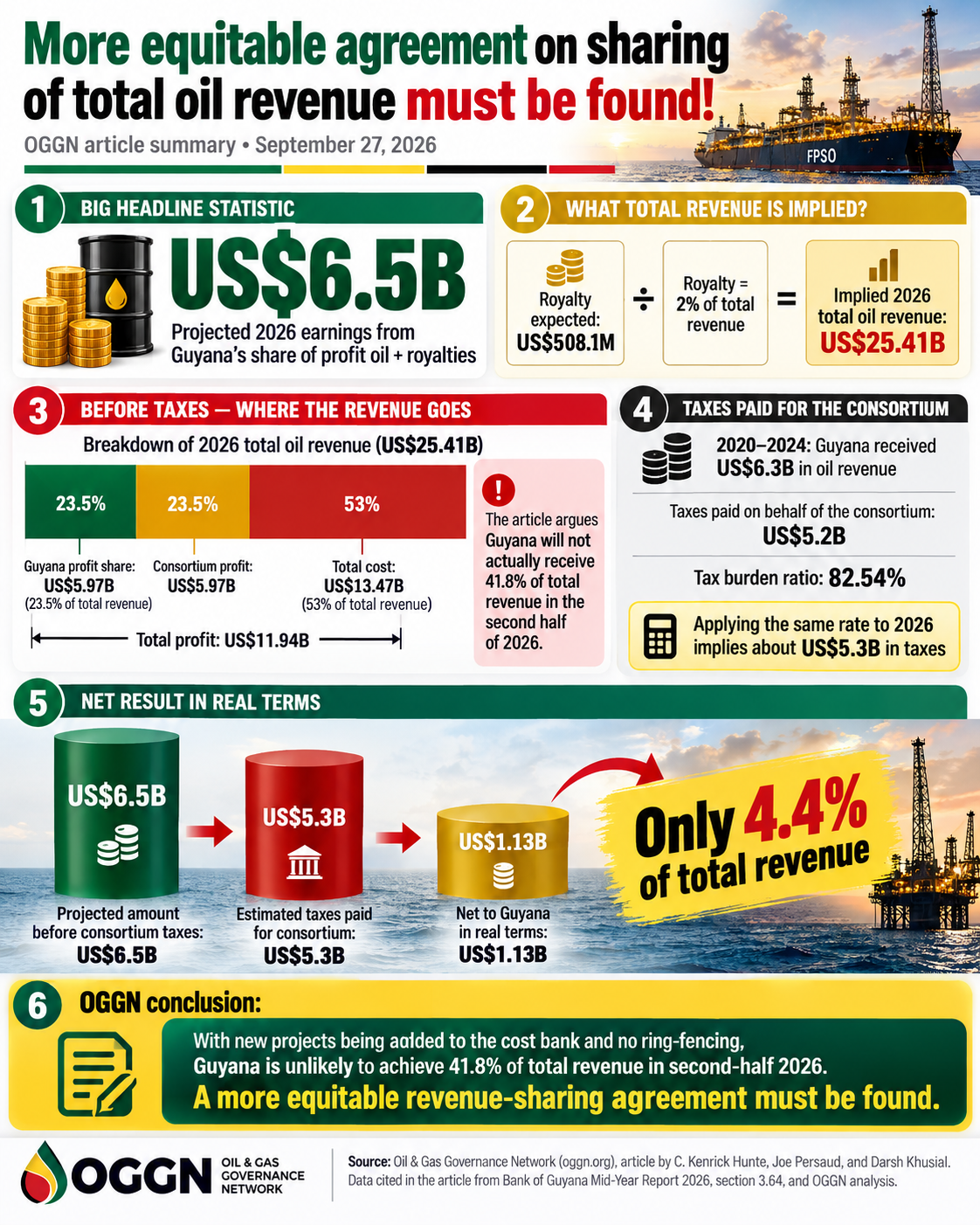
Adding to Guyana’s financial outlay is the requirement that Guyana must pay from its oil revenue the taxes of the company (PSA Article 15.4). This will expand the magnitude of the captured revenue by the company beyond the US$9.7 Billion.
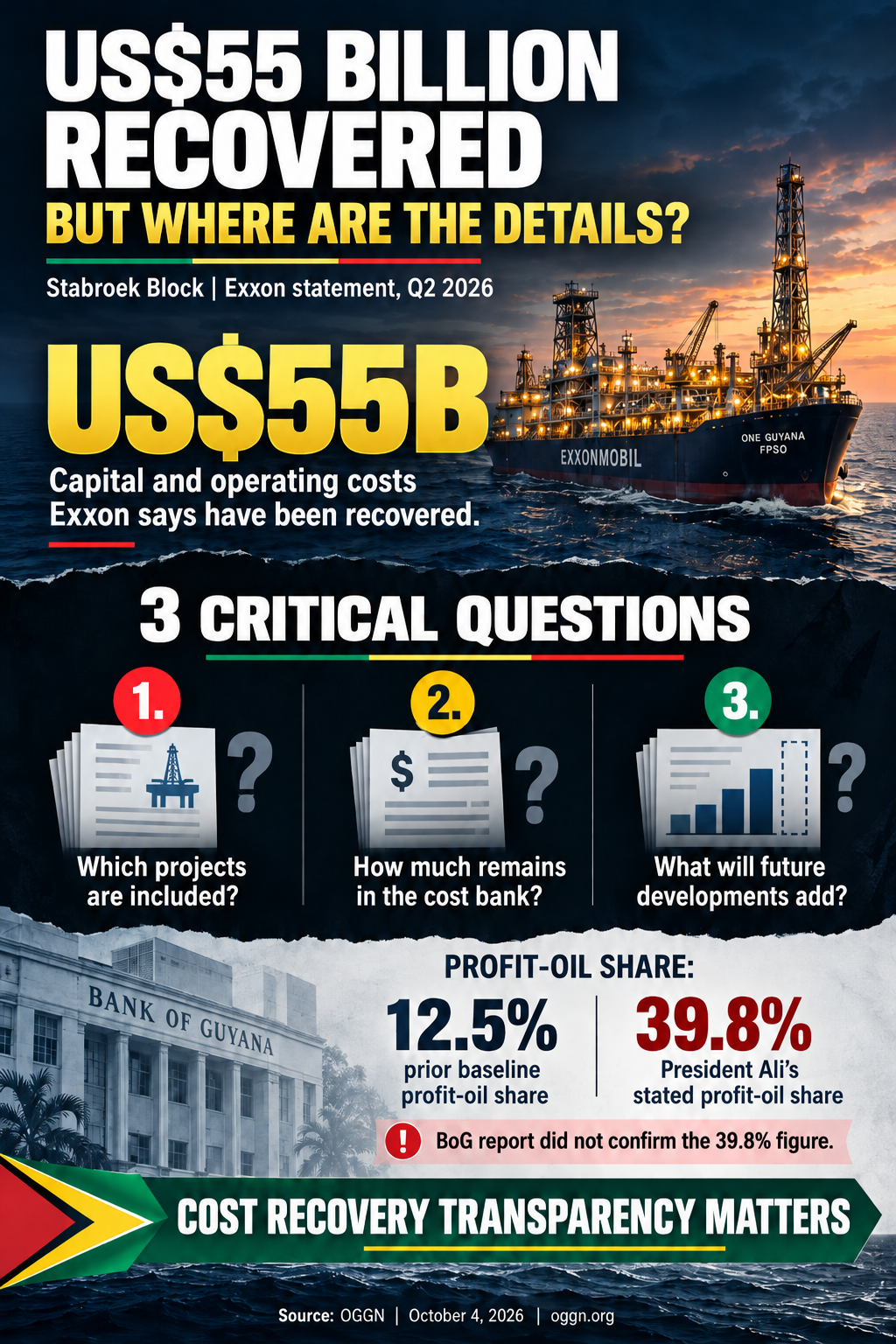
Furthermore, we must dispel the unsubstantiated notion that Guyana’s share of profit oil will eventually rise above the current 12.5 percent baseline. The 2016 PSA contains no clause to trigger such an increase. As long as the lack of ring-fencing allows the operator to consistently hit the 75 percent cost recovery ceiling, our returns will remain stagnant.
Under this mechanism, the ‘expense’ of a barrel is effectively pegged to its market price. For example, at an oil price of US$81.06, the 75 percent recovery creates a deductible expense of US$60.80 per barrel. Mathematically, whenever the price (P) increases, the claimed expense increases in lockstep (Claimed Expense = 0.75 x P). Conversely, if market prices drop and revenue falls short of costs, Article 11.3 allows those losses to be carried forward, indefinitely deferring any increase in Guyana’s share.
Meanwhile, under ring-fencing, the ‘expense’ per barrel is only US$17.74 for Liza 1, consisting of capital expense of US$7.74 per barrel (investment cost divided by the number of barrels of oil). And we will assume an operating cost of US$10 a barrel based on HESS reporting Guyana lifts costs in 2024 of US$6.73/barrel and given the combined 2024 expenditures for the oil companies, excluding depreciation, was US$7.91 per barrel. In January 2020, a month into production, Global Witness had estimated the operating costs at US$10.98/barrel. Hence, we feel US$10/barrel estimate is a reasonable estimate of operating costs given what is known now from the financials of the oil companies. Therefore, the captured difference between the no ring-fence expense of US$60.80 (that is 75% x *81.06) and the ring fence expense of US$17.74, yields an amount of US$43.05 per barrel which is the hidden profit per barrel of oil that is captured by the company. Since Guyana should receive 50 percent of the captured profit, this amount for the 452 million barrels of oil is equivalent to US$9.7 Billion, see Table 3.
Considering this matter of the captured US$9.7 Billion in profits by the company just for Liza 1, it is clear that Parliament must ensure that ring-fencing and credible ‘expense’ calculations are immediately introduced for all proposed new projects, not only for oil, but for all non-renewable resources, such as gold, diamond, silver, bauxite, manganese, and other minerals. This should be part of the work programme of a professionally managed Ministry of Natural Resources.
Meanwhile, a question which can be asked is as follows: What could have been the use of the US$9.7 Billion from Liza 1 captured by EMGL? Here is a possible scenario: The US$ 9.7 Billion could have been used to pay down Guyana’s public debt of US$10.0 Billion. This is the initial analysis of one project, but there are 4 active projects, and 3 more approved for production. Plus, there are many more potential projects. Finally, given the circumstances outlined above, it is clear that Guyanese policymakers must wake-up for it is time to ring-fence all new projects as part of the approval process. It is time for Guyana to receive an equitable share of oil revenue that will safeguard the financial wellbeing of current and future generations. Otherwise, policymakers, history, will note your failures to act in Guyana’s interest.