

A high-calibre delegation from ExxonMobil, led by its Chief Executive Officer and Chairman, Darren Woods, is currently visiting Guyana. On the occasion of a welcome dinner for the visiting delegation, hosted by President Irfaan Ali on the evening of the 56th Republic Anniver-sary observance, Mr Woods unveiled a US$100 million programme to advance training in science, technology and mathematics. The aim is to establish a nationwide network of student STEM centres. The initiative will begin with the training of secondary-school teachers in mathematics and the natural sciences, in collaboration with the University of Guyana, and is expected to reach thousands of educators. Ultimately, the target is to reach tens of thousands of students across the country. In Mr Woods’ words, “Our goal is very simple: inspiring the next generation of Guyana’s engineers and scientists.” The US$100 million investment by ExxonMobil is to be disbursed over a period of ten years, equivalent to US$10 million annually.
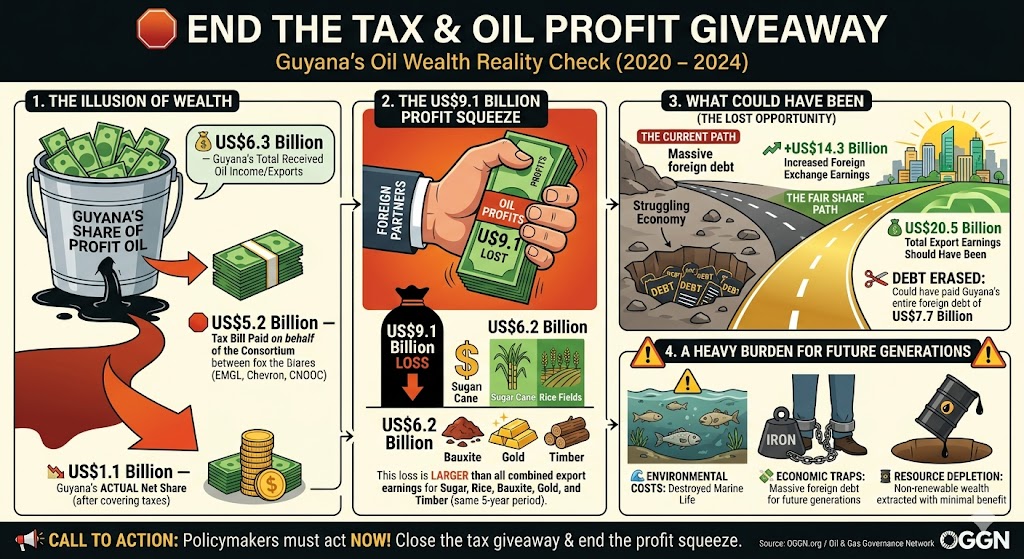
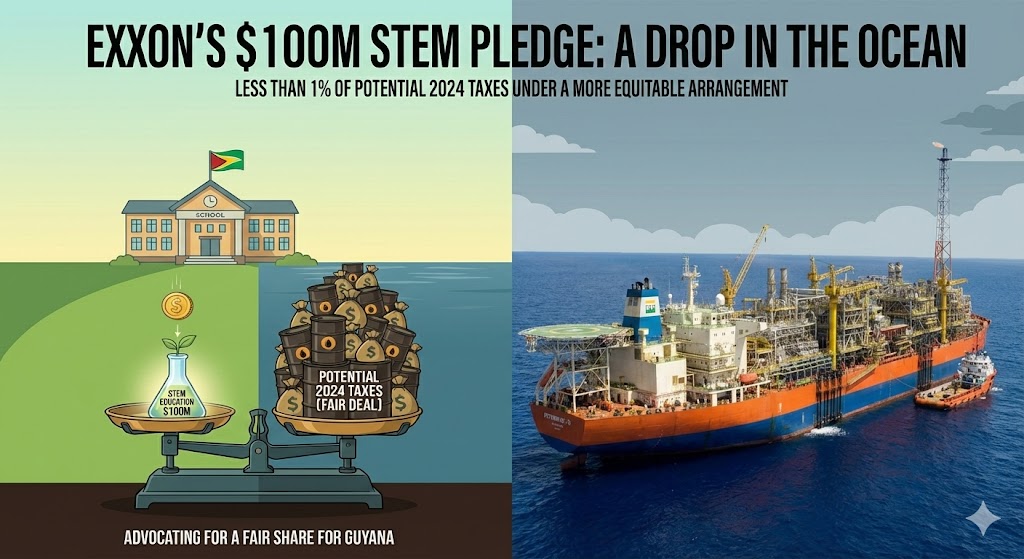
Any private initiative aimed at preparing the youth of Guyana for the challenges of the 21st century must be welcomed. Science and technology form the foundation of modern competitive nations, as they foster innovation and the technical know-how that is critical for Guyana’s economy. While the new partnership between ExxonMobil and the Government of Guyana sounds generous, it needs to be seen in a broader context. ExxonMobil is committing US$100 million over ten years, or US$10 million per year. Under the 2016 Petroleum Agreement between the Stabroek Block co-venturers and the Government of Guyana, the companies’ income-tax liabilities are met from Guyana’s share of profit oil. In 2024 alone, ExxonMobil reported US$1.236 billion in taxes paid in Guyana in its Specialized Disclosure Report (Form SD) filed with the United States Securities and Exchange Commission.
To be clear, these are not taxes paid out of ExxonMobil’s own resources; they are paid by the Government of Guyana on the company’s behalf from Guyana’s share of petroleum revenues, for which the Guyana Revenue Authority is contractually required to issue tax certificates to the contractor. The annual US$10 million investment in Guyana’s STEM education, while welcome, represents approximately 0.8% of the taxes that would accrue to the Government and people of Guyana under a less lopsided petroleum agreement. One may therefore ask: who is receiving the better end of the bargain?
Sincerely,
Andre Brandli
Alfred Bhulai
Janette Bulkan
Kenrick Hunte
Darshanand Khusial
Joe Persaud
Mike Persaud
For the Oil and Gas Governance Network Guyana
(OGGN; www.oggn.org)