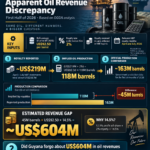

It has been reported that Guyana profit share from oil exports will increase from 12.5% to 39.8%).(https://kiskadeewatch.com/opinion/editorial/profit-oil-of-39-8/). This expected increase in profit is because the total investment cost of the oil project (US$55 Billion) has been repaid in full and profits will therefore increase, due to the only cost item being the operating cost of extracting and selling each barrel of the oil.
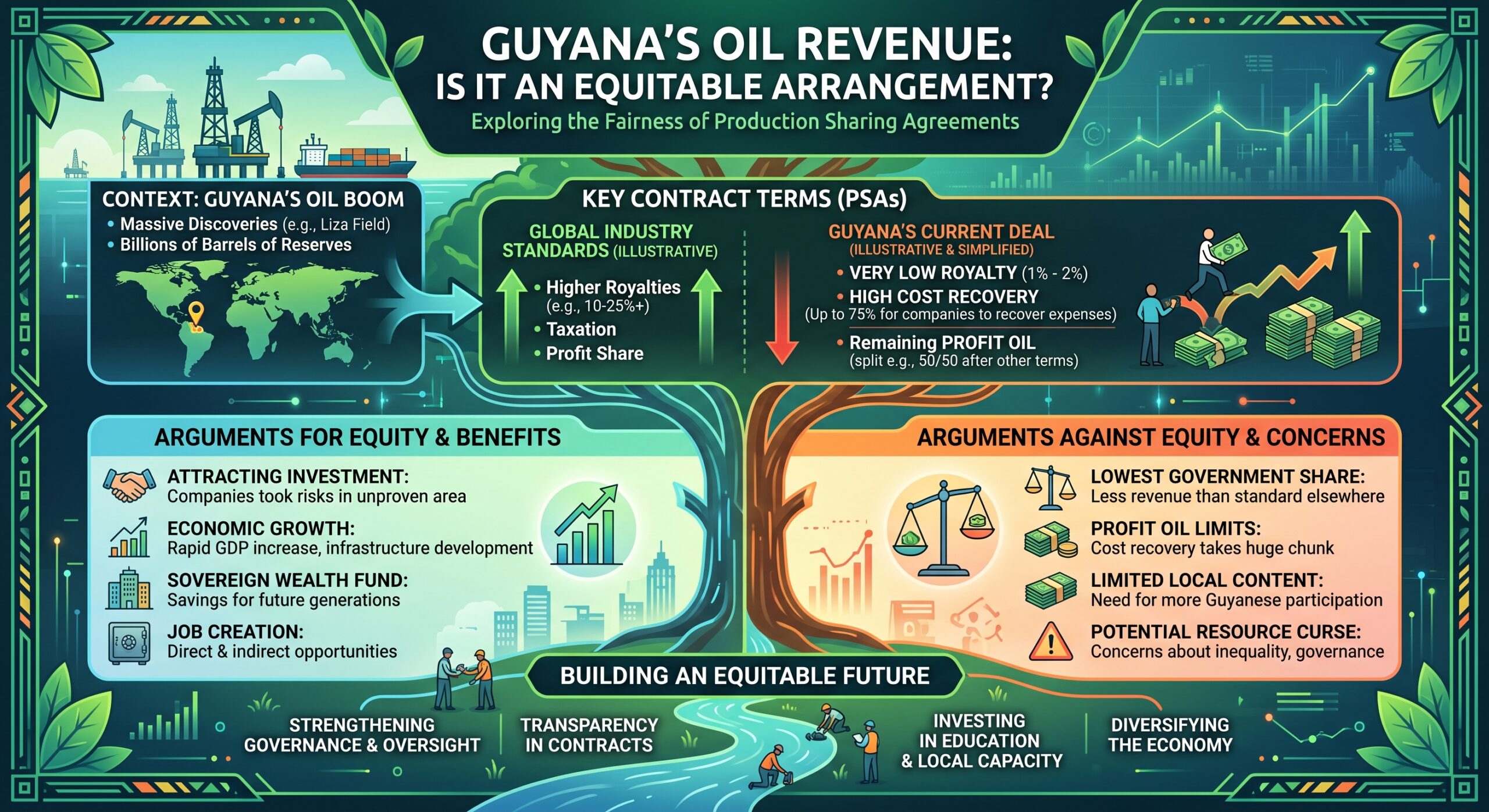
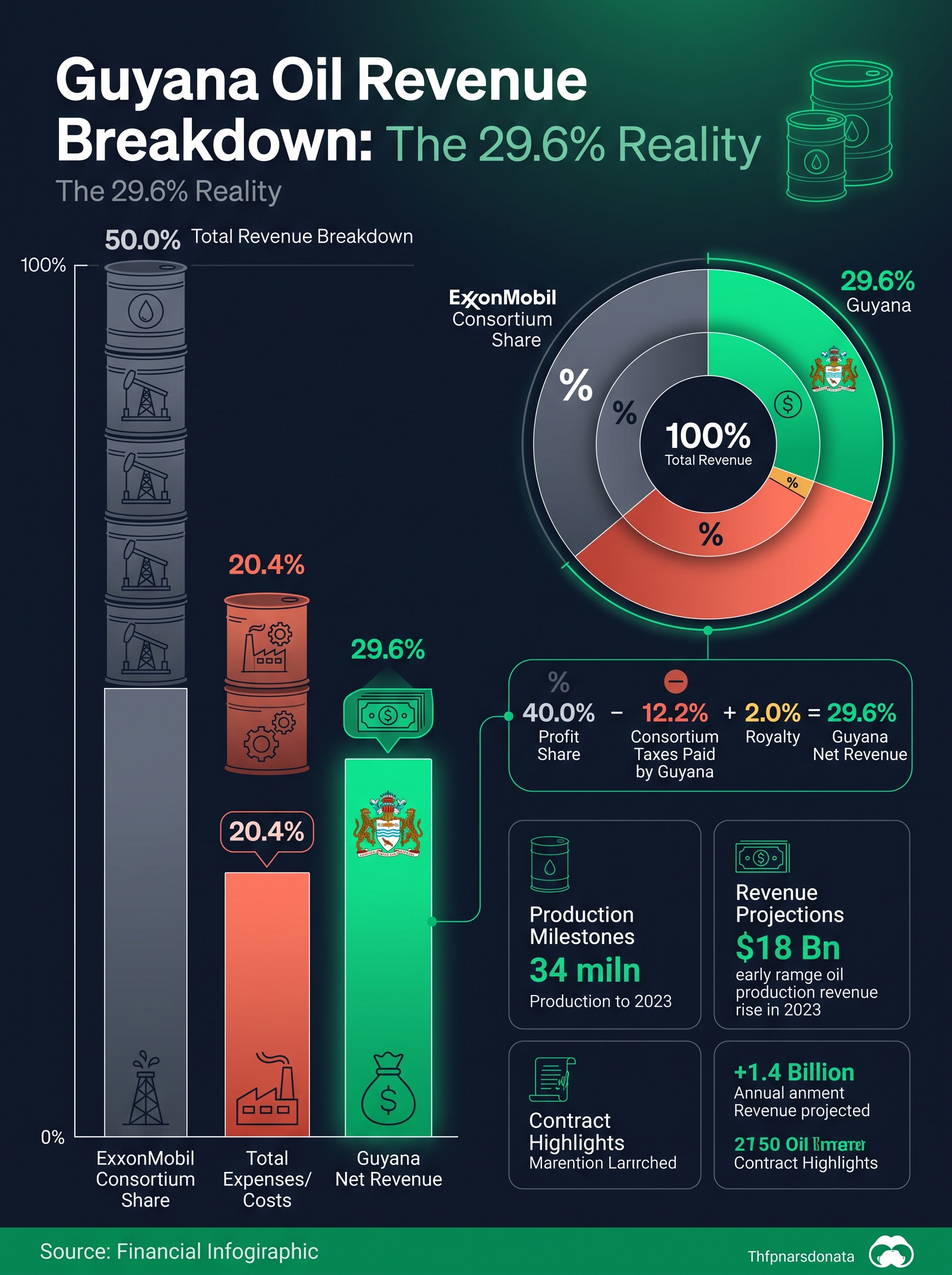
While Guyana’s profit share will increase to 39.8 %, what really matters is not the profit share, but the share of total revenue that Guyana receives after Guyana collects its royalty of 2%; and pays the taxes for the ExxonMobil-led consortium from its share of revenue. Measuring profits in this manner after the Government pays the taxes for the consortium is troubling; and it is not an equitable sharing of the revenue between the consortium and the people of Guyana, who own the non-renewable resource. Therefore, the purpose of this letter is to show how Guyana only receives in real terms only 29.6% of total revenue, while ExxonMobil consortium receives 50 % of total revenue, with total expenses being 20.4% of total revenue.
When Guyana receives profit of 39.8% of total revenue, this implies that the ExxonMobil consortium receives the same amount of profit, yielding a total profit (TP) between Guyana and the consortium of 79.6%. When this profit amount of 79.6% is subtracted from the 100% of total revenue (TR), this yields total cost (TC) of 20.4% of total revenue(Table 1).

What is now required from the consortium is a detailed breakdown of the cost that is associated with the 20.4%. This is important as Guyanese still need to know the average cost of producing a barrel of oil; and how much in real terms will Guyana receive after paying the taxes for the consortium (PSA Article 15.2. 15.3, 15.5); and giving the consortium tax receipts for tax payments the consortium never paid is a benefit to the consortium. This is because the consortium will not frame these receipts and put them on a wall, but they can present these Government of Guyana tax receipts in their specified country(wherever that is) to avoid paying taxes on the money earned in Guyana.
One of the interesting features of the oil price (P) is its variability. For example, given the oil transportation difficulties through the Strait of Hormuz, oil prices today could be US$60.00 per barrel; and the next day, it could be US$100.00 or US$80.00 (https://tradingeconomics.com/commodity/crude-oil). This price information is important because under the current method of calculating the cost of a barrel of oil (CoBO), the cost is specified as: CoBO = (20.4%)P. Therefore, whenever the price changes, the CoBO changes, even though nothing in the CoBO has changed. Table 2 contains information showing when Guyana receives 39.8% of total revenue as profits and the price of a barrel of oil change from US$80.00 to US$100.00 and to US$60.00, respectively. In these price changes, the cost of a barrel of oil is US$16.32, US$20.40, and US$12.24, respectively (Table 2).

Therefore, it is important that the correct cost of a barrel of oil be identified; otherwise, the amount of profit that Guyana receives could be undervalued, when the price increases; or losses could result, when the price of barrel of oil decreases below the real cost of a barrel of oil.
As noted previously, profit is not the only concern for Guyana; instead, what matters is the share of total revenue that Guyana receives after collecting 2 % royalty and paying the taxes for the consortium. In this case, since Guyana received 39.8% as profit and 2 % as royalty, but must subtract taxes of 12.2% of total revenue (the average tax rate over previous years), this gives Guyana a net of 29.6% of total revenue, while the consortium receives 50 % of total revenue and expenses of 20.4% (Table 3).

When the price of a barrel of oil is US$80.00, Guyana receives US$23.65 per barrel of oil; when it is US$100.00, Guyana receives US$29.56 per barrel; or when it is US$60.00, Guyana receives US$17.76 per barrel of oil. It is therefore recommended that the CoBO must exclude the price of a barrel of oil from its accounting methodology.
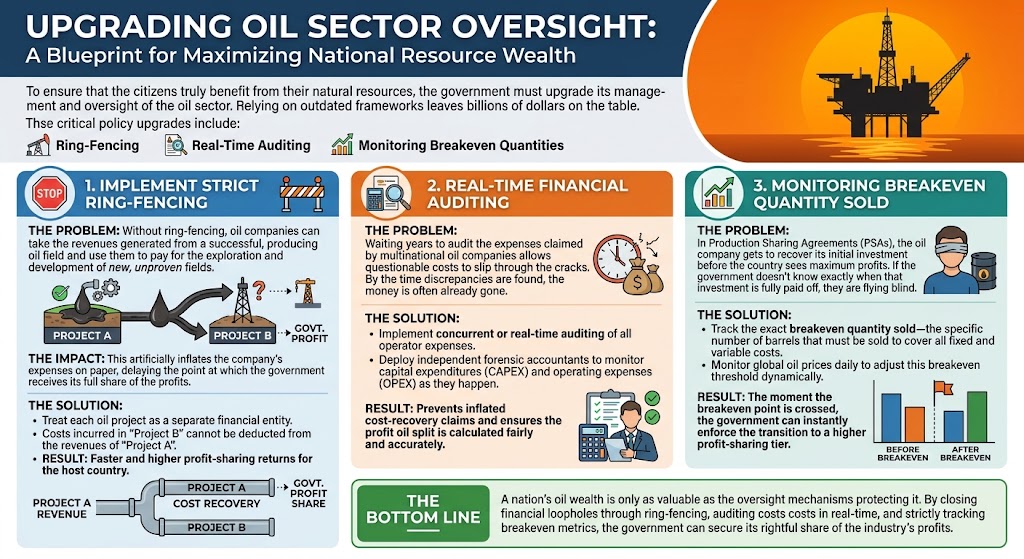
To conclude, it is clear that the consortium receives 50% of total revenue, while Guyana receives 29.6% of total revenue, with expenses being 20.4% of total revenue. Moreover, the real cost of a barrel of oil must be obtained; and real time auditing is required. Also, Guyana paying the taxes of the consortium must be terminated; and ring-fencing must be a central pillar of the new projects that are expected to be started shortly.
Sincerely,
Dr. C. Kenrick Hunte
Professor and Former Ambassador