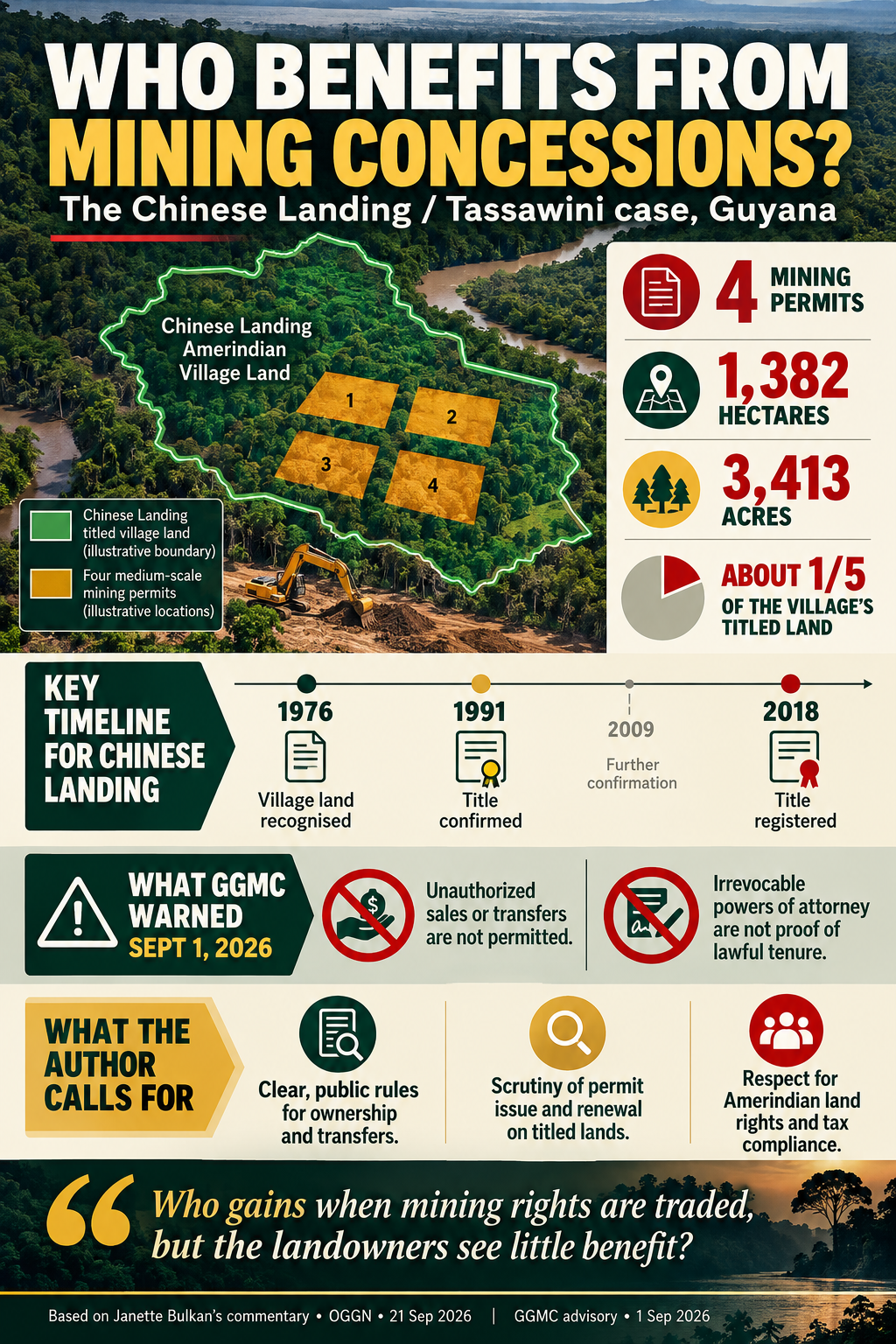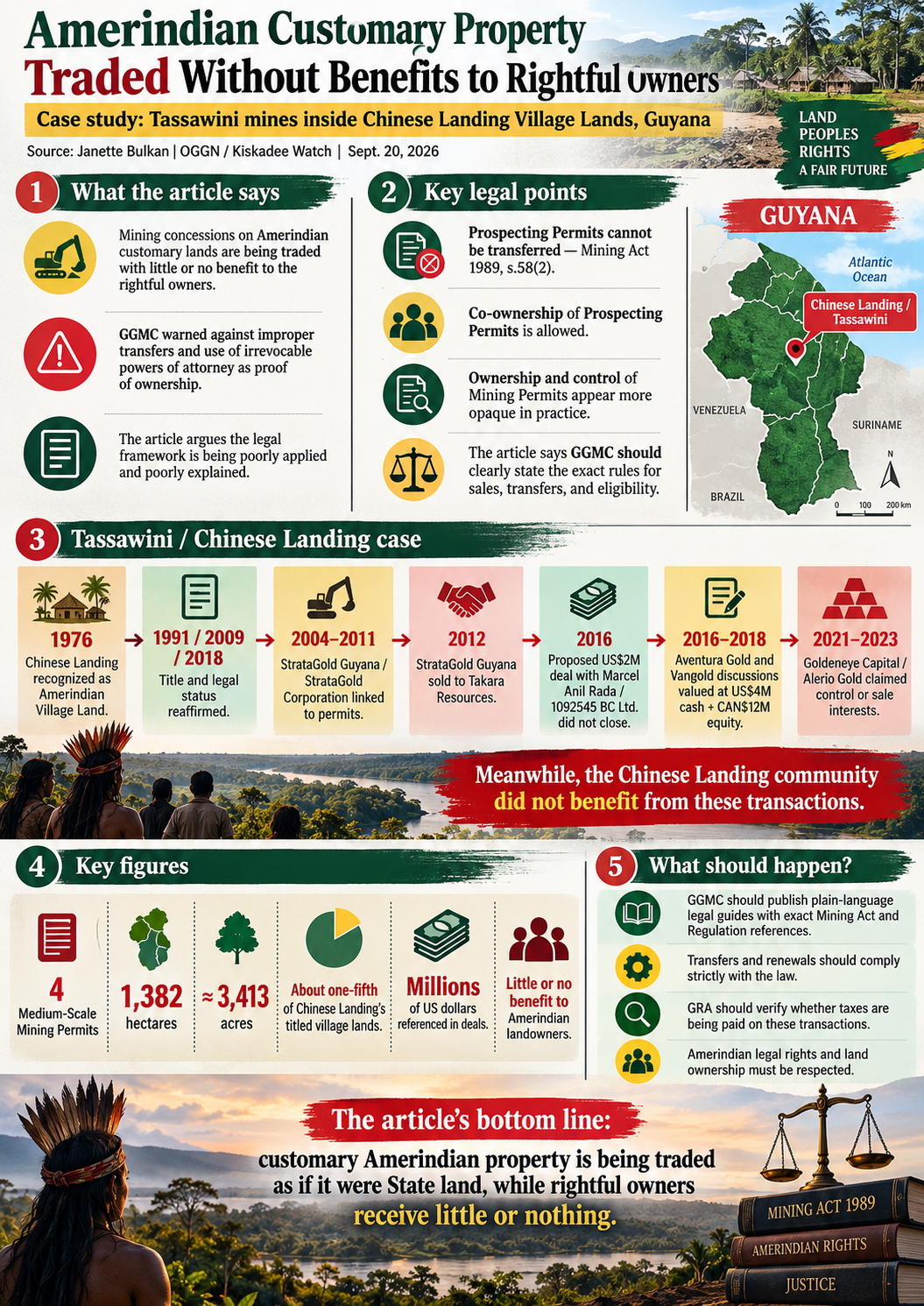




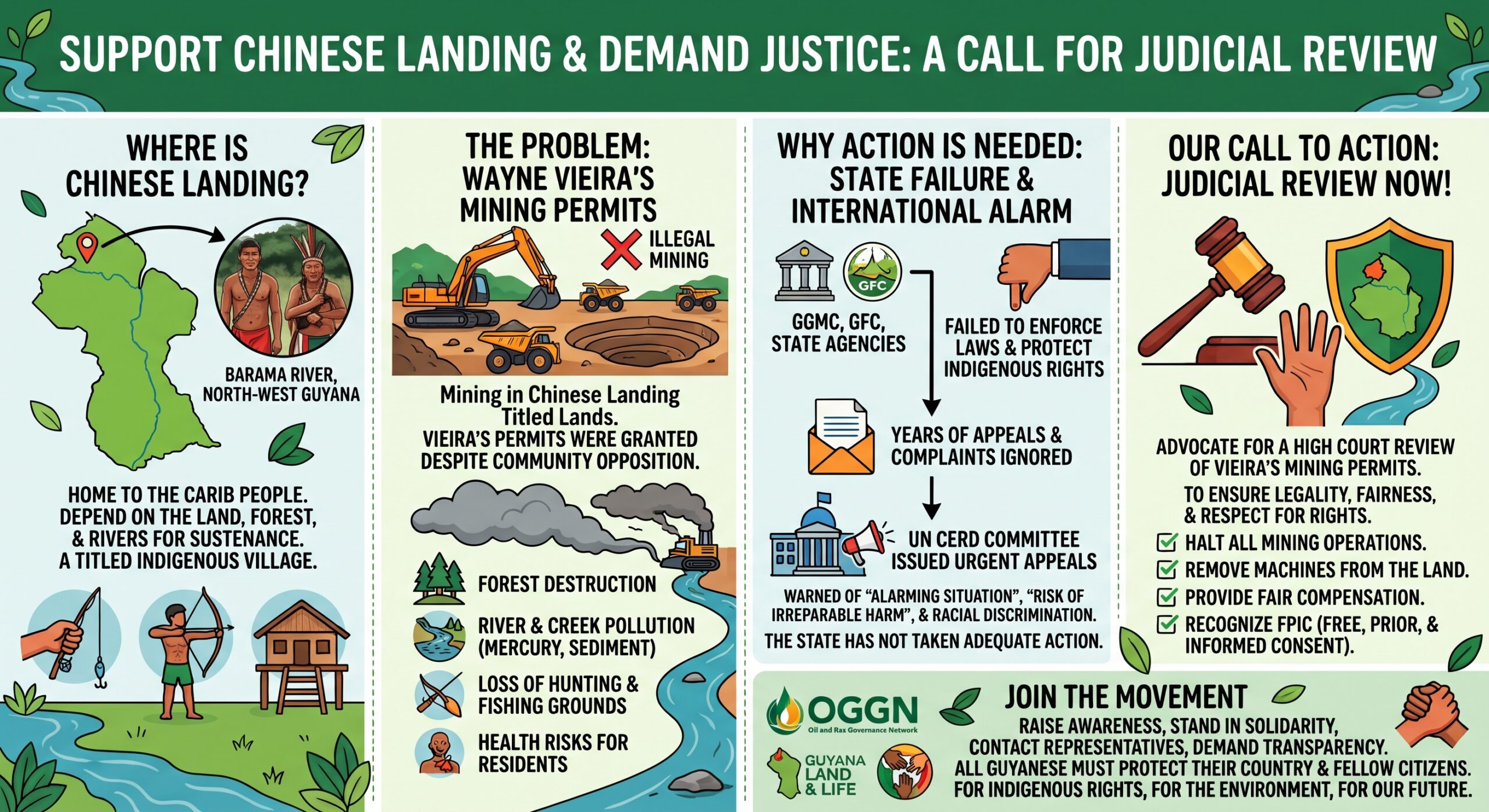
Coastlander goldminer Wayne Vieira once again protests his four GGMC-awarded medium-scale mining permits for Tassawni which is within the titled Amerindian Village Lands (AVL) of Chinese Landing; ‘Chinese Landing Toshao chooses village watch over emergency meeting with Bharrat’, Kiskadee Watch, 27 August 2026. Well done, Toshao Miller. Indeed, let us look at the Mining Act (1989) and the associated mining policies and Regulations.
The Amerindian community at Chinese Landing has had titled Amerindian Village Land (AVL) since 1976 (section 19 (2) and Schedule to the Amerindian (Amended) Act (1976)). This title has been further secured by association with the State Lands Act through the Absolute Grant of Title to State Lands in 1991 and by the association with the Land Registry Act through a Certificate of Title in 2018.
The one Prospecting Permit and the four Mining Permits Medium Scale at Tassawini (which is inside Chinese Landing AVL) should never have been issued by GGMC to Wayne Vieira because –
- The Prospecting Permit and the Mining Permits name ‘State Land’, but Chinese Landing is private, titled Amerindian Village Land gazetted since 1976, protected by section 111 of the Mining Act 1989 – the ‘quiet enjoyment’ clause;
- These one Prospecting and later four Mining Permits explicitly exclude all lands lawfully held and occupied and titled, which of course include the Amerindian Village Lands (AVL).
The four Mining Permits at Tassawini (which is inside Chinese Landing AVL) should never have been legally operable because –
- There is no valid agreement between the miner and the titled Village (landowner), as required by section 85 of the Mining Act 1989;
- There has been no written consent by the Minister to mine within a village, section 80 (1) (a) (v) of the Mining Act 1989;
- There has been no written consent by the lawful occupier (the village) for mining close to buildings or current or immediate past farmland, section 80 (1) (b) (i to iii);
- The village agreement allegedly coerced from an almost non-literate Village Captain in both 1998 and 1999 (with the same text) for Mining Permit number 47/98 was invalid according to the Amerindian Village Rules of Procedure 1959, and would be anyway invalid as a contract because of the asymmetry of understanding between the Parties of the meaning of the text.
- The objection at (4) has been supported consistently by the Chinese Landing community since 1998, with around 50 petitions submitted by the Amerindian Village Council (AVC) of Chinese Landing to the President, Vice-President, Ministers, heads of GGMC and EPA, Regional Democratic Council, etc. The AVC’s records have copies of these written petitions. There is no record in the AVC files of any counter-petition.
The four Mining Permits at Tassawini (which is inside Chinese Landing AVL) should never have been renewed by GGMC because the permit holder has been consistently in default, section 63 (3) (b) of the Mining Act 1989, where ‘in default’ is as defined in section 1 of the Mining Act 1989. The permit holder has not operated at Tassawini according to the GGMC Mining Regulations or environmental Codes of Practice, as verified by published Press photographs and by video taken by lawyers acting for Chinese Landing in 2021, and by reports from GGMC Mines Officers/ Wardens. The permit holder is also not compliant with the Environmental Protection Act 1996, section 11 and schedule 4 project 9. There is no public record that GGMC carried out due diligence checks before any of the renewals of these Mining Permits.
After the validation of the commencement of the Amerindian Act 2006 in December 2010, the four Mining Permits at Tassawini (which is inside Chinese Landing AVL) should not have been renewed by GGMC because –
- The GGMC did not comply with the Amerindian Act 2006, section 53 (i) notification of the Village or (ii) due diligence to satisfy itself that the impact of mining on the Village will not be harmful.
- The permit holder did not comply with the Amerindian Act 2006, section 48 (engagement with the Village) and section 49 (having a valid agreement with the Village).
Vieira has thus been consistently in default, as defined in the Mining Act 1989, and thus renewal of his Mining Permits should have been refused under section 63 (3) (b) of the Mining Act 1989. Revocation/cancellation by reason of being in default is provided for in section 65 of the Mining Act 1989.
This catalogue of errors should be sufficient grounds for the Chinese Landing Amerindian Village Council (CL/AVC) to petition in the High Court for a Judicial Review (Act cap. 03:06, 2010) of the actions of the GGMC since 1998, and of the government (Ministry of Parliamentary Affairs and Governance/Cabinet) in August 2023 in its Stop Mining order for which there is no legal backing in mining law or regulations. A review leads logically to the revocation and cancellation of the four Mining Permits by GGMC and the lifting of the Stop Mining order which is blocking the Village from mining under Amerindian traditional mining privilege within the AVL.
Wayne Vieira’s protest in Kaieteur News (‘Vieira invokes CCJ ruling in standoff, demands equal enforcement of Guyana’s mining laws’, 27 August 2026) includes reference to a long but simple court case involving an incorrect action by GGMC against him, where GGMC tried to use the Amerindian Act 2006, which does not give authority to GGMC. This court case did not affect the legally correct claims of the Chinese Landing community.
In addition to the legal mistakes made by GGMC, the licensed holder (Wayne Vieira) of the Tassawini Mining Permits has violated the terms of mining law by repeatedly seeking to transfer the mining rights without following the prescribed procedure. In the international mining Press, the ownership of the four Mining Permits at Tassawini is held by Lighthouse Gold Inc. (formerly Alerio Gold Corporation) under a nebulous agreement with Wayne Vieira.
The UN Commission on the Elimination of all forms of Racial Discrimination (UN-CERD) has also made the same recommendation to the government of Guyana, as repeated in its letter in January 2022, extracted into Stabroek News 10 June 2022 –
‘Consider suspending or revoking the mining concessions that affect the lands, territories or resources of the Chinese Landing and the Wapichan indigenous peoples until FPIC is granted by these indigenous peoples; refrain from approving projects and granting mining permits or concessions within the lands of indigenous peoples, whether titled or not; …’
Editor, Chinese Landing has held legal title since 1976. Since 1998 the community of Chinese Landing has been calling on Mr Vieira and his employees and sub-contractors to leave their titled land, to no avail. All Amerindians, indeed all Guyanese, should now support the Chinese Landing community, and advocate for a Judicial Review. The contrast between the hostility directed at Chinese Landing residents by government ministries and agencies versus the welcome mat laid out for Canadian gold and uranium mining companies is a national shame.
Yours truly,
Janette Bulkan