Article 7, Part II
…Guyana’s changing gas picture shows why strategy must adapt without turning today’s assumptions into tomorrow’s liabilities
By Anthony E. Paul
Senior Energy Governance, Policy & Strategy Advisor; formerly Director of Geology and Geophysics, Trinidad and Tobago Ministry of Energy; Amoco Trinidad and BPTT Manager responsible for Exploration and Appraisal / Gas Field Development / Oil Production
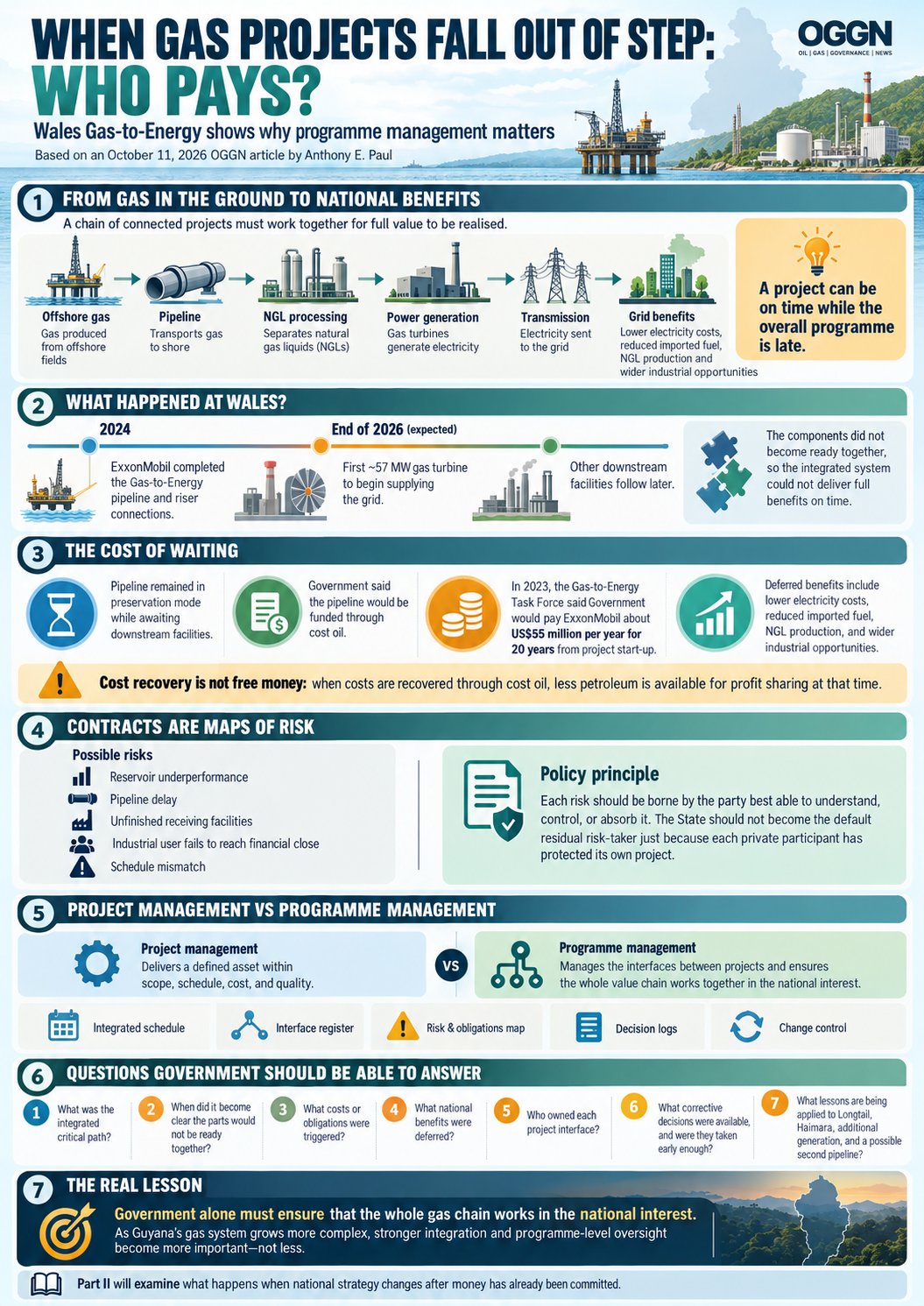
Part I examined one way an integrated gas programme can fall out of step: the individual projects do not arrive together. Since then, two developments have illustrated another challenge. Sometimes the underlying resource picture itself changes while Government is considering the infrastructure, industries and contracts that will depend upon it.
Reuters reported this week that ExxonMobil and its Stabroek partners estimate that approximately 2 billion cubic feet per day of gas may ultimately be required for reinjection to sustain oil-production targets. Sources told Reuters that this could cause Guyana to reduce a proposed 6 million tonne-per-year LNG project, perhaps initially to 3 million tonnes, or defer part of the export programme while giving priority to domestic power and industrial uses. No final decision has been reported.
Almost simultaneously, another piece of the resource picture moved in the opposite direction. Exxon’s head of exploration told Energy Intelligence that the company had made what he described as a “big discovery” in the central Stabroek Block several weeks earlier. Appraisal and production testing are continuing before a development proposal is submitted. If developed, it could become the tenth Stabroek development. The public information available so far does not establish how much of the discovery is oil, gas or condensate, or how much gas might eventually be commercially available.
Exxon’s Exploration Push Gains Ground From Gabon to Azerbaijan.pdf
One development may constrain the gas available for sale. The other may eventually enlarge the resource base. Neither can yet be translated simply into firm gas available for LNG, power or petrochemicals.
That is precisely why Guyana needs resource orchestration rather than a collection of individual projects.
The molecule may already have a job underground
A gas discovery is not the same thing as gas available for sale.
In an oil reservoir, gas may be needed for pressure maintenance, reinjection or other reservoir-management purposes that protect oil recovery. The value of that molecule may therefore be greater underground, at least temporarily, than if it were immediately sent ashore or exported.
The first allocation decision is consequently not LNG versus electricity versus fertiliser. It may be production versus reinjection.
This does not mean that Exxon’s estimate should automatically determine national strategy. The operator properly has to optimise reservoir performance and the commercial value of its developments. Government, as resource owner, has a different obligation: it must understand independently why particular reinjection volumes are required, what incremental oil recovery they support, how those requirements change through time, what alternatives exist, and how new developments such as Longtail, Haimara or later discoveries alter the portfolio.
Longtail is already under Government review as the first Stabroek development centred heavily on gas, with start-up proposed for 2030, while the gas-rich Haimara development is progressing through the regulatory process for the early 2030s.
The question is therefore not simply, “How much gas has Guyana discovered?”
It is: How much gas can reliably leave the reservoirs, when, for how long, and without sacrificing greater value elsewhere in the petroleum system?
Strategy should change when the evidence changes
Changing a plan is not necessarily evidence that the original plan was wrong.
Petroleum development proceeds through progressively better information. Wells are drilled. Reservoir models change. Production performance reveals things that seismic data and appraisal wells could not establish perfectly beforehand. New discoveries create options that did not previously exist.
Good strategy must therefore be neither rigid nor disposable. It must be durable enough to support long-lived investments, but adaptable enough to change when geology, markets, economics or national priorities change.
The difficulty is that infrastructure and contracts become progressively harder to change.
An LNG facility, second pipeline, power plant or petrochemical complex may require commitments decades before the final molecule is produced. Investors require confidence about feedstock. Lenders require contracts. Pipeline capacity has to be sized. Industrial sites, ports and utilities may have to be developed.
This creates an important sequencing principle: uncertain resources should not be converted prematurely into inflexible commitments.
Government does not need perfect knowledge before acting; that would paralyse development. It does need decision gates at which the evidence supporting the next commitment is tested. As uncertainty reduces, commitments can become firmer. Programme management then becomes a way of preserving options while the resource picture evolves.
The questions become practical: What level of resource assurance supports the proposed LNG scale? Which commitments can be phased? Which contracts remain conditional upon gas availability? Who bears volume risk if reservoir requirements change? What happens to a pipeline or industrial investment if expected gas arrives later, or in smaller volumes, than initially forecast?
These are not reasons to delay indefinitely. They are reasons to understand what becomes difficult to undo at each stage.
When change comes after commitment
Trinidad and Tobago’s Alutrint experience illustrates the harder case: strategy changes after several parts of the supporting programme have already moved forward.
The proposed aluminium smelter at La Brea formed part of a broader industrial-development strategy. Before the project was abandoned, supporting infrastructure and commercial arrangements were already progressing. Construction of the smelter itself had also encountered environmental and legal challenges before the 2010 change of government, so its discontinuation should not be reduced simply to politics.
The associated Trinidad Generation Unlimited power plant, however, demonstrates how programme obligations can survive the project that originally helped justify them.
TGU’s 720 MW combined-cycle plant began construction in 2009. Its 30-year Power Purchase Agreement originally allocated 240 MW to Alutrint and 480 MW to T&TEC, with the buyers jointly and severally responsible. After Alutrint was cancelled, the full output was contracted to T&TEC. The plant subsequently became an important part of Trinidad and Tobago’s electricity system and today provides roughly half of national electrical energy.
The lesson is not that cancelling Alutrint was necessarily right or wrong. It is that when one component of an integrated development strategy disappears, the infrastructure, contracts and financial obligations connected to it do not necessarily disappear as well. They migrate, must be repurposed, renegotiated or absorbed elsewhere.
That is why Part I described contracts as maps of risk.
Continuity does not mean rigidity
Governments must retain the right to reconsider inherited projects. Democratic change would mean little if every major policy decision became irreversible simply because a previous administration had begun implementing it.
But there is a difference between reviewing a transaction and repeatedly redefining the national destination.
Trinidad and Tobago’s Manakin-Cocuina cross-border gas field provides a useful counterpoint. The unitisation agreement with Venezuela was executed in 2015. More than a decade later, in August 2026, NGC acquired a 20% participating interest in the Trinidad-side Manakin acreage, aligning it with its existing 20% interest in Cocuina. The project and the transactions surrounding it have crossed political administrations, while the commercial arrangements themselves remain legitimate subjects for scrutiny.
That distinction matters.
Strategic continuity does not require transactional continuity. Governments can retain a long-term national objective while changing the route, renegotiating terms, replacing counterparties or abandoning individual transactions that no longer withstand scrutiny.
Equally, strategy should be capable of changing when the underlying evidence changes. Guyana’s evolving gas picture illustrates that point particularly well.
The objective should not be to freeze today’s LNG, pipeline or industrial plans in place. Nor should every new reservoir estimate or political administration trigger wholesale redesign.
The task is to preserve a coherent national purpose while continuously testing the assumptions beneath it.
Managed change is part of good governance
Guyana may now have an unusually valuable opportunity.
If the reported reinjection requirement materially alters gas availability, and if appraisal of the new discovery enlarges the portfolio, Government can reassess its LNG ambitions before every downstream commitment becomes difficult to reverse.
That is preferable to discovering the mismatch after the LNG plant is built, the pipeline sized, gas-sales agreements signed and lenders expecting repayment.
Programme management therefore has another role beyond keeping projects on schedule. It should help Government understand the consequences of changing the programme itself: which commitments have already hardened, which remain flexible, where costs migrate, what can be repurposed, and which decisions should wait for better information.
The resource owner’s challenge is not to avoid change. It is to make change deliberate, informed and early enough to preserve value.
For Guyana, the emerging lesson is increasingly clear. Gas strategy cannot be separated from reservoir stewardship. Reservoir stewardship cannot be separated from oil recovery. Neither can be separated from pipelines, electricity, LNG, industrial development, contracts or fiscal value.
Someone must see those decisions as one portfolio.
That is upstream resource orchestration.
And the governance principle that follows is equally important:
Strategic continuity, transactional discipline and managed change.
The destination should endure where the national interest still supports it. The transactions used to get there should remain open to scrutiny. And when the evidence changes, Government should be able to change course before yesterday’s assumptions become tomorrow’s liabilities.