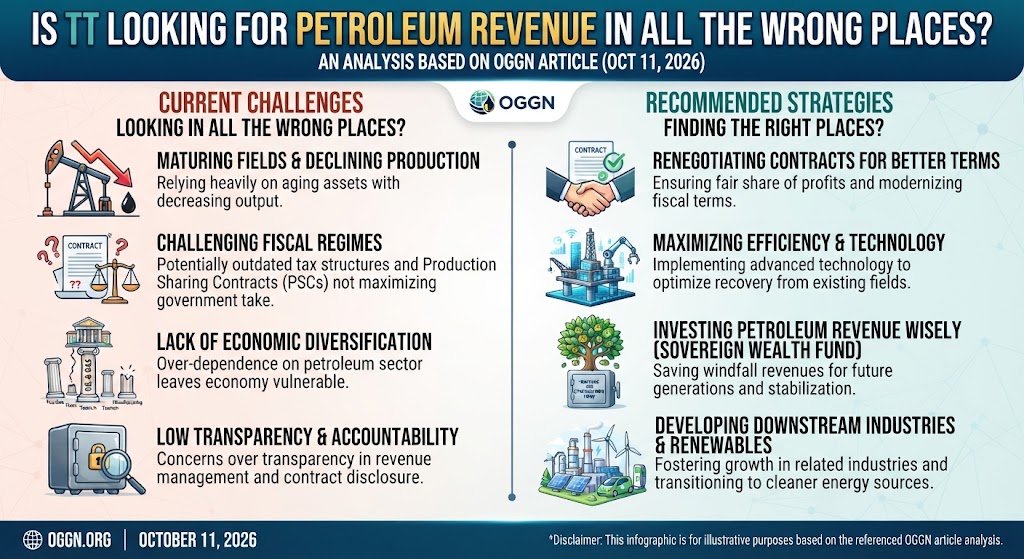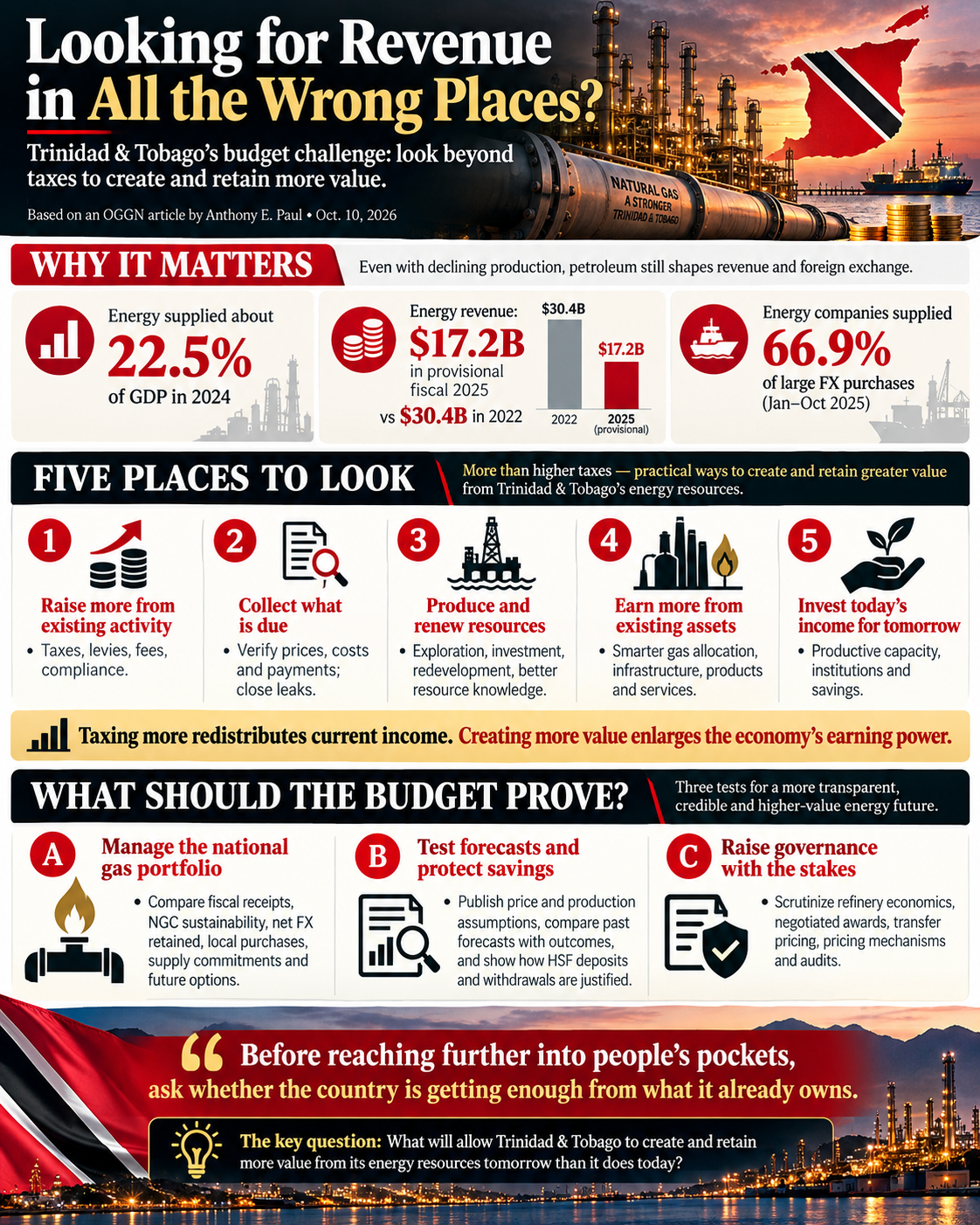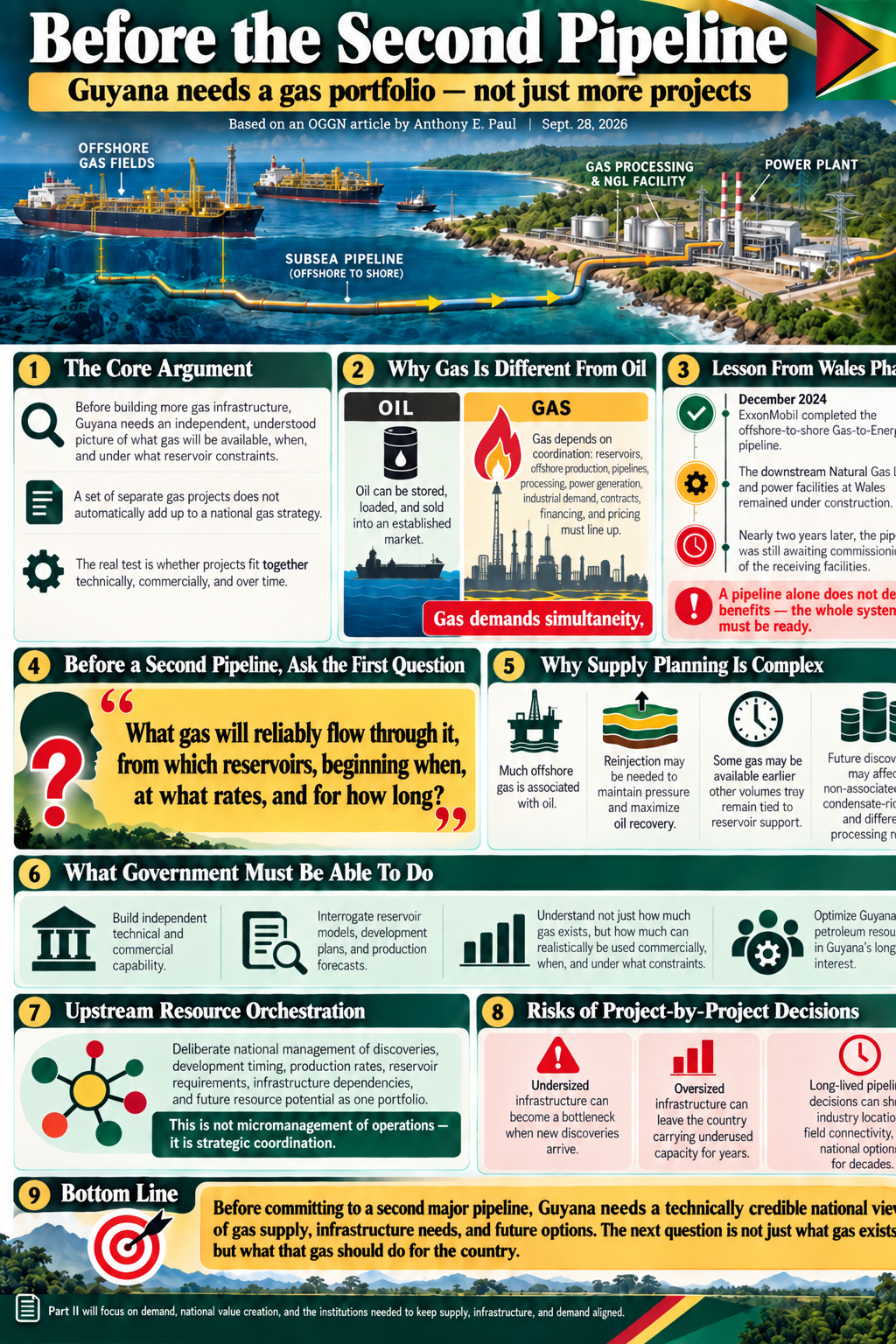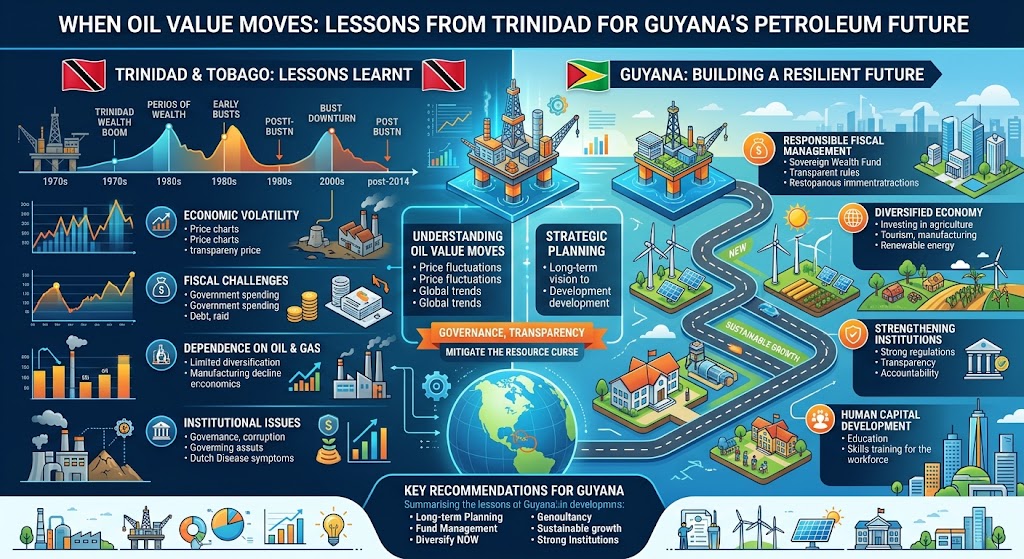


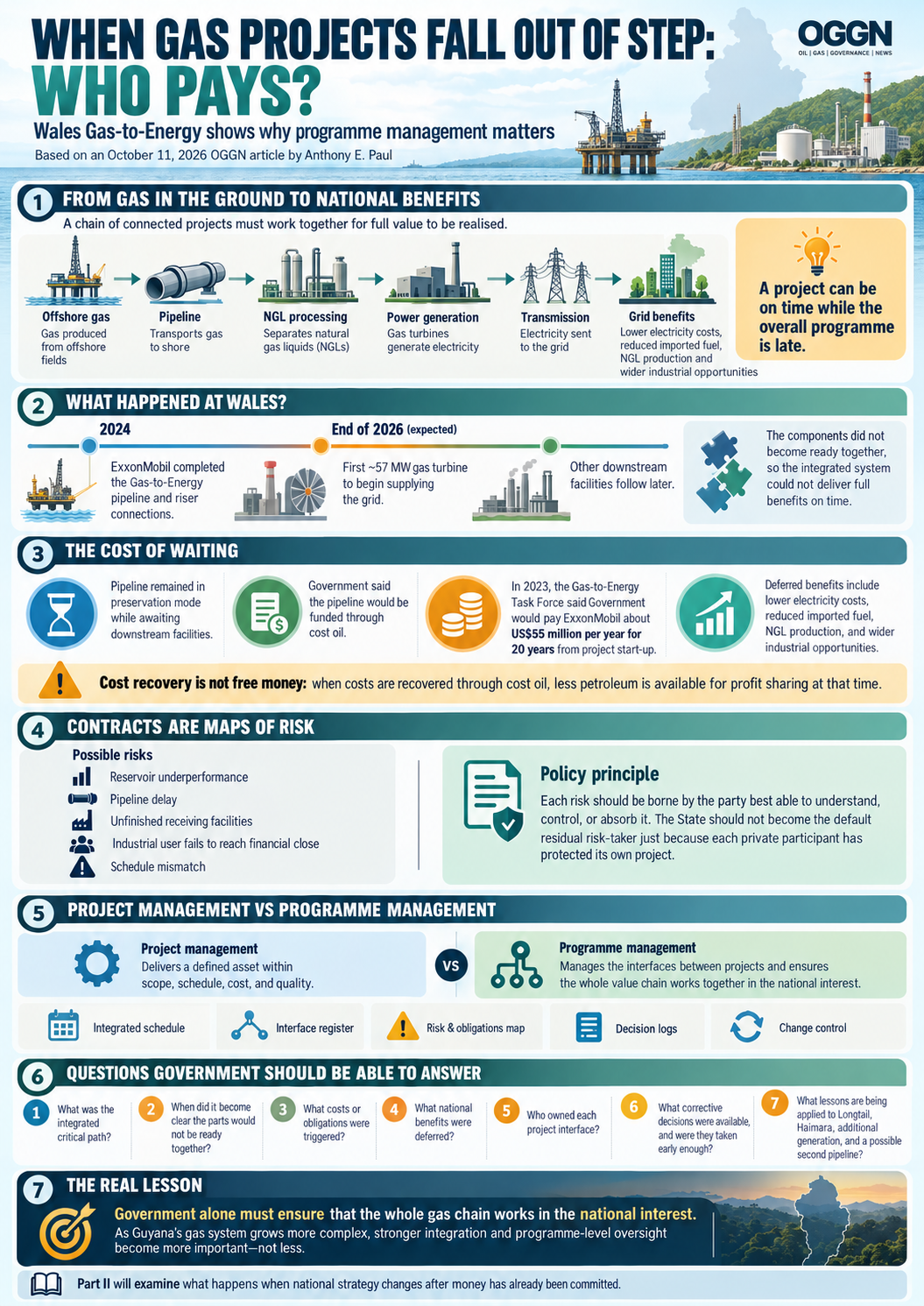
The editor created these infographics for understanding, but Anthony Paul has not validated them. They may lack technical precision, but they remain a useful resource for general readers.
By Anthony E. Paul
Senior Energy Governance, Policy & Strategy Advisor; formerly Director of Geology and Geophysics, Trinidad and Tobago Ministry of Energy; Amoco Trinidad and BPTT Manager responsible for Exploration and Appraisal / Gas Field Development / Oil Production
The previous article argued that, as Guyana’s gas system becomes more complex, Government will increasingly need an owner-side programme-management function capable of seeing across schedules, risks, commitments and dependencies. Wales provides an early opportunity to see why.
ExxonMobil completed its Gas-to-Energy pipeline and riser connections in 2024. The Government-led Natural Gas Liquids and power facilities have taken longer, with the first approximately 57 MW gas turbine expected to begin supplying the grid by the end of 2026 and other facilities following.
The issue is not simply that one component finished before another. Large projects are delayed for many reasons. The more important lesson is that individual projects can satisfy their own technical or contractual requirements while the programme as a whole still fails to deliver its intended benefit on time. A pipeline without a receiving facility cannot fulfil its purpose; a completed power plant without gas faces the opposite problem. Once projects become interdependent, Government has to manage not only the projects, but the interfaces between them.
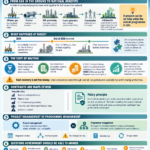
There is more than one cost of waiting
Public discussion around Wales has understandably focused on whether Guyana is paying for a pipeline that has not yet transported gas. That question requires care because several different costs and commercial mechanisms can easily be confused.
The completed pipeline has remained in preservation mode awaiting the downstream facilities. Government has previously said the pipeline would be funded through cost oil, while in 2023 the Head of the Gas-to-Energy Task Force said Government would pay ExxonMobil an annual fixed sum of approximately US$55 million over twenty years from the time the project came onstream.
Those statements may describe different aspects of the same commercial arrangement, but their relationship should be clear. Recovery through petroleum production is not the same as Government writing an immediate Treasury cheque, but neither is it economically neutral for the resource owner. To the extent expenditure is recovered through cost oil, that petroleum is not available for profit sharing at that time. Cost recovery is not free money.
There is also the cost of deferred benefits. Lower electricity costs, reduced imported-fuel requirements, NGL production and wider industrial opportunities begin only when the integrated system operates.
Contracts as maps of risk
Much of the complexity of gas and infrastructure contracts comes down to a basic question: who bears the consequences when something does not happen as expected?
A producer may seek take-or-pay protection before committing capital. Pipeline or power infrastructure may require capacity or availability payments because investors and lenders need revenue certainty. Such provisions are not inherently unreasonable; in many cases they make infrastructure financeable.
The public-policy issue is whether each risk has been assigned to the party best able to understand, control or absorb it, and whether the compensation for carrying that risk is reasonable. Reservoir underperformance, pipeline delay, unfinished receiving facilities and an industrial user failing to reach financial close are different risks arising in different parts of the system.
Government should not try to transfer every risk to investors; they will price those risks into their returns or decline to invest. But neither should the State become the residual risk-taker simply because each private participant has protected its own project. Someone acting for the resource owner must see where risks accumulate when separate contracts are assembled into one national system. In that sense, programme management is also a risk-management discipline: it is where risks at the interfaces become visible before they become costs.
A project can be on time while the programme is late
Wales should therefore become a case study from which Guyana learns before the next generation of gas investments is committed.
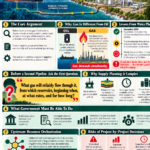
A Government-side programme-management view should be able to answer some very concrete questions:
- What was the integrated critical path linking offshore gas availability, pipeline completion, NGL processing, power generation, transmission and operational readiness?
- When did it first become clear that the major components would not be ready together, and who was responsible for escalating that information?
- What contractual and financial consequences were triggered as the schedules separated, including cost recovery, preservation costs, financing, liquidated damages or other obligations?
- What national benefits were deferred by the mismatch, and how should those opportunity costs be measured?
- Who owned each major interface between the projects? Were there points at which everybody managed his or her own scope but nobody managed the dependency between them?
- What corrective decisions were available once the divergence became apparent, and were they taken early enough to reduce the consequences?
- What lessons from Wales are now being incorporated into Longtail, Haimara, additional generation and the proposed second pipeline before those commitments become difficult or expensive to change?
These are not questions designed simply to allocate blame retrospectively. They are questions a resource owner should be able to answer if it intends to manage the next programme better than the first.
Project management is not programme management
A project manager concentrates on delivering a defined asset within agreed scope, schedule, cost and quality. Government’s programme-management function must ask how that asset interacts with every other project, contract and public-policy objective that depends upon it.
For Wales, that means seeing one integrated programme across offshore supply, pipeline, processing, generation, transmission, commissioning and the commercial arrangements connecting them. It requires an integrated schedule, interface register, programme-wide risk and obligations map, decision logs and change-control arrangements capable of showing what a change in one component does to the others.
Those tools are relatively easy to name. The harder task is designing the system around them: deciding who owns the integrated view, what information each participant must provide, who can challenge assumptions, what deviations require escalation, and how unresolved risks reach senior decision-makers before contracts, expenditure or infrastructure make choices difficult to reverse. That is programme governance, not simply programme reporting.
Guyana already has project-level oversight and management arrangements. The programme-management question is broader: what happens elsewhere in the value chain when one project’s schedule, cost or commercial position changes?
That wider view will become more important as Longtail, Haimara, additional generation and a second pipeline add new sources, users and contractual interfaces. The issue is not whether Government needs another large bureaucracy. It is whether the resource owner has a continuous, independently informed line of sight across an increasingly complex programme. Ministries, regulators, utilities, operators and contractors can each perform their mandates competently and the national programme can still become misaligned at the interfaces.
From transparency to institutional learning
A programme-level risk and obligations map should extend beyond engineering schedules. Government should know what constitutes completion, what triggers payment, who carries schedule and volume risk, how capital is recovered, which facilities depend on one another, and what happens if expected supply or demand does not materialise.
That information also has a transparency value. Cost recovery, amortisation, take-or-pay and capacity payment are not interchangeable terms. They represent different commercial mechanisms and different allocations of risk.
For Wales, clearer explanation of what triggers recovery or payment for the pipeline, how the stated twenty-year arrangement relates to cost recovery, and which costs belong to which part of the system would allow the country to move beyond speculation and turn its first major gas programme into a source of institutional learning.
The resource owner’s problem is different from the problem facing any individual contractor, operator or agency: Government alone must ensure that the whole chain works in the national interest.
The lesson is not that Guyana should slow its gas development. If the country intends to move quickly, stronger integration becomes more important because the cost of correcting misalignment rises as projects, contracts and investors multiply.
Wales illustrates one form of misalignment: projects that do not arrive together. There is another. Sometimes infrastructure is being built, contracts have been signed and money has been committed, only for the national strategy connecting those investments to change before the value chain is complete.
Trinidad and Tobago experienced exactly that with the proposed Alutrint aluminium smelter at La Brea. That is the subject of Part II: “When the Strategy Changes Midstream: Who Pays for What Is Left Behind?”