


Over the last few days, I have been constantly reading in the Guyana press, “Now that Exxon has recovered its $55 billion investment (same thing called Capex, Capital outlays), when will Guyana start getting its 50% oil profit? (The quick answer is that Guyana has always been getting its 50% profit as defined in the PSA).
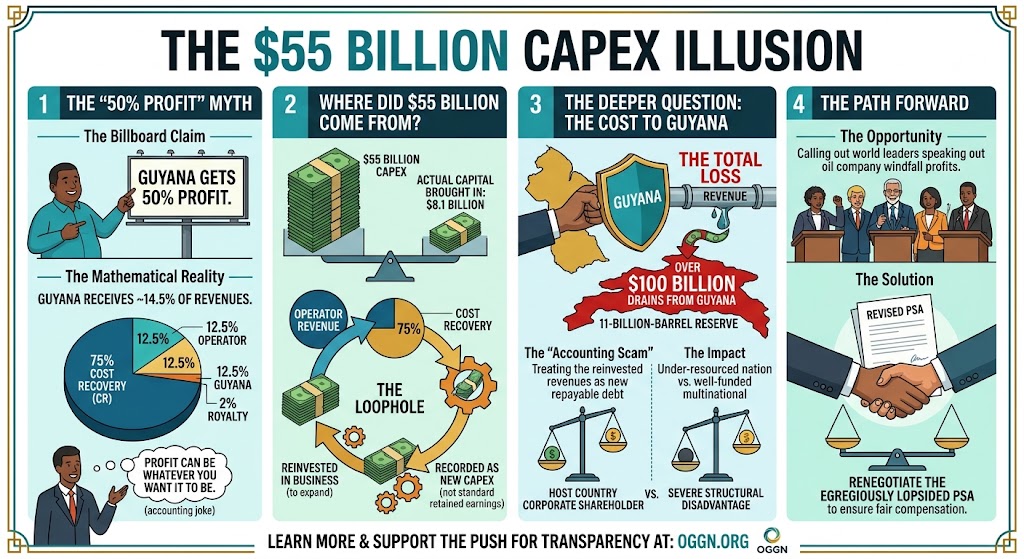
Well, no doubt about it – there has been a lot of confusion on this 50%-profit thing. And, that Exxon Billboard along our roadways declaring “Guyana gets 50% profit” has only helped to fuel this confusion. That billboard should be taken down and replaced with another that says, “Guyana gets only 14.5% of revenues”.
Let me illustrate: (a) Suppose CR (Cost Recovery) is 90% of revenues, then Guyana would receive 5% of revenues (or 5 barrels out of every 100 produced) – and that is defined in the PSA as 50% profit; (b) Further, suppose CR is 75% of revenues (which is the actual case), then Guyana would receive 12.5% of revenues (or 12.5/100 barrels) – and this too is defined as 50% profit in the PSA.
So, profit can be anything. There is an old accounting joke where the accountant tells the CEO, “I can make profit be anything. Just tell me what you want it to be”. In my illustration here, 50% profit can be 5/100 barrels or 12.5/100 barrels. So, we Guyanese must ask ourselves, why is our government still using the profit metric? This is very misleading and perpetuates confusion.
I was in a meeting a few days ago, and folks were asking what constitutes this $55 billion that reportedly has been fully recovered – Is it actual investment (Capex)? Does it also include operating costs? Minister of Energy, Vickram Bharat should explain these matters to the Guyanese public.
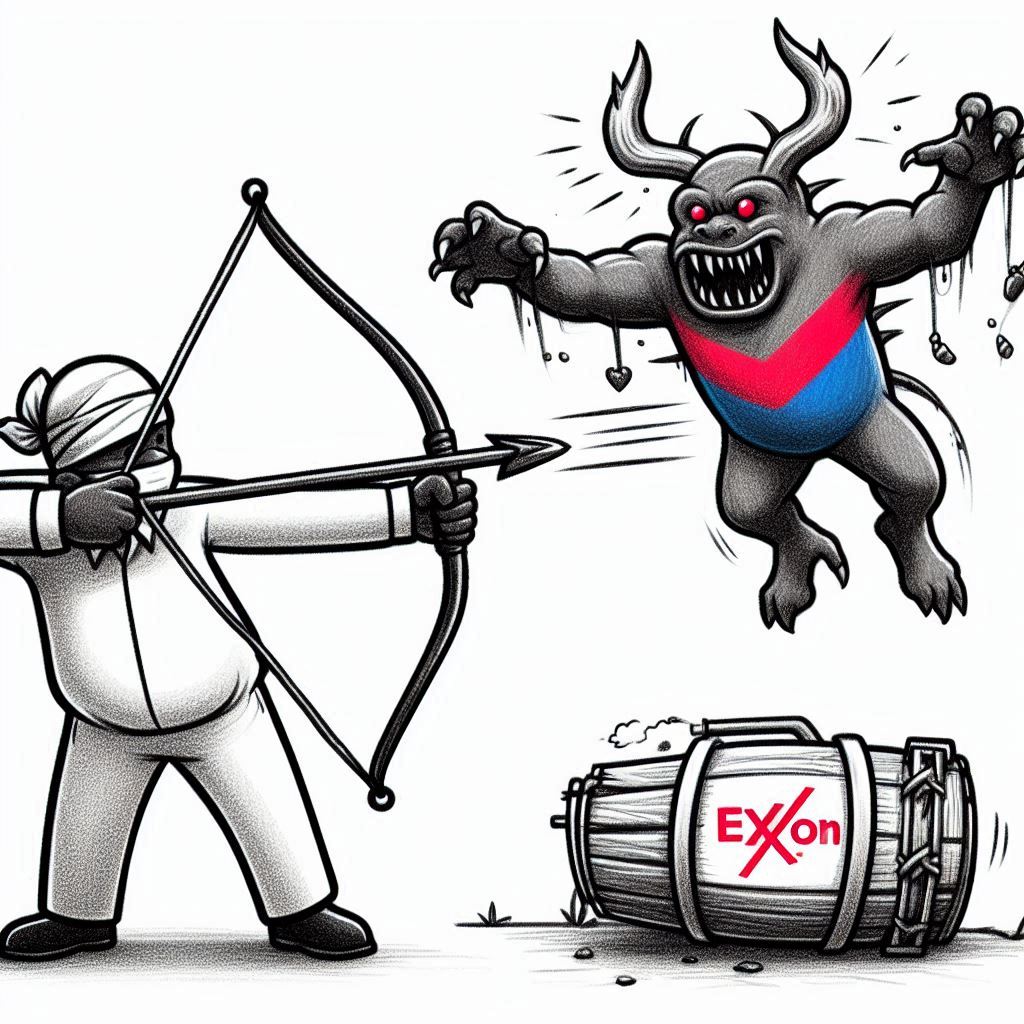
I had previously written (see my letter in KN, Nov 20, 2025) about attending a meeting with Exxon’s president (Guyana) Alistair Routledge, here in Queens, New York. Routledge told the Guyanese audience that Exxon had invested $55 billion in Guyana. I had confronted Routledge on this $55 billion number. I told him: that is a falsehood; that Exxon and partners had only invested $8.1 billion; that is the total sum of money brought into the country. I told him to his face that they were pumping back most of the 75% CR money back into the business – and each time they did, they were recording it as fresh Capex. And, that’s how they derive the $55 billion number.
I have previously described Exxon’s practice as an accounting scam. It is really the concept of Retained Earnings turned on its head. Reinvesting revenues/profits to expand a business is the same thing as Retained Earnings. In normal practice, RE (reinvested) is never recorded as fresh capex to be later repaid. Why do I label Exxon’s practice as a scam? Well, Guyana is not a shareholder in the business – and this practice denies Guyana its fair share of revenues. It keeps Guyana’s “take” fixed at 14.5 barrels out of every 100 (same as 14.5%).
Re-investing revenues/profits to expand a business is done for the benefit of shareholders – and Guyana is not a shareholder. Darsh Khusial of the OGGN group has done the Math – and has proven that Guyana is losing over a $100 billion on an 11-billion-barrel reserve because of this accounting scam. Readers can read more on this matter at Oggn.org.
Exxon’s defenders have always said the accounting practice of recording re-invested revenues as fresh capex is legal. I have to say: I have read the 114-page oil contract, and this practice is not described anywhere. For this reason, we call for the re-negotiation of the oil contract – even if only to make the contract just a little bit less lopsided.
I refer to Albert Baldeo’s letter in Saturday’s KN (Aug 15th) in which he cited a statement of President Trump calling out the oil companies of making too much money – [Windfall profits from the Iran war] – without giving back anything to consumers and presumably to oil-host countries. President Ali must recognise this moment as Trump’s invitation to engage Exxon – and press Guyana’s case for renegotiation of an egregiously lopsided contract.
Mike Persaud